Posted in English, Portuguese

A Escada do Mal

Someone or other once said that poetry isn’t a puzzle to be solved, but it annoys me to see someone clearly doing something clever and I don’t understand it so I thought I’d dig into this one and see what was going on. It’s from Atirar Para o Torto.
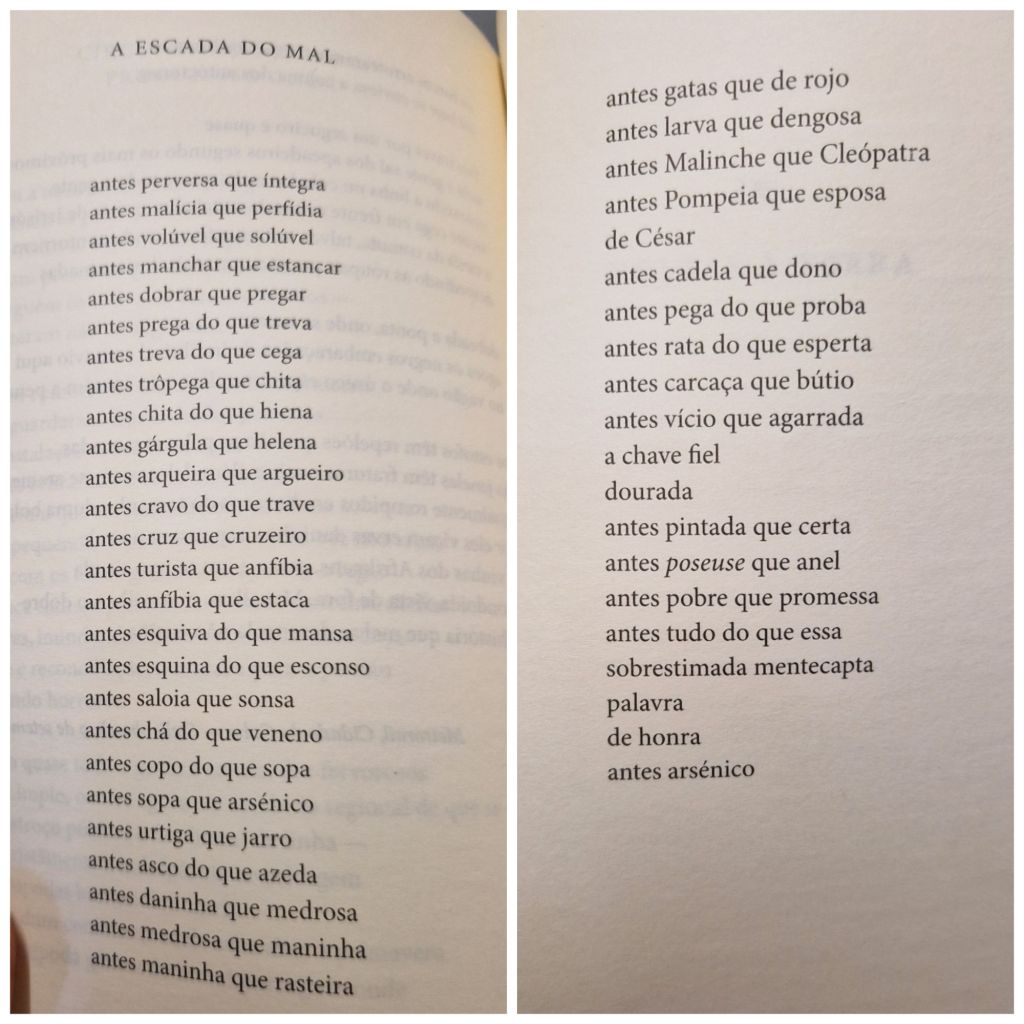
OK, let’s do this….

Most of the lines are in the form Antes ……….. (do) que ……. Which in english would be something like “Better a ………. than a ……..” or “I’d rather …………. than ………..” or “I’d prefer ……. to ……”.

Some lines use “do que” and some just “que” on it own, so i have one eye on this page which I usually use as a reference when I’m not sure which to use, and I’m curious to see how closely the poem follows the strict rules. Not very, I expect. Actually, not at all. If you look at the pattern, the presence or absence of the “do” depends on the number of syllables. Que sounds better with longer words, Do Que with shorter

Quite a lot of the words have multiple meanings so part of the game is working out which meaning the writer intends. In some cases the resulting sentence sounds ridiculous and I am pretty sure I have the wrong end of a few sticks, but for what it’s worth, here’s my best shot….

A ESCADA DO MAL
antes perversa que íntegra – better perverse than entire
antes malícia que perfídia – better malice than perfidy
antes volúvel que solúvel – better voluble than soluble
antes manchar que estancar – better to stain than to staunch
antes dobrar que pregar – better to fold than to pin
antes prega do que treva – better a fold than darkness
antes treva do que cega – better darkness than blind
antes trôpega que chita – better immobile than linen (um…. don’t get this one!)
antes chita do que hiena – better cheetah than hyena (second meaning of chita!)
antes gárgula que helena – better gargoyle than a hellenic
antes arqueira que argueiro – better a bowmaker than a speck
antes cravo do que trave – better a nail than a crossbar (assuming cravo is nail here, not a carnation)
antes cruz que cruzeiro – better a cross than a cruise
antes turista que anfíbia – better tourist than amphibian
antes anfíbia que estática – better amphibian than static
antes esquiva do que mansa – better a loner than domesticated
antes autista que sápida – better autistic than tasty
antes esquina do que esconso – better corner than garret
antes saloia que sonsa – better yokel than poser
antes chá do que veneno – better tea than poison
antes copo do que sopa – better a glass than soup
antes sopa que arsénico – better soup than arsenic
antes verbena que urtiga – better verbena than nettle
antes agreste que azeda – better bitter than sour
antes daninha que medrosa – better harmful than fearful
antes medrosa que maninha – better fearful than a little sister
antes maninha que rasteira – better a little sister than servile
antes gatas que de rojo – better on hands and knees than dragging
antes larva que dengosa – better maggot than brown-noser (dengoso has a lot of meanings – it could be a person with dengue fever!)
antes Malinche que Cleópatra – better Malinche than Cleopatra
antes Pompeia que esposa de César – better Pompey than Caesar’s wife
antes cadela que dono – better bitch than master
antes pega do que proba – better thief than honest person
antes rata do que esperta – better eccentric than astute
antes carcaça que bútio – better skeleton than lazybones
antes vício que agarrada – better addicted than hooked
a chave fiel – the faithful key
dourada – golden
antes pintada que certa – better painted than true
antes poseuse que anel – better poser than ring (than married?)
antes pobre que promessa – better poor than promise
antes tudo do que essa – better anything than that
sobrestimada mentecapta – overestimated brainless
palavra – word
de honra – of honour
antes arsénico – better arsenic.

And if you’re interested, here’s what Deepl has to say about it

rather perverse than upright
rather malice than perfidy
rather fickle than soluble
rather stain than stop
rather bend than preach
rather preach than darkness
rather darkness than blindness
rather stumble than cheetah
rather cheetah than hyena
before gargoyle than helena
before an archer
better carnation than beam
rather cross than cruise
before tourist than amphibian
rather amphibian than static
rather dodgy than meek

Translated with DeepL.com (free version)

Posted in English, Portuguese

Licença Poética ou Só Crime?

Having tried to write a sonnet the other day, I felt like trying a different poetic form. The Clerihew is something of a lost art form but I was obsessed with them for a few weeks in about 1998. My Favourite was

The people of Spain think Cervantes
Equal to half-a-dozen Dantes:
An opinion resented most bitterly
By the people of Italy.

And I can’t do a direct translation, so I decided to have a crack at recreating the spirit of the thing in Portuguese. I know some of the words are in a weird order, but I hope I haven’t stretched the grammar too far and it’s allowable within the poetic form…

Camões, segundo os portugueses,
Vale mais, uma dúzia de vezes,
Do que Shakespeare, o que provoca uma exclamação
De qualquer cidadão da minha nação.

I crowdsourced an answer to that question and one of the two respondents replied in the positive at least so I’m calling that a victory. Both suggested I sort out the metre, but Clerihews are allowed to be rambling and uneven so I haven’t even really tried to do that. If you’re curious, you could do worse than check out u/urinaRabugenta’s answer under my post here, for a more professional version. It’s better in every way, especially the second line (which is a real dog s breakfast in my version). The only thing I don’t like about it is rhyming – ção with – dão in the last line. Apart from that, it’s a banger! Notes underneath explain the reason for the changes. It’s good stuff.

I love how the AI has made a sexy Camões with an eyepatch that looks suspiciously like sunglasses
Posted in English, Portuguese

Rústica – Florbela Espanca.

I mentioned a few days ago that I was trying to memorise poems in both English and Portuguese. Well, today’s is a Portuguese one: Rústica by Florbela Espanca. As with so many of these poems, reading it through once a couple of years ago, I was my usual poetry-reading self: “Yes yes, very poetic. Next!” But now that I’m immersing myself in them, I’m starting to get the point of poetry. Here is the original:

Rústica

Ser a moça mais linda do povoado.
Pisar, sempre contente, o mesmo trilho,
Ver descer sobre o ninho aconchegado
A bênção do Senhor em cada filho.

Um vestido de chita bem lavado,
Cheirando a alfazema e a tomilho…
– Com o luar matar a sede ao gado,
Dar às pombas o sol num grão de milho…

Ser pura como a água da cisterna,
Ter confiança numa vida eterna
Quando descer à “terra da verdade”…

Deus, dai-me esta calma, esta pobreza!
Dou por elas meu trono de Princesa,
E todos os meus Reinos de Ansiedade.

Rústica, Florbela Espanca, from Charneca Em Flor

Florbela Espanca

There are a few unfamiliar words in it so I’ll have a go at translating it:

Rustic

To be the prettiest girl in the village
To walk contentedly on the same trail
To see descending on the cosy home*
The blessings of the Lord on every child 

A calico** dress, well-washed
Smelling of lavender*** and thyme 
With the moonshine quenching the thirst of the cattle****
Giving the doves the sun in a grain of corn

To be pure as the water in the cistern
To believe in a life eternal 
When I go down to the land of truth*****

God, give me this calm, the poverty
I’ll give them my princess throne
And all my kingdoms of anxiety

*=The word used in the original is “ninho” which means nest, but I think in this context its just a folksy way of saying home.

**=my paper dictionary says chintz, but I think chintz is made of calico (?) and that calico goes more with the vibe of the poem. But I’m not an expert in cloth, so I could easily be wrong.

***=I’ve been saying “lavandas” for lavender but I think that might be a brazilism because according to the wiki this is the word used in Portugal.

****=matar a sede means kill the thirst, literally, but quench seems better. And it’s not “a sede do gado” (the thirst of the cattle) but ao gado (to the cattle) , another example of Portuguese speakers using prepositions in a way that are just a little different to what an english speaker would expect.

*****=Descer in this sentence is the future subjunctive, not the infinitive, and I believe its “when I go down” not “when he/she/it goes down” but I can only get that from context since there no way of telling grammatically! I’m not sure what the land of truth means here either. If it’s heaven, why is she descending and not ascending? I’ve read the bible and spent a lot of time in church but this makes no sense to me I’m afraid.

Here’s an analysis I wrote of the poem, in Portuguese, for today’s writing challenge (thanks to Dani Morgenstern for the help)

O Poema de hoje é Rústica de Florbela Espanca. O poema fala do anseio da poeta por uma vida mais bucólica, numa aldeia onde ela seja “a moça mais linda” e o ar seja perfumado de ervas e flores.
Este desejo, esta saudade duma vida sem ansiedade e sem problemas é, no entanto, pouco realista porque a vida numa aldeia tem as suas próprias ansiedades e nem todas as moças podem ser a mais linda. Mas isso não contraria a mensagem do poema nem a vontade que todos nós temos de afastar-nos da vida moderna.
O poema tem quatro versos: dois de quatro linhas e dois de três, e tanto quanto sei, este padrão é muito comum na obra desta poeta. Usa imagens da natureza (o que é pouco surpreendente neste caso!) e temas religiosos. Aliás, a religião não é apenas um tema: a saudade da religião faz parte da saudade da vida simples. É como se Deus não tivesse poder nenhum na cidade e só soubesse tocar o coração de quem vive nalguma quinta.

Posted in English

O Verso Alcançando o Infinito

*groan*

So ages ago, I heard Jose Jorge Letria (a poet who wrote, among other things,”Era Uma Vez Um Cravo”) read a poem called O Dia Mundial da Poesia. I mean, I thought it was called that. I thought he’d written it for world poetry day and he’d called it that because it was about poetry itself, where it comes from and how it’s made. And I spent ages looking for a printed copy because I liked it so much even though my listening skills were terrible and I could only make out about one line in five.

The poem is born of an impulse [… Blah blah blah… ] from the sonorous temptation of a metaphor [… Something something…] Afterwards, it’s writing, the work of hands on the incandescent material of syllables [… Tum ti tum…] The poem is born, finally, from the illusion that there is something left that hasn’t been said [… Etc… ]

I couldn’t catch it all. But I got enough to know I wanted more but I couldn’t find it anywhere online or in any of his books.

Anyway, as you’ve probably gathered by now, it’s not called O Dia Mundial da Poesia at all; it’s called O Verso Alcançando o Infinito. So that explains why I couldn’t find it. Anyway, now I know what to plug into Google, I’ve found another recording of it here…

And if you need the lyrics (I wish I’d had access to then five years ago!) they’re here. Well, some of them are. Another one for my project to learn poetry, I think!

Posted in Portuguese

A Poesia

Today’s text was corrected by the very kind Pistaxia. Notes at the bottom as usual

Por motivo nenhum* decidi há duas semanas que queria aprender algo novo. Além dos assuntos técnicos que ando a estudar para o meu desenvolvimento profissional, e além do português que ando a aprender (e que provavelmente continuarei até eu ser enterrado!) apetecia-me aprender um poema. Aliás mais do que um. Uma por semana até… Até ficar sem vontade de ler.

Na semana passada, passei umas horas a memorizar “Weathers” (“Tempos”) do poeta inglês Thomas Hardy, que fala das chuvas da Primavera e do Outono (Spoiler alert: ele prefere as da Primavera).

Filme colorizada do poeta Tom Hardy a ler o seu poema Weathers

Consegui, e já sou capaz de recitar o poema inteiro. Ora bem, isso não é assim tão impressionante. Só tem 18 linhas. Esta semana estou a aprender um mais comprido: “The Subaltern’s Love Song” (a Canção do Amor do… Hum… Oh! Do Subalterno. Devia ter adivinhado!). Depois penso em experimentar alguns portugueses, tal como “Mar Português” de Fernando Pessoa.

Porque é que decidi encher a minha cabeça com  rimas? Porque os poemas fazem parte dos nossos “móveis mentais” e eu conheço poucos.

*=oof, straight out of the gate with my first error. I wrote “sem motivo qualquer” (literally “without any reason”) but its better as “por motivo nenhum” (“through no reason at all”)

The rest of it wasn’t so bad or so interesting. Just errors of carelessness really.