Posted in English

Aparrantly This Is Swearing

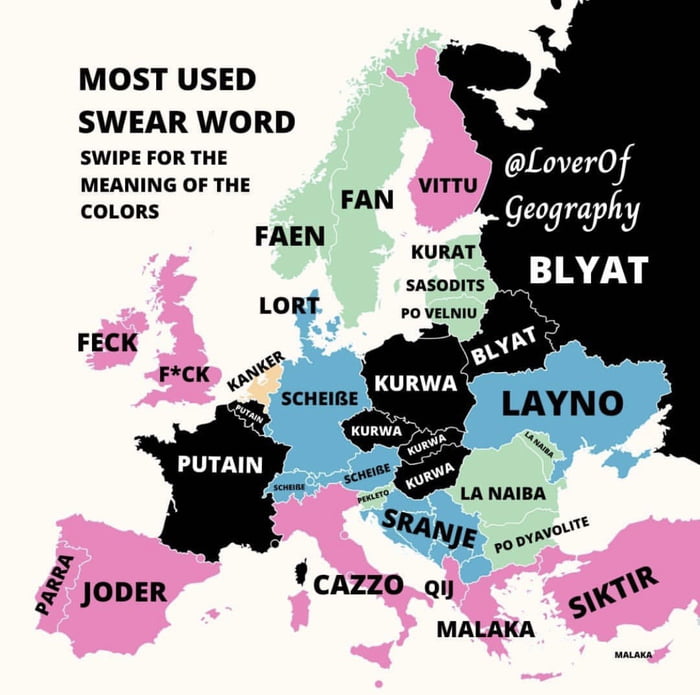
Portuguese twitter is very amused by this Instagram Post from “Lover of Geography”

For those not in the know, the actual palavrão here is “porra“, not “parra”.

Palavrão? Don’t I mean “asneira”? Palavrão is a swear word, whereas an asneira is any bad thing. You can “dizer asneiras” (say bad things) but you can also fazer asneiras (do bad things) so an asneira isn’t necessarily a swear word, it depends on context. The other relevant word is “calão” which just means slang.

By the way, why is Fuck the only one of these considered rude enough to have an asterisk? Or do they mean that English people actually say “Effasteriskseekay”? I wouldn’t put it past some people to be honest.

Posted in Portuguese

Scarecrow

Text with corrections from Dani Morgenstern. Notes at the bottom

Isto é uma tradução duma explicação ao lado de um quadro da exposição da qual eu falei ontem

O Espantalho
Litografia

Paula Rego tomou inspiração do dramaturgo Martin MacDonald. Na perspectiva dela “[…] a peça de teatro mexe* com religião… E a menina que queria ser Jesus… Que tinha muito a ver com o tema português também.” Esta litografia pode também representar a natureza paradoxal das consequências das nossas acções dentro dos nossos assuntos infelizes.
O Espantalho não é uma representação directa duma das cenas mais macabras da peça mas, com a sua imagem central dominadora dum espantalho crucificado, refere-se àquela parte da peça na qual a menina certinha, que faz sempre boas acções como se quisesse ser Jesus, perde os pais por causa dum acidente pelo qual, em** última análise, ela é que é culpada.
Ela é transferida para uns pais adoptivos sádicos*** que a tormentam com uma coroa de espinhos, uma chicotada e um cruz de madeira que ela tem de carregar (ela tem apenas 6 anos). Eles a perguntam se ou não ela quer ser Jesus e quando ela responde que sim, pregam-na ao cruz e voltam a perguntar se ou não ainda quer ser Jesus. A esta questão ela responda “Não, não *quero* ser Jesus, sou Jesus mesmo, caralho!” portanto, enfiam uma lança nas costas dela e o resto da história da crucificação desenrola-se no palco como antes.

*=hum… Na minha opinião “meddles with religion” não está bem traduzido porque ninguém fala assim em inglês. Julgo que é tradução de “mexer com” e não “interferir em”, e deve ser “touches on” em inglês, mas não faço ideia propriamente porque não li/ouvi as palavras originais da artista.

** =”em” not “na”. I was literally translating “in the final analysis” but it doesn’t need the article.

***=not “sadisticos”

Posted in Portuguese

A Semiótica Do Palavrão

(Description of an article about swearing in Porto: there are some grammar and vocab pointers down at the bottom for anyone who needs them. The portuguese is uncorrected and might contain errors but hopefully not many! Thanks to Dani and “Iznogoud” of the r/WriteStreakPT subreddit for helping me tidy up a few errors in the original text)

Acabo de ler um artigo no site do jornal Público intitulado “A Semiótica do Palavrão“. O autor, Paulo Moura, defende que a língua do Porto é rica porque a gente de lá usa muitas expressões com palavrões. Estas expressões não se trata de insultos como seria noutras regiões, mas sim de uma filosofia da vida. Acho que ele está a brincar, ou pelo menos está a escrever numa maneira ligeira. Parece que ele tem muito carinho pelos cidadãos daquela cidade e a sua maneira de falar. Apesar das obscenidades, acha-os acolhedores e simpáticos.

Já ouvi falar desta tendência portuense de usar palavras feias. Tenho uma amiga lisboeta que considera os portuenses bárbaros por isso mesma! Fica escandalizada quando vê vídeos online ou programas televisivas de tripeiros e o seu calão.

Notes on the text.

I’ve referred to Porto residents in three different ways

  • “a gente de lá” (the people from there). Gente is a collective noun so it’s treated as a singular (“a gente… usa” instead of “a gente… usam”)
  • “portuenses” is just a standard adjective meaning “from Porto”
  • “tripeiros” means tripe sellers, and has a couple of origin stories, both dating back about 600 years into the early history of portuguese navigation. You can read more about the most common version here

If you’re reading the article, hopefullly you’ll realise that the missing words are all rude

  • c=cu in every case, meaning “arse”. There are ruder c words in Portuguese like “caralho” (cock), “cagar” (verb meaning to shit) or “cona” (cunt) but I don’t think any of these are the c in any of the expressions on the page
  • p=puta which is a word for a prostitute. You occasionally see the abbreviation pqp online, meaning “puta que pariu” or “puta que te pariu” which is the whore who gave birth to you
  • b= I’m less sure about this one. “Bico” possibly? That just means beak but has a lot of alternative meanings, one of which is “Prática sexual que consiste em estimular o pénis com a boca ou com a língua. = FELAÇÃO”

Checking the theory in the last post, dealing with gender of – ão nouns, just to make sure it isn’t leading me astray:

  • Palavrão (swear-word) – masc: fits the rule
  • Expressão (expression) – fem: fits the rule
  • Razão (reason) – fem: doesn’t fit the rule, but it’s listed as one of the exceptions in the article so that’s no surprise
  • Regiao (region) – fem: fits the rule
  • Cidadão (citizen) – masc: fits the rule
  • Calão (slang) – masc: fits the rule
  • Felação (fellatio) – fem: fits the rule

Posted in English

Birds and Bad Words (Pássaros e Palavrões)

Today I had a lesson with a Portuguese teacher via Skype. She follows me on Instagram so she asked me about a picture I’d posted of some birds that have made a home in a nesting box on our allotment. So I described them, but I hit a problem fairly early on: I don’t know the names of many birds. Let’s see… umm… corvo (crow), pomba (pigeon), farm birds like Ganso, Pato, Galinha, Peru, um… what else? Ostrich, I think is avestruz, eagle is… águia (I needed spellcheck’s help even on that one), owl is coruja (I only know this from reading Harry Potter e a Pedra Filosofal), and melro-preto I know from a song is a blackbird. That’s about it. Sadly, the nesting birds were not blackbirds, nor owls, much less ostriches, so that put paid to that. So I went to my old friend google translate to find out how to say “blue tits”. If you’re british you know blue tits and great tits are real birds whose place in the comedy double-entendre pantheon of our island nation is inestimable. But the reason the liked of Benny Hill have been able to exploit their comic potential is that “tit” also means something else.

Here’s what I got:
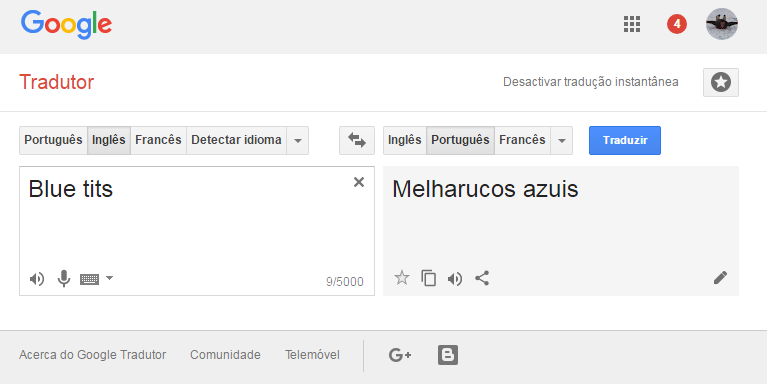
bt_one

I was none the wiser. Should I just blurt it out and hope she didn’t burst out laughing? I blurted, while simultaneously plugging the words back into google search and was reassured to see lots of images of actual feathery blue tits.  This is one of those times when the choice of tools matters though because if I’d used Bing Translate I would have got this…
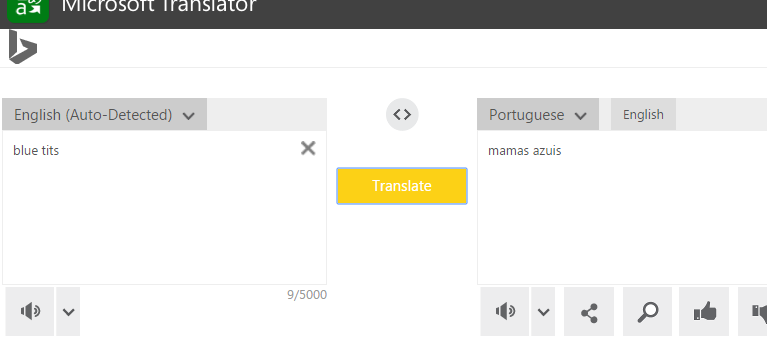
bt_two

…which actually does mean blue breasts (bit not the cruder “tetas” which is more of a direct equivalent for “tits”).

Bird names are a minefield, actually. There’s a bird called a shag and another called a booby. It’s almost as if, when Adam named all the animals, he started getting bored by the time he reached the birds and decided to see what he could get away with.

So what’s the message? Something about not letting Bill Gates teach you how to speak a language, I think.