Posted in English

Wales & Portugal – Not As Different as You’d Think!

I’ve been doing Welsh Duolingo for about two months now. I’m not planning to go all the way to fluency, but the company who makes the software that is my bread and butter have recently sold it to a host of Welsh local authorities so I thought it would be useful to try and get familiar with the language in case I end up working with them.

Wow, the AI really smashed it with this one, didn’t it! The Galo de Barcelos should probably be a bit darker, and the dragon a bit redder, but still, it’s an impressive setup!

So far, I haven’t had any real breakthrough moments like I did when I learned Scots Gaelic during lockdown. Back then, I wrote a blog about the surprising parallels between a Gaelic, a celtic language, and Portuguese, a romance language. This time, I’m not having quite the same experience and it’s not as much fun, frankly, as the Scots Gaelic course. But it’s interesting all the same. Time spent learning stuff is never time wasted.

Duolingo is a great tool, which is why it’s such a shame their Portuguese course is so Brazilocentric. I’m making really good progress with Welsh, but the nuances of why I have to pick a word like Ydy instead of Mae or Roedd sometimes eludes me, so in my efforts to get a bit more background about the grammar and logic of the language, I found myself watching this guy’s videos and – oh look! He has one about the celtic influence on portuguese. It’s super-intersting and I’ve found myself getting enthused all over again for Welsh.

Linguistics is a really fascinating subject. I can’t remember if I’ve mentioned it already, but John McWhorter’s lecture series on linguistics really opened my third eye to this stuff and I definitely recommend it if you want to add a new dimension to your studies.
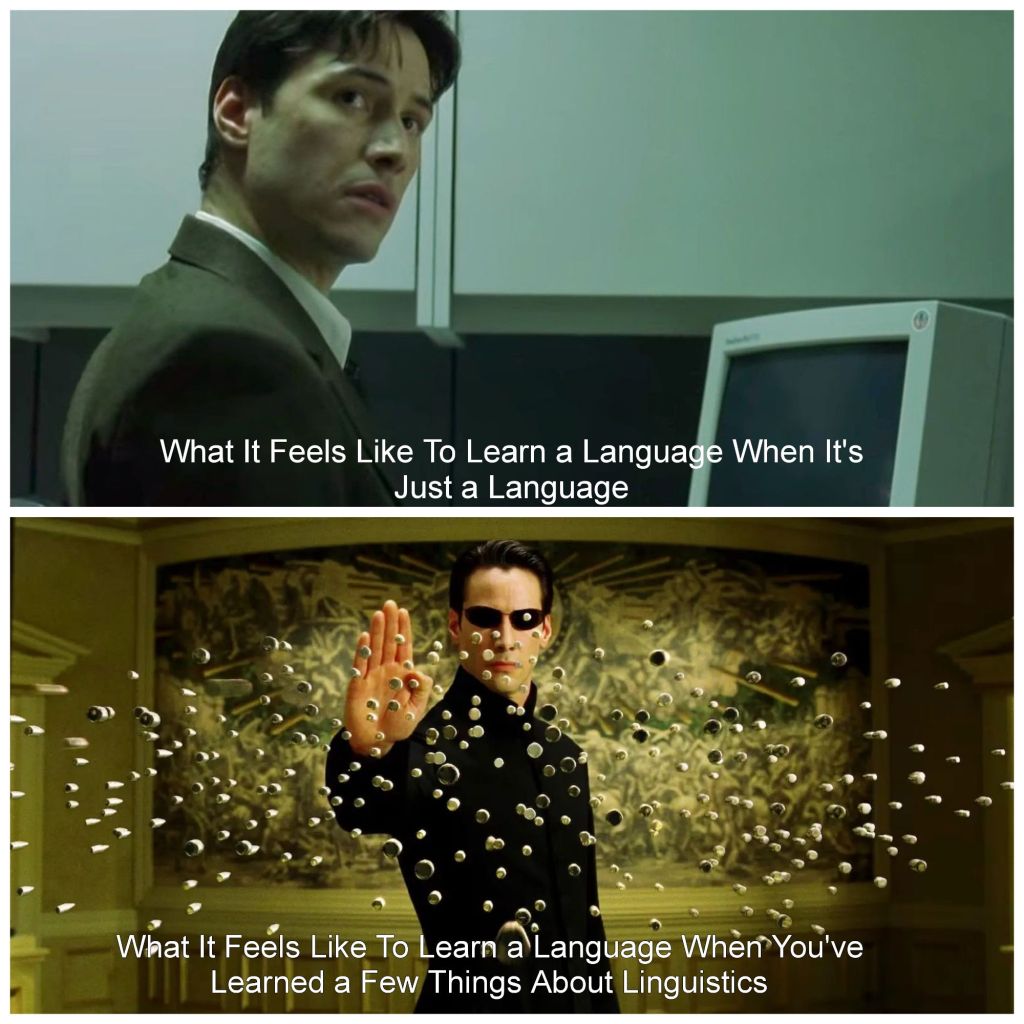
Well, this is a low effort English post. My resolution to write in Portuguese every day didn’t last as long as I’d hoped. Hi ho. I actually have quite a few ideas in my head but it’s just finding time to sit down and write them when we’re still living out of a suitcase. The builders have at least finished now, so we just need to slap some paint on the walls, move all our stuff out of the bedrooms and into their usual resting places and things will get back to normal, more or less.

Posted in Portuguese

Little Big Man

Há muito tempo que não falo do Marco Neves, o linguista bem conhecido, autor, anfitrião de podcasts, bloguista, sábio e fornecedor de conteúdos do exame C1. Neste blog, fala da expressão “Beijinhos grandes” que os portugueses usam para se despedir dos amigos. Como em inglês, existem picuinhas que gostam de interpretar de forma muito literal expressões e conjunções de palavras e fazem deles um “ódio de estimação”. Neste caso, “beijinho” é um diminutivo**. Portanto a frase significa “grandes pequenos beijos”, que não faz o mínimo sentido, pois não?

Temos esta espécie de polémica no mundo anglófono, e eu sou fã da interação entre descritivistas como o John McWhorter*** e pessoas mais escrupulosas como o (falecido) escritor Kingsley Amis. O Neves tem mais em comum com o McWhorter: tem uma predileção por desmentir os desabafos dos pedantes.

Beijinhos Grandes
So many artists’ work plundered and this is the best AI art can come up with in response to the prompt “big little kisses”. Horrifying!

O seu primeiro argumento trata da relatividade do tamanho. Por exemplo, uma criança brinca com dezenas de carrinhos, mas não são iguais. Há carrinhos maiores e menores.

Além disso, a palavra “beijinho” assumiu um novo significado, ligeiramente diferente: um beijinho não é simplesmente um beijo pequeno mas sim um tipo de beijo – geralmente no face ou no ar.

Nos últimos parágrafos, o linguista desvenda a raiz da questão: o diminutivo português transmite um sentido de carinho.

O seu ensaio é muito curto e vale mesmo a pena.

*Cumprimentar is the word he uses but more realistically, despedir-se is the more appropriate verb.

**Hum, pensando nisto, porque é que esta palavra termina com -o? Beijinho é uma (palavra) diminutiva não é?

***He’s very good generally, and his Great Courses Series is absolutely mind-blowing. I can’t recommend it enough. However, I would cheerfully crucify the man for this absolute travesty. Sorry, but I have my limits.

Thanks as always to Cristina of Say It In Portuguese for the help with proofreading

Posted in English

Linguistics

Hello! Well, I have been quiet for a few days after a long, long time of consistent language learning and consistent banging-on-about-it on here. We went to France and I had to squeeze my brain into French mode and its taken me a while to get back into the right frame of mind to get back to work on Portuguese. I’m actually still jointly reading the French translation of Six of Crows with my daughter so I’m going to be twin-track for a few weeks to come, but at least I’m starting the ball rolling again.

The Story of Human Language by John McWhorter

I’ve also just finished listening to this course about languistics, presented by John McWhorter who is an author and the host of the Lexicon Valley podcast as well as being an accomplished academic in his own right. He really brought the subject alive. I’ve been interested in the development of language for ages and enjoyed seeing how some of my pet theories, derived from learning Portuguese, French and Scots Gaelic, lined up with current ideas formed by people who actually know what they’re talking about. Portuguese is mentioned a few times, both in its relation to other romance languages and in its role as a source languages for creoles and pidgins in areas where Portugal’s empire spread its influence. Of course, knowing about linguistics doesn’t make you better at speaking another language but I feel like it adds an extra dimension to the experience and I’d definitely recommend it if it’s not something you’ve already tried. It’s on Audible’s free list, meaning if you’re a member you can just listen without spending precious, precious credits.