Posted in Portuguese

Viriato

notebook_image_777636
Nuno Tavares Obra do próprio CC BY-SA 2.5

Viriato (em latim: “Viriatus”) foi um líder dos lusitanos que se opôs aos romanos no século II antes de Cristo. Sob a sua liderança, os lusitanos, (naquela altura, a mais poderosa nação da Hispânia) infligiram muitas derrotas no exército de ocupação. Era um herói nacional tal como a inglesa Boudicca (em latim “Boadicea”), o alemão Hermann (em latim “Arminius”) ou o francês Astérix (em latim “por Júpiter, deixa de bater-me!”)
Eventualmente, dois companheiros do Viriato tornaram-se traídores e assassinaram-no. Sem a presença do Viriato, os romanos foram capazes de cumprir a sua campanha para anexar a península ibérica.
Segundo o Diodoro (e confesso que vou colar esta frase da Wikipedia) “Enquanto ele comandava ele foi mais amado do que alguma vez alguém foi antes dele.” e até hoje em dia, existem muitas estátuas dele em Portugal e Espanha.
Eu pesquisei o nome de Viriato por causa de uma canção dos Deolinda*, que se chama “Berbicacho”. A letra trata de um homem chamado “Viriato”. Não percebi porquê. E apesar de ter feito uma pesquisa, ainda não faço ideia. É muito esquisito.

*=Já mencionei que os Deolinda são a minha banda preferida? Dois milhões de vezes? Ah, peço desculpa.


Thanks to Nini for helping me correct the errors in this one. He also gave the opinion that the name Viriato was chosen by the songwriter more for its sound than for any historical connection. Link to a track-by-track description of the album here.
Posted in English

Portugal Is Not The Only Fruit

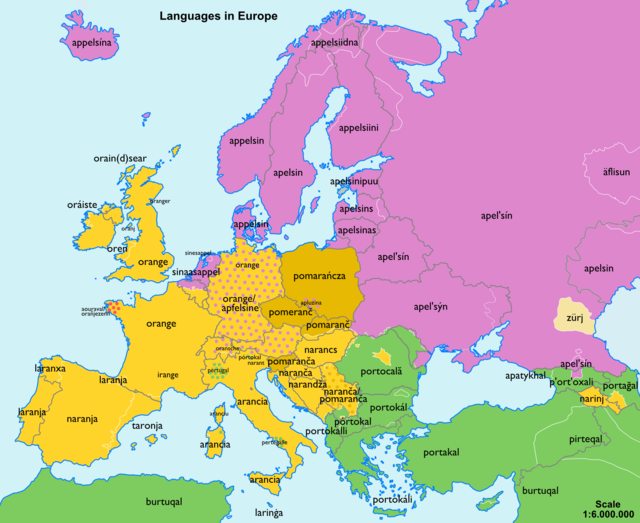
I saw something really interesting online the other day. Someone shared a link from imgur showing all the different words used for “orange” in languages in and around Europe.

The word for the fruit “orange” in various European languages
NgdlZRyl

Notice anything? I’m looking at the green ones, mainly. These are countries with strong Arabic influences or strong Greek ones. And… They all seem to be close variants of “Portugal”. This aroused my curiosity, so I did what any self-respecting inhabitant of the twenty-first century would do: I looked it up on Wikipedia.

According to this section, the origin of the name of the country is from the Latin “Portus Cale” – the port of Cale, where Cale is probably a Celtic name for something-or-other. It evolved into Portugal between the seventh and ninth centuries when the country had been conquered by an Arabic-speaking army and was part of the land known as الأندلس (Al-Andalus). I can’t help feeling like the similarity of “Portus Cale” to their word for a small fruit might have influenced the colonists’ pronunciation of the name of their new possession. Citrus fruits do grow in the area, so maybe if there were a lot of orange groves around it might have been a pretty good fit to call it the orange region. A few centuries later, after the reconquista rolled back the invaders, the name lives on.  A place named after orange groves isn’t far-fetched. Orange County in California got its name the same way, although California hasn’t been conquered by Muslims, whatever Donald Trump might tell you.

I have absolutely no idea if there’s any truth in this. Fact-checking was never my strong point. It would be an odd linguistic legacy. Portuguese does have some inheritances from Arabic (there’s a list here if you’re interested) but their word for Orange (“laranja”) não é um deles. And yet, it just seems too… well, too right.