Posted in English

AmErrorca’s Most Wanted

There are a few really stubborn mistakes I just can’t seem to get past. They crop up again and again, and I never get around to addressing them because they are boring and too obscure to be easily addressed by googling “How to do ____ in Portuguese”. I think if I could sort them out a lot of the baseline problems with my sentence-construction would be sorted and I’d be a much stronger speaker.

Little Fiddly Words In Front of Infinitives

Infinitives are the definitive forms of a verb, normally translated as “to be”, “to know”, “to do” and so on. Because of this, when I write one in portuguese I expect it to not need anything in front of it but sometimes it does and sometimes it doesn’t. About the only rules here are to do with Gostar and Precisar, each of which takes a “de” after it

Ter can have a “que” or a “de”, depending what you’re doing and in other cases it might have an “a”, a “para” or just nothing. I need to get to the bottom of this and work out how it works once and for all.

Genders of Nouns

I think I’m right about 80% of the time but that’s not enough. Difficult to think how to do this without biting the bullet and learning them by rote. I considered making little stickers with lipstick on some and a moustache on others and sticking them on all the objects in my house, but that wouldn’t help me with abstract nouns. Have you ever tried sticking a moustache on despair?

Reflexive and Pseudo-Reflexive Verbs

First of all: there seem to be a hell of a lot of reflexive verbs – far more than in french – and I sometimes come across verbs that look like they have a reflexive pronoun but aren’t actually reflexive. They seem to be something to do with the passive voice – e.g. sabe-se que = “it is known that…” and yet my grammar book doesn’t show that as a way of constructing the passive voice. This sounds like one I will have to ask a teacher about.

Awkward Irregular Verbs

Things like Ser, Ir and Estar are easy because they get so much attention. The real killers are things like Dar, Pôr and of course the terrible twins, ver and vir, because they irregular and fairly common but not so common that you get a real familiarity with them day-to-day. I printed these buggers out ages ago, thinking I would just bruteforce it all into my head but somehow, whenever I think about it, there always seems to be something more pressing like picking fluff of the carpet with my bare hands, arranging my socks alphabetically or playing the national anthem on the teeth of a comb. Important stuff, you know.

So that’s what I’ll be working on this week in addition to my Hot Summer Reading. I’ll probably write blog posts about some of them as a way of motivating myself and getting them to stick.

Posted in English

Two Become One

CpR1xmZXgAE54XYSo the other day, my wife was reading the Observer to maintain our impeccable middle-class credentials, when she showed me a full-page graphic in which the headline “Why two languages are better than one” is written in several different languages, including Portuguese.

“Do you see a problem?” she asked, and I’m happy to say that, yes, it jumped out at me straight away. It turned out to be quite educational. Stay awhile and read the next few paragraphs and I will lift the lid on the whole sorry affair.

To further burnish those impeccable middle-class credentials I mentioned, I decided to take a picture of the page and tweet about it in a slightly smarmy way.  I also mentioned it to a couple of other people – a Portuguese friend on Hellotalk and an online tutor. To my surprise, both of them thought the sentence was absolutely fine and error-free. Well, what was I to do? How could I break the news to Mrs L that she had been outvoted? I asked a different tutor and she initially joined the “No, it’s fine” crowd, but then after thinking about it agreed that it was a mistake. Two all. Mrs Lusk then started pinging it out to people she was at school with – people in their forties who went to school before the Acordo Ortográfico when it all got a bit slack. At last the balance of opinion shifted decisively in favour of it being a mistake and her faith in humanity was restored.

So what was the problem? Well, my Portuguese is pretty feeble, but let me have a stab at describing what I think is going on and why it wasn’t obvious whether or not there was an error. Basically, the problem is the mismatch between

são + melhor

in the middle there. “São” is third person plural but “melhor” is singular. There are two languages so it looks like it ought to be “melhores”.

That’s as far as I had got when I was smarmily tweeting at the Observer, but I’m not even sure “sao melhores” is right either. What does the adjective describe? Not the languages themselves surely? That would be like hearing the sentence

Why two languages are better than one

and parsing it as

Why two languages are both better than this other language

That makes a sort of sense but what we’re really interested in is not the languages themselves but a person’s ability to speak the two languages. There’s a word missing:

Why speaking two languages is better than speaking one

Now it makes more sense because here “speaking” is a gerund – a present participle used as a noun. If you add the gerund back in it’s obvious what we’re actually talking about here. The adjective and the verb now refer to “speaking” so they can go back to being singular again and we can make another version of the sentence.

OK, here goes – I’m really putting my neck on the line here. If I muck this up after this much build-up I’m going to look a right tit:

Porque falar duas línguas é melhor do que falar uma

If this were Brazilian portuguese we would use a portuguese gerund (“falando”) but European Portuguese seems to prefer infinitivos (“falar”) in these kinds of situation. Apart from that… I think this is better, but if it’s not you can have a good laugh at me in the comments box below this post.

This kind of thing isn’t just a portuguese problem of course. We’ve all heard English-speakers mangling sentences because they haven’t really thought about what the words mean. Me, I always get muddled up with collective nouns. Do you say “a small group of bankers are destroying the economy” because there are multiple bankers, or “a small group of bankers is destroying the country” because there’s only one group. So it doesn’t really surprise me that there are sentences like this that can trip up perfectly intelligent portuguese people. I’ll just note it down as an interesting artefact I’ve come across on the road to fluency.

Posted in English

Key Learnings 5 – Gender Rannygazoo

I haven’t blug for a while. Blug is the past tense of blog, right? Anyway, while I have been in silent mode, I’ve been involved in a group discussion on Hellotalk run by a Portuguese friend. There are a few Portuguese-learners in there and it’s interesting to see how the conversation evolves.

Now, normally, I mention my own failings in conversation, but in this case, someone else made a mistake that I thought was really interesting and I definitely would have made it too if I’d been trying to say the same thing, so I’m writing about it to help cement the knowledge in my brain. What he said was

Eu tenho dupla nacionalidade, Americano e Português

The correction came back as

Eu tenho dupla nacionalidade, Americana e Portuguesa

Weird. He’s a bloke, so why is it “Americana” and not “Americano”? Well, the answer is that nacionalidade is a noun in its own right and the way the sentence is structured, it’s his nationality that is described as American, not him. Since nacionalidade is feminine, it becomes “Americana”. If he had said

Eu tenho dupla nacionalidade. Sou Americano e Português

that would have been OK, because in that sentence the adjective is applied to him directly. I was taken aback at first, because we anglophones are so used to not having to think about this stuff, but when you think about it, it makes sense, and opens up a little window into how the language works.

Posted in Portuguese

Key Learnings 3 -A Pair of Ears and a Stray à

Today’s top two new things were:

Orelha and Ouvida: I have known for a while that there were two words for the ear but I had lazily assumed they were synonyms. But in fact, Ouvido is the bit you hear with and Orelha is just the flappy bit on the outside.

This sentence:

Em casa da família de acolhimento é melhor que o estudante tenha a idade aproximada à das crianças da família.

was baffling to me because the à [a+a], immediately followed by das [de+as] seems to mean “to the of the children” until I finally wrapped my head around what it was doing. The à is actually “to it” not “to the” because an a can be a pronoun as well as an article, so the sentence means

In the house of the host family it’s better that the student be of the same age as it (i.e “as the age”) of the children in the family.

As for the actual statement itself, OK, I know, I’m not sure why that would be true, but when I had the initial conversation about this I thought “família de acolhimento” meant a foster family, so it made a sort of sense. I think it’s more like a host family in some sort of school exchange program though.

Posted in English

Mind Mapping

Clipboard01

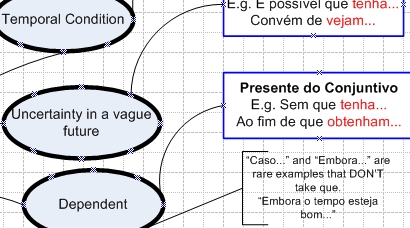
I decided to try my hand at mind-mapping to set out all the situations in which I might need to use the subjunctive tenses. In case you don’t know, these are three tenses that are used in situations where there’s some sort of doubt, intention, or future eventuality implied. Usually, they are not the main verb in a sentence, just part of a supporting phrase. They’re actually pretty easy to conjugate. The difficulty for us English speakers is recognising the situation in which they are needed, and remembering to pull one out of the bag in place of the standard indicative. That’s because we hardly use them at all in English. Basically the only time they would rear their head is in a phrase like “If I were a rich man”. So, in the song:

If I were a rich man,
Daidle deedle daidle
Daidle daidle deedle daidle dum,
All day long I’d biddy-biddy-bum.

“Were” is a subjunctive (imperfect subjunctive, I think) because it’s describing a hypothetical situation (being a rich man), which is why we’re using “were” instead of “was”. When it comes to translating, I think the verb we want here is “Ser” because although rich people can become poor, it feels more like a statement about a permanent state of affairs. I don’t think he wants to be rich for just one day. So we would translate this as “fosse” (first person imperfect subjunctive of “ser”)

“I’d” – short for “I would” of course – indicates we’re dealing with the conditional, which is a normal indicative tense, because it’s leading into the main thrust in the sentence: what he would do in that hypothetical situation. It’s a little difficult to translate because I don’t know the Portuguese verb for “to biddy-biddy-bum” but let me make an educated guess: bidibidibombiar, and you can make the first person conditional by just whacking an “-ia” on the end.

As for the daidles and deedles, well, I’ll have to leave those to someone with more expertise. Hey, my degrees are both in science, so what do I know about language? They’ll be adverbs, I expect. I never trusted adverbs.
Putting it all together then:

Se eu fosse um homem rico,
Daidle deedle daidle
Daidle daidle deedle daidle dum,
Todos os dias, eu bidibidibombiaria.

If you’re reading this and you’re not sure if you need to know about subjunctives, check with your teacher, but I believe they only really come into play at DIPLE/B2 level. It’s worth looking at them earlier, if only because they come up in books quite often and it’s useful to be able to recognise them, but I don’t think you would need to worry about them at B1 level… I didn’t anyway!

Anyway, if you’re interested, I’ve saved a pdf of the work in progress here. So far it only has the presente do conjuntivo (present subjunctive) but when it’s finished it’ll have the other two subjunctives – imperfeito (imperfect) and futuro (future)

Anyway, if you’re interested, I’ve saved a pdf of the work in progress here. So far it only has the presente do conjuntivo (present subjunctive) but when it’s finished it’ll have the other two subjunctives – imperfeito (imperfect) and futuro (future)

Anyway, if you’re interested, I’ve saved a pdf of the diagram here.

Posted in Portuguese

Uma Quinta Pequenininha Na Cidade

Há seis anos, a minha esposa registou-nos numa lista de espera para um “allotment” e a semana passada, tivemos novidades que vamos ter a oportunidade de arrendar um deles. Não sei se existe uma palavra equivalente em português*. Um “allotment” é um lote de terra na cidade, talvez cinquenta metros quadrados, onde podemos cultivar** legumes, frutas e flores.
São propriedade do governo local e os cidadãos pagam uma renda para poderem usar-los.
A minha filha quer cultivar batatas e flores. A minha esposa quer cultivar morangos, cebolas, alhos, brócolos, bacalhau e esparguete*** (hei-de ter uma conversa longa com ela…), e eu… eu quero apenas construir lá um barracão onde posso sentar-me e praticar português sem perturbar os outros membros da família com os meus sons horríveis.

*= “quinta urbana” (urban farm) was suggested. “Lote de Terra” (used in the next sentence) was suggested as a possible alternative in Brazil too, although it does seem to indicate that the answer to the question “is there a specific word for a plot of public land in the city, for rent to residents” is “no, there’s only a plot of land, and you’ll have to do the rest of the description yourself!”.

**=My use of “crescer” (to grow) was universally nixed in both countries. Apparently you can’t use “to grow” as a transitive verb. What’s a transitive verb? Grammar isn’t taught very thoroughly in the UK because our grammar is a lot simpler than most, so for those of you who are puzzled at this point,  a transitive verb is a verb that takes a direct object. So if you say “I kick the ball”, kick is transitive because it is happening to the ball. In “I sleep for eight hours each night”, sleep is not transitive because you aren’t sleeping something, you’re just sleeping. In English, grow is transitive because you can say “I grow flowers in my window box” but in Portuguese, crescer is intransitive. My flowers grow but I don’t grow them. I can cultivate them (cultivar v.t), plant them (plantar v.t) or water them (regar v.t.) but I can’t grow them. They just grow. Crescer, by the way, is obviously related to the Italian word often (mis)used in English “crescendo”, so it’s easy to remember since a crescendo is when the music is growing in volume.

***=strawberries, onions, garlic, broccoli, codfish and spaghetti”. Despite the brackets saying “I will have to have a long conversation with her…”) two of the three people who helped me correct the work didn’t detect the joke and assumed I was either (a) using the wrong words and meant something else or (b) badly deluded about the basic principles of agriculture. Both fair assumptions, I suppose, given how any screw-ups there were in the rest of the text. Note that alhos and brócolos are both plural, whereas in English we would just treat both as uncountable stuff.

Thanks Susana, Greyck and Ester for helping correct this when it appeared on iTalki

Posted in Portuguese

A Livraria

Ontem, tinha uma bilhete para um debate no sexto andar duma livraria no centro de Londres que se chama “Foyles”. Foi parte duma série de debates antes da eleição do prefeito da cidade sobre sujeitos no que concerne aos cidadãos*. O de ontem foi sobre a migração: Os refugiados da Síria, o movimento das pessoas por dentro do Reino Unido, as cidadãos da União Europeu, e pessoas que chegam doutros países de África e da Ásia, por exemplo.
Os falantes são todos de esquerda política: Daniel Trilling, o editor da revista “A Humanista”, Rebecca Omonira-Oyekanmi, uma jornalista que escreve sobre os direitos da mulher, e Owen Jones, escritor de dois livros, “Chavs” e “O Estabelecimento”. Por isso, não havia muito desacordo entre eles, e o que é um debate sem divergências? Não faz mal, mesmo ainda foi interessante.

Uma coisa muito estranha aconteceu. Tendo chegado atrasado na sala onde foi a discussão, tirei o meu casaco e sentei-me. Passado uns minutos. De repente, uma mulher, que chegou também atrasada, sentou-se ao meu lado. Reconheci-a. Esta era a irmã mais nova da minha esposa!

notebook_image_678034Depois do debate, e depois de termos saído da sala, vimos a secção de livros estrangeiros, onde estavam talvez trezentos livros portugueses, mas não precisamos de livros novos agora.

*=É correcto? O “Spellcheck” disse que sim, mas porque não “cidadões?

http://www.foyles.co.uk/Our-London-Moving


Picking up on that last footnote about the plurals: Apparently I am an idiot because I knew several words that didn’t fit the pattern in my head that -ão words become -ões words when pluralised. Cão, for example, becomes cães. Apparently it depends on the word’s root in Latin.

If it had a_u in the latin form, it will follow the -ão/-ãos pattern

Hand = Manus (Latin) -> Mão (Portuguese Singular)  -> Mãos (Portuguese Plural)

If it started as an a_i word in Latin then it will follow the -ão/-ães pattern

Dog = Canis (Latin) -> Cão (Portuguese Singular) -> Cães (Portuguese Plural)

If it started as an a_o word in Latin then it will follow the -ão/-ões pattern

Nation = Nationis (Latin) -> Nação (Portuguese Singular) -> Nações (Portuguese Plural)

Now of course this is all the kind of thing that you don’t need to know AT ALL to be able to speak the language, but it’s freaking amazing to know! I only did two years of Latin at school, about 35 years ago so it doesn’t help me very much but knowing there’s an order to it makes it feel more manageable than if it was just pure randomness!

The third form seems to be the most common so in a pinch, if I don’t know which way to jump, I would make that my default guess. More Portuguese plurals here.

Thanks again to Sophia and to Rubens for their help with corrections and in decrypting the mystery of the plurals!