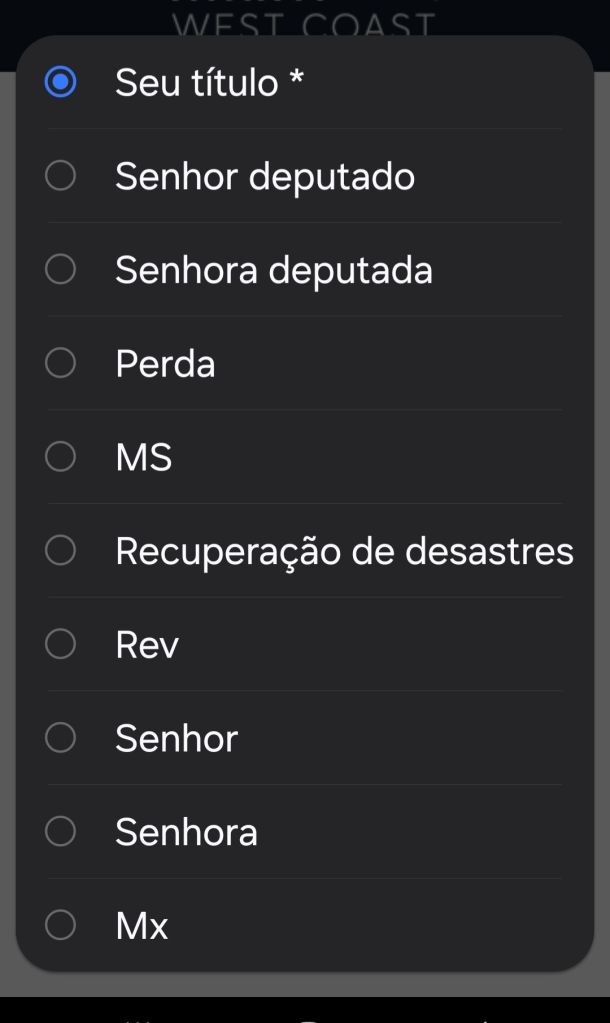
Signing into the Avanti Trains Wi-Fi the other day, I had to enter my personal details, including my title – you know, Mr, Mrs, Miss, etc. As usual, since my phone is in portuguese, the site delivered the portuguese version of the page and this was the list I got.
My first thought was that this was some sort of data quality error – maybe they had included a couple of department names (Perda=lost property? And Recuperação de desastres= Disaster Recovery) in their list of titles and that whoever had been given the job of translating it had just translated them without thinking.
But in reflection, how would that even happen? After a couple of minutes, I realised the original list was OK, it was just a spectacularly terrible bit of AI translation.
So starting from the top:
Senhor/a Deputado/a refer to members of parliament and since that would just be one item in an English list, I assume they started out as “lord” and “lady” or something
Perda is my favourite: Miss. One of the meanings of perda is a miss or a loss.
MS must be Ms. MS does exist in Priberam as the abbreviation for a Brazilian province called Mato Grosso do Sul.
Recuperação de Desastres is the biggest leap, but since there isn’t a “Doutor” in the list, my guess is that this one started out as “Dr”, so the AI read it as “DR” and since DR stands for Disaster Recovery in management speak, it’s translated it as Recuperação de Desastres
Rev isn’t translated. Boring.
Then you’ve got Mr and Mrs and the unpronounceable Mx that a few people were trying to make happen in about 2020, much to the annoyance of everyone else.
I wonder how much the consultant charged them for this load of crap. It’s a brilliant example of what happens if you cut corners!
So I was asked a question about something I said in the post about Linguee the other day. I said that I thought Google Translate (aka Gtranslate) was better than Deepl for certain things. Both are translation apps, but Deepl is usually thought of as better at European portuguese, so people will usually recommend it. That’s usually good advice: if you didn’t know any Portuguese and you wanted to translate something into European Portuguese you’re usually better off with Deepl.
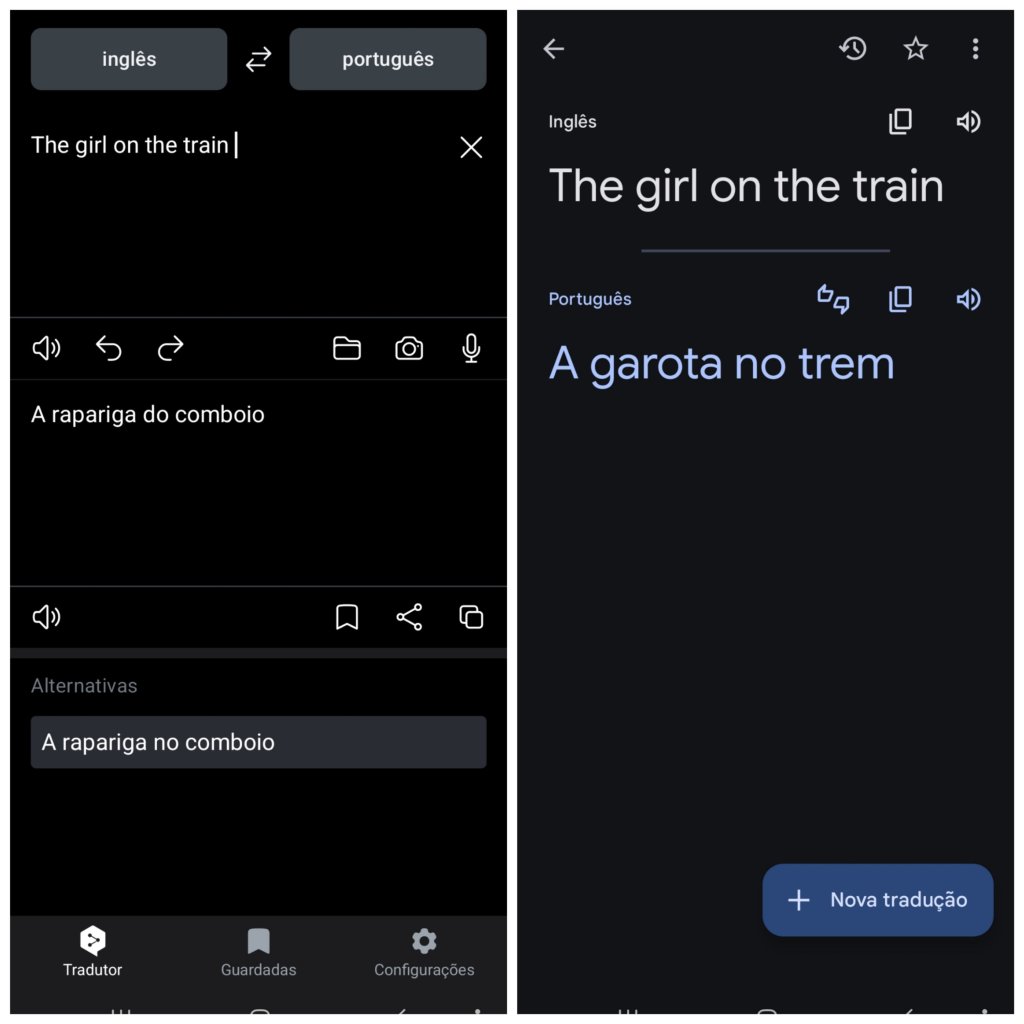
Deepl (left) correctly translates this book title into European Portuguese while Gtranslate comes up with the Brazilian version.
So why did I say Gtranslate was better? Because we’re language students, so I think we usually don’t want the app to do all the work for us. English-Portuguese translation isn’t something we need often. But what we do want is the opposite: we want it to check our work by translating it back into English because of it can understand it then that’s a pretty good indicator that we got it right.
So for example, if I’ve written “Este carro é muito carro”, what I want is for it to say “this car is very car”, so I know I’ve goofed; I’ve put an extra r in “caro”. If it translated it correctly as “this car is very expensive”, I wouldn’t notice my idiocy.
And so I thought Deepl would be less useful because it is AI and it’s cleverer, which means if you did something like this it would be more likely to guess what you meant and translate it correctly, hiding the error and lulling you into a false sense of security.
Líliana, (whose website The Talking Sardines caters for early stage learners around A1/A2), asked for an example so I tried a few. Want to see if I was right? Read on!
Let Battle Commence
OK, so let’s put both apps in the Thunderdome together and see which emerges victorious. Two apps enter, one app leaves. In each round, I have presented the translators with a sentence with a couple of minor errors. Remember, it’s a backwards competition. What I want is for it to give the wrong answer because that’s more useful than hiding the mistake.
In each case, Deepl on the left, Gtranslate on the right
“Gosto de escreve contas de fada”
Escreve should be an infinitive “escrever” and a fairy tale is a “conto de fado”, not a “conta de fado”
Deepl responded to “conta de fada” better, by translating it literally. Gtranslate is cleverer (ie less useful) because it has hidden the mistake, but Gtranslate also makes change suggestions – in the middle of the screen it asks: “Será que quis dizer…”, meaning “Did you mean to say…” and there it gets bonus points for spotting the grammatical error in escrever and suggesting I change it. Great!
Result: tie! Each spotted one mistake and ignored the other.
Well, this is a surprise. Maybe I was too harsh on Deepl?
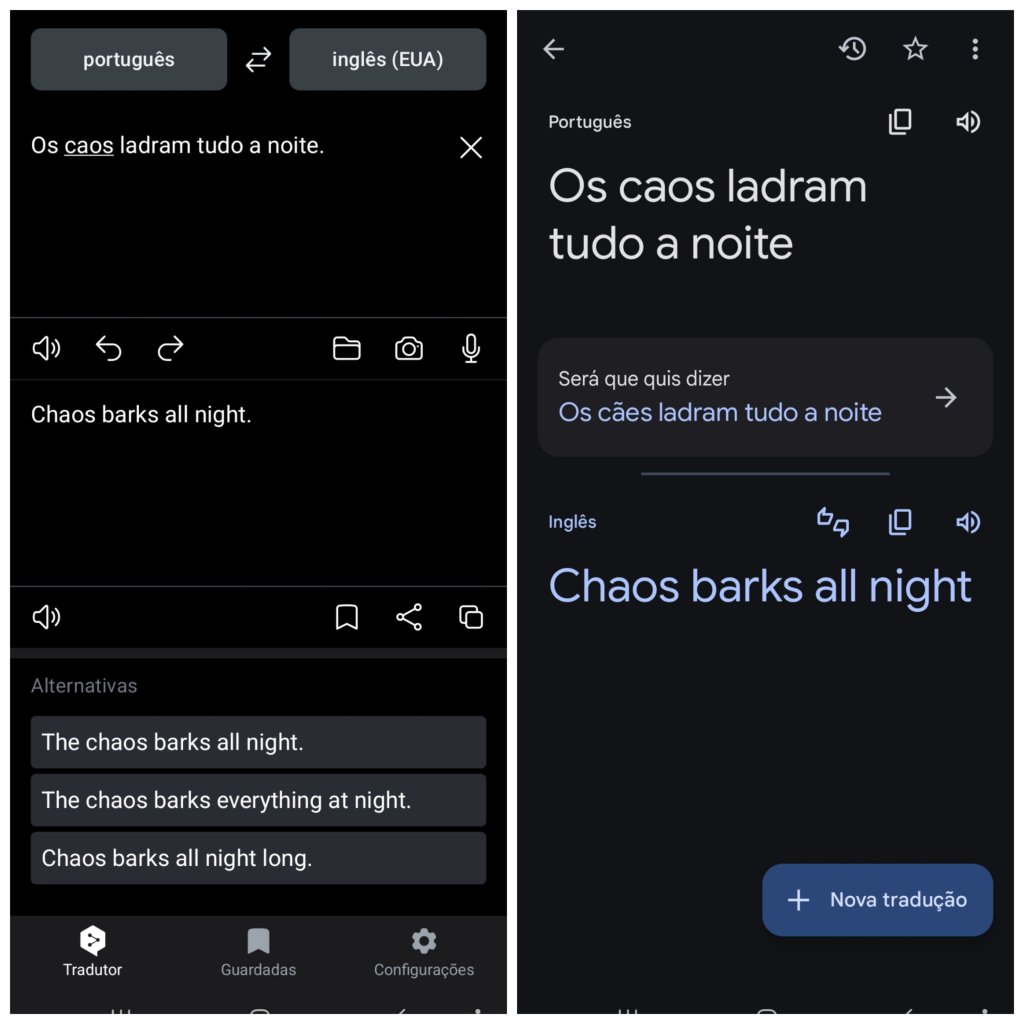
“Os caos ladram tudo a noite”
The word cão (Dog) has one of those weird plurals: cães. The word “caos” does exist but it means “chaos”. Oh and and obviously I’ve used “tudo” (everything) in place of “toda” (all).
This would make a great album title, wouldnt it? Gtranslate has a helpful suggestion, but both have correctly translated one mistake and erased the other
Result: tie! Both get one right, one wrong. Whether or not you want it to spoon feed the answer is a matter of taste so I don’t give Gtranslate extra points for that.
“Estou na quinda a trater dos porcos”
Quinta and tratar are both spelled wrong
Deepl is just freestlying. I don’t even know what it’s thinking there. Gtranslate has translated it correctly (not helpful) but it has very cleverly and helpfully suggests that I fix both spelling errors. Great work!
Result: Gtranslate is victorious. Initially it loses marks for ostensibly ignoring the errors, but it scores top marks for prompting me to fix both, not just the first. Deepl only highlights one mistake.
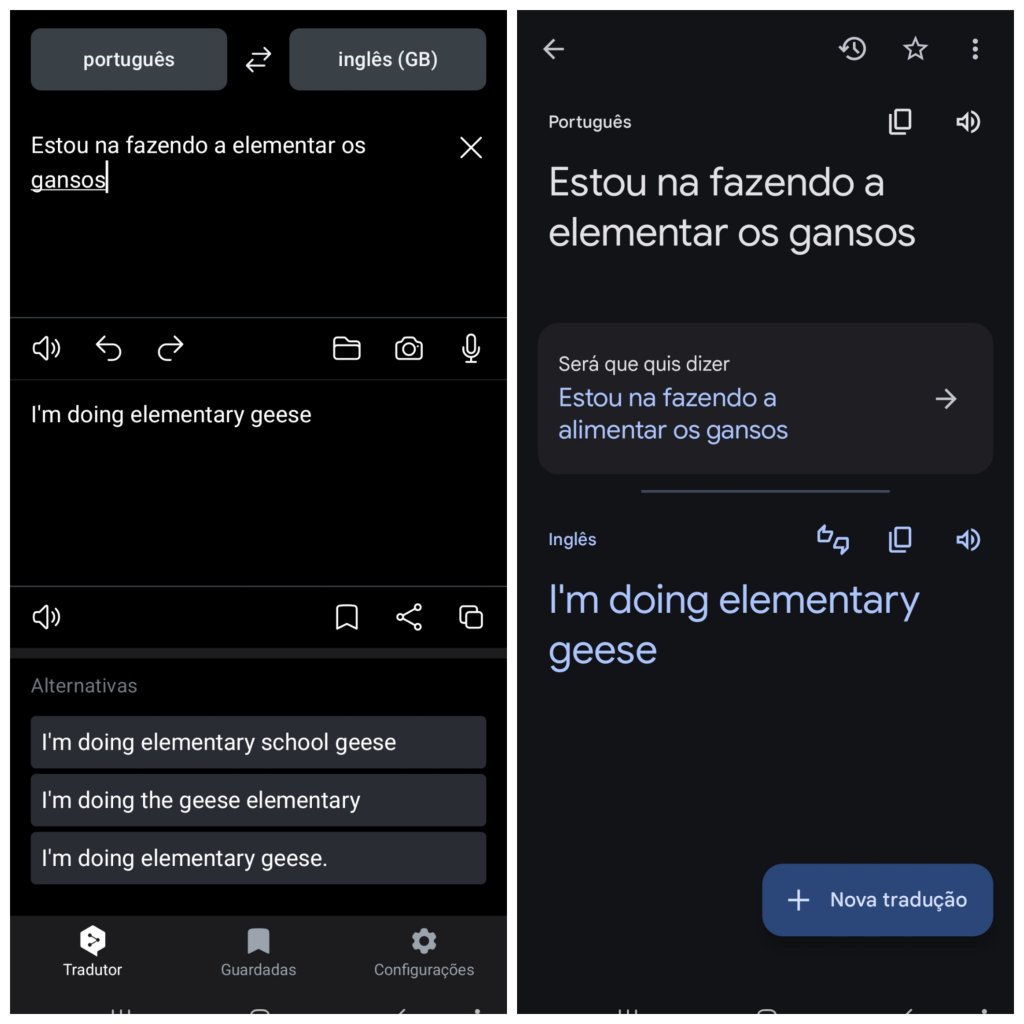
“Estou na fazendo a elementar os gansos”
Fazenda is another word for farm (I think I’m right in saying it’s more specifically a larger, family owned farm), whereas fazendo is just the present participle of fazer. And the verb I’m looking for is “alimentar”.
Both helpfully mistranslated both words. Gtranslate is correctly able to suggest the correction for one of them at least.
Result: tie! Both have done their job correctly, translating garbage into garbage. Whether or not you want the extra help Gtranslate gives you is a matter of taste.
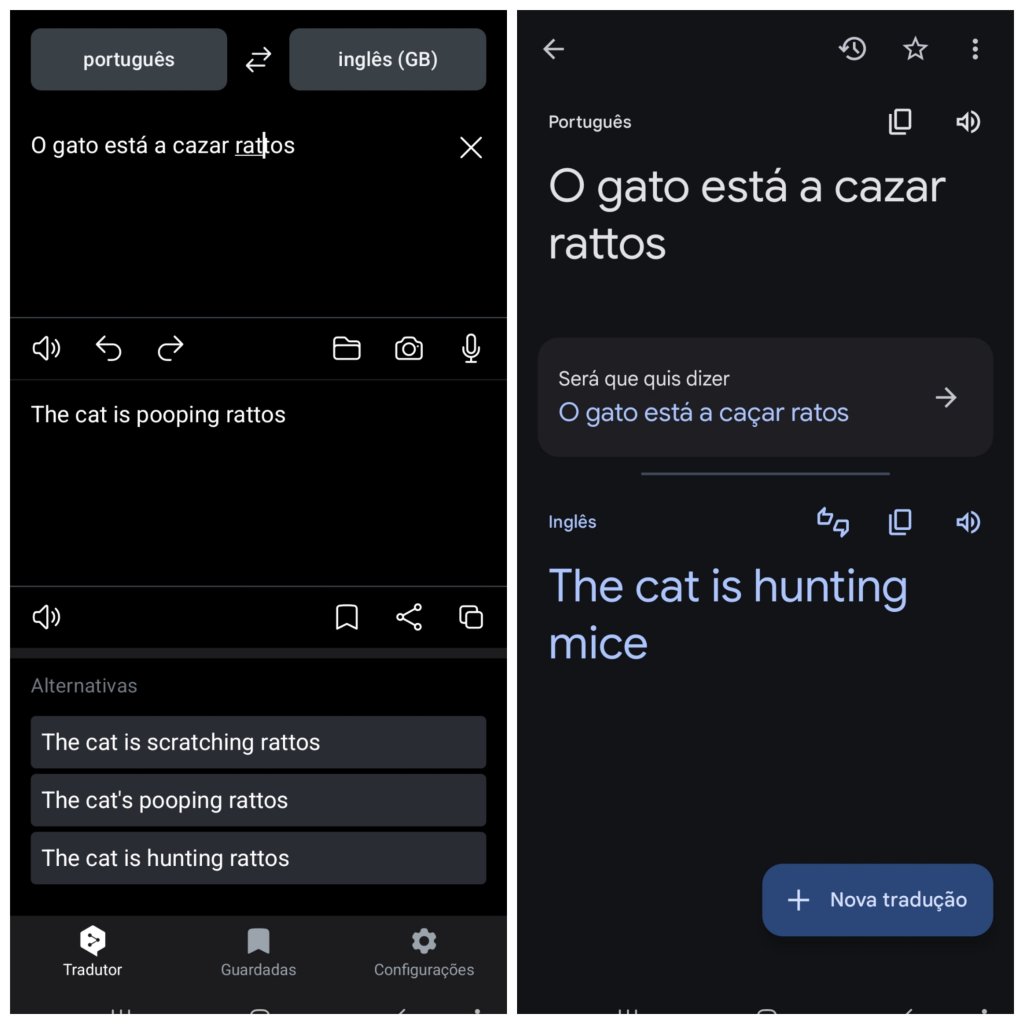
“O gato está a cazar rattos”
Caçar and ratos are both spelled wrong.
Deepl tries to be clever and interpret cazar but guesses the z is supposed to be a g. It has no idea what I am talking about with the extra t in rattos. Good. Gtranslate cleverly translates both words correctly, which is unhelpful, but it redeems itself by suggesting corrections for both words.
Result: Deepl is victorious. Although gtranslate has clearly done a better job here, I think I would prefer Deepl’s confusion, prompting me to rethink what I’d written, so I’m reluctantly awarding it the laurels here.
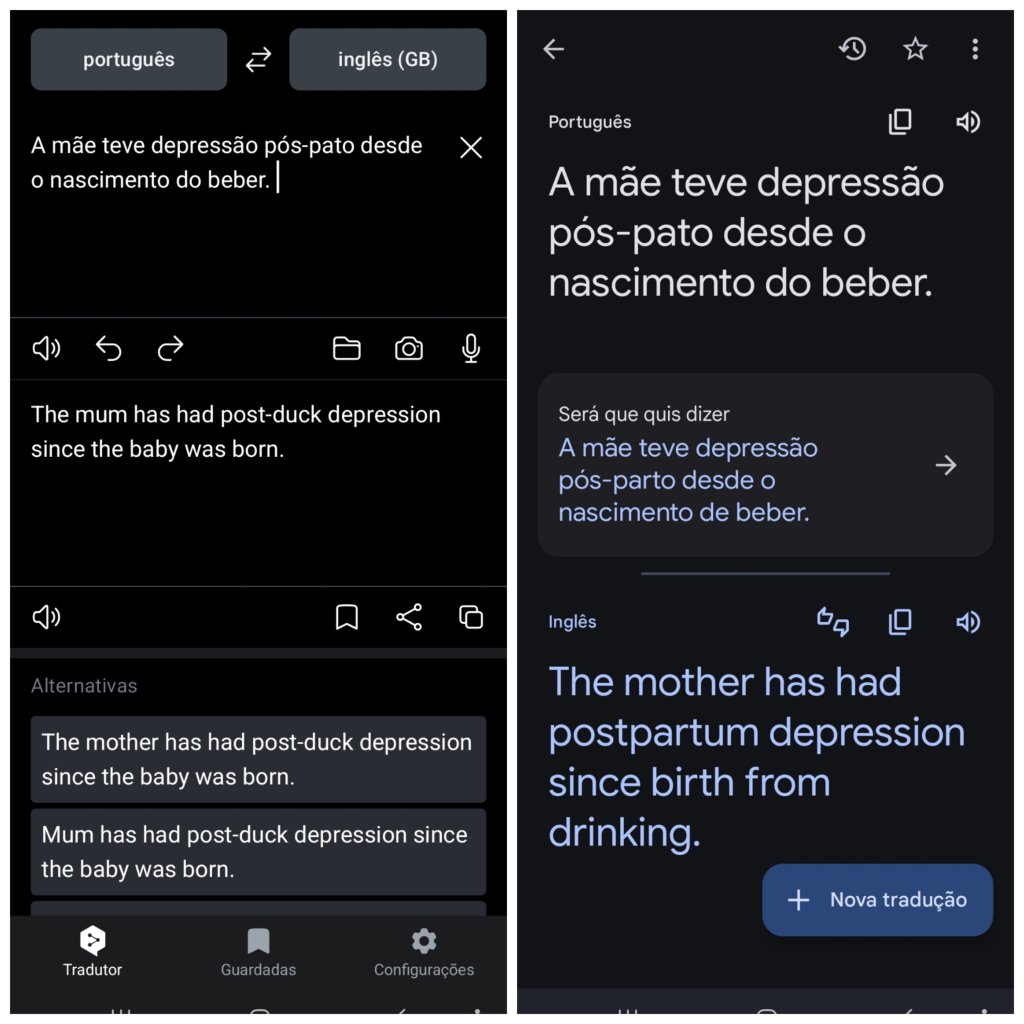
“A mãe teve depressão pós-pato desde o nascimento do beber.”
Postpartum depression is missing an r and bebé has gained one.
Deepl helpfully produces surreal results on the first mistake but annoyingly airbrushes out the second. Gtranslate unhelpfully takes the first error in its stride but does a better job of highlighting the second. It also provides a suggested correction in which it suggests a spelling change, so between its two parts of its reply it has correctly flagged both errors.
Result: Gtranslate wins another round.
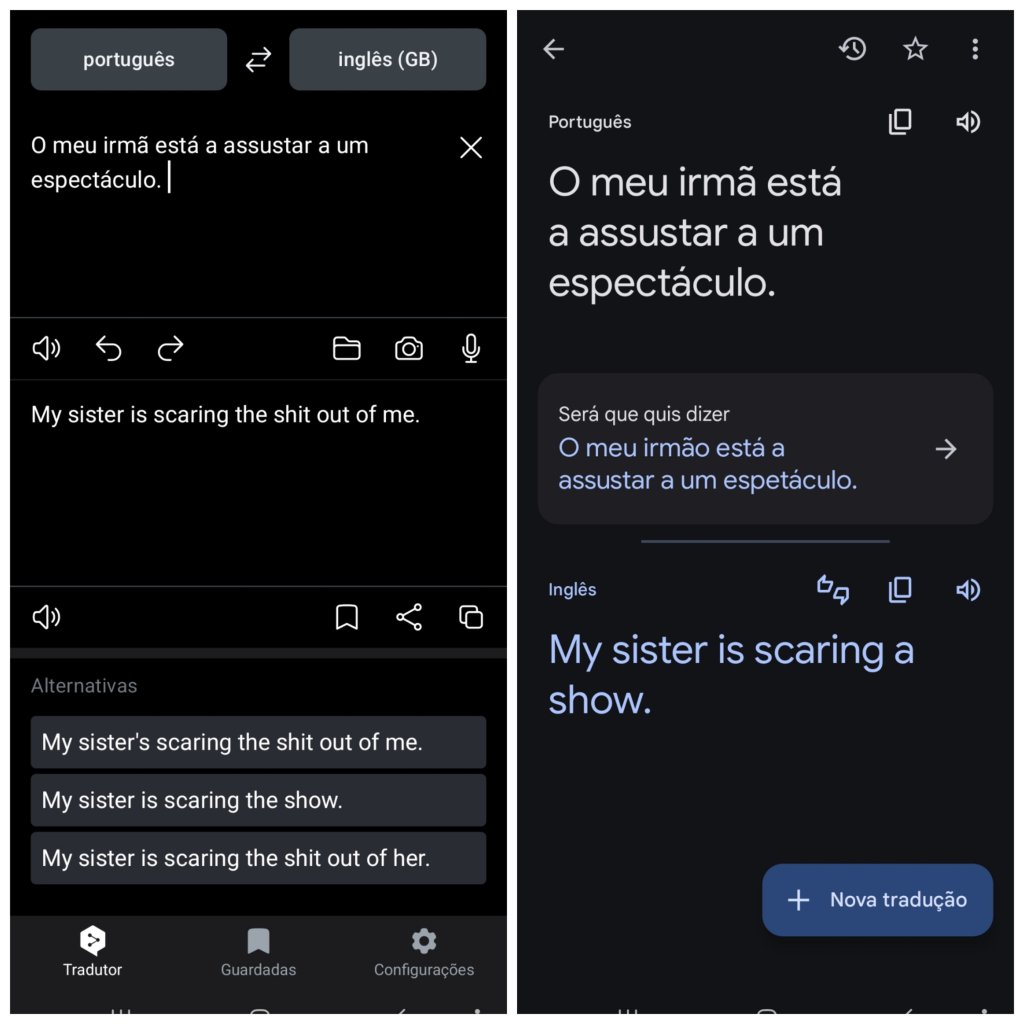
“O meu irmã está a assustar a um espectáculo”
Irmã is feminine and the “o meu” should match. The verb should be assistir, not assustar
Deepl is reliving childhood trauma. Well, that’s fine, at least it acknowledges something is wrong. Gtranslate keeps a level head, correctly mistranslates the word that is incorrect. It also offers a suggestion to harmonise the gender of irmã.
Result: Gtranslate is a clear winner since it gives a far more precise indication of what’s wrong without peeing in its pants.
Conclusion
As I said at the beginning, Deepl remains the best for English-Portuguese translation, but as the results show, in most cases, Gtranslate is better for reverse-translation in situations where you want to check your own written portuguese.
I was surprised by the results. I was expecting Deepl to be more accomplished at working around errors. It was far more hit and miss than that, but it’s undeniable in most cases that what Gtranslate offers is much more useful than what Deepl offers. You’re much more likely to be able to fix your errors that way.
Remember, this isn’t going to be enough on its own. My process is usually:
Read the text and correct obvious errors.
Paste into Gtranslate, correct what it mistranslates.
Paste into FLiP to check for syntactical errors. FLiP has its blind spots and will occasionally flag a valid word, but by and large it’s helpful.
Show to a teacher and/or post it here and wait for someone to tell me i have 38 more errors to fix.
Found on someone’s Pinterest. No idea who owns it. Too good not to use.
I’ve been repeating a lot of silly errors lately, often just typos that don’t get caught by my usual method: pasting my Portuguese texts into Google Translate to see if it can correctly translate them back into English. Google Translate is quite forgiving of “gralhas” (typos) so if you wrote “ni” instead of “no” because you are a medieval Knight and that’s your favourite word and autocorrect has changed it for you, Google Translate will probably correctly guess what you meant, and the error will slip through.
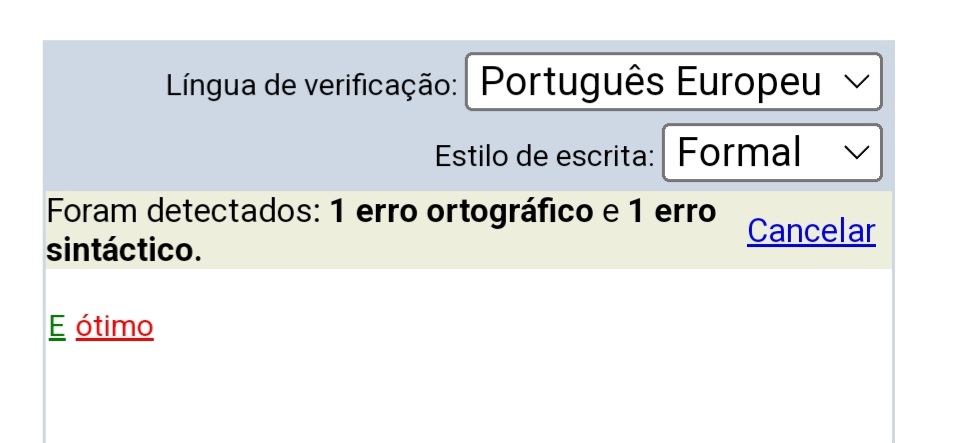
One of the correctors on the subreddit suggested I incorporate FLiP into my routine. It’s a spelling and syntax validator. I’ve had a play and concluded it definitely has its uses. It has a pretty big gotcha though. In fact, I thought it was wrong about a couple of AO spellings. It prompted me to change the spelling of Ótimo to the older Óptimo, for example. Well, I like the old version so I’m not too bothered, but it’s the wrong advice.
When it did the same with the word “corre(c)ção” I really started giving it side-eye. Considering corre(c)ções are its raison d’etre, that would be a pretty big error. It turned out there was a good reason though. Can you spot my mistake?
Yeah, it defaults to the old spellings and i hadn’t noticed there was a box to tick right there at the top that makes it use the newer ones. So make sure you remember that!
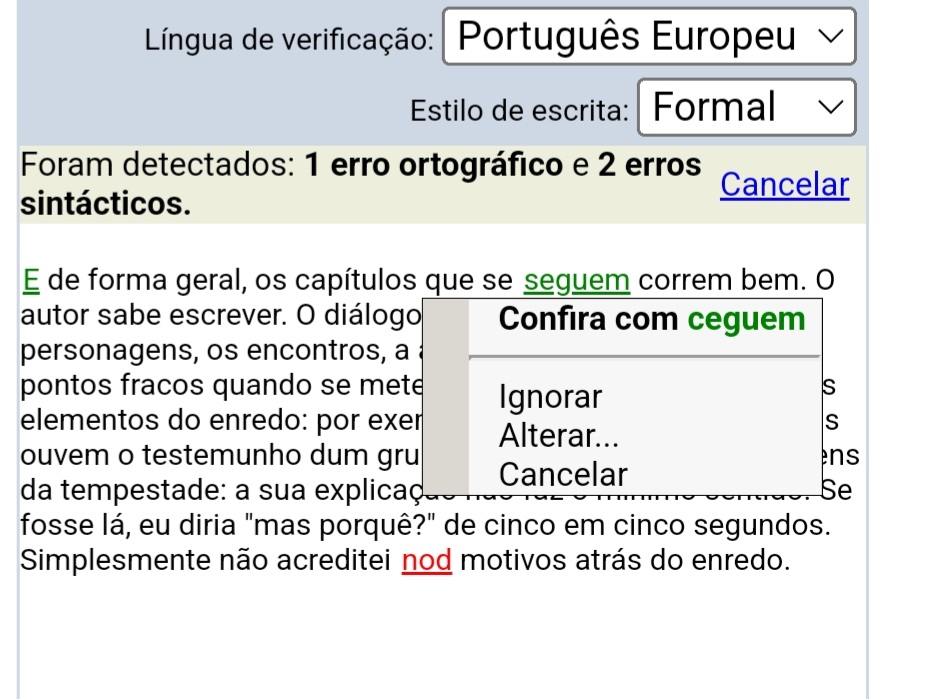
Like any computer program, it’s not immune to errors though. Today’s text includes the phrase “os capítulos que se seguem” (“the following chapters”). Computer said no, advising me to say “the chapters that blind themselves” instead.
Still though, like most online tools, it has its uses. It’s probably best to treat it like a GPS navigation system: follow its directions most of the time but not when it’s telling you to drive off a pier into the sea to get to Calais.
One of my pet theories is that every tech company has a guy somewhere in the organisation whose job title is “visionary architect of making everything slightly worse”. He (and I’m sorry to be one of those dudes who disses other dudes to ingratiate himself to his female readers, but yes, I’m sure he’s a he) is the one behind all those little changes to apps that make them look sleeker but leave the user frustrated and annoyed because they are harder to use. Anyway, the guy who holds that role at google translate has obviously been busy because its latest incarnation is hugely irritating. Well done, mate.
It remains quite useful though. I’ve just written a text about street food and I mentioned a disposable glove. As usual, when I finished, I pasted it into gtranslate to see what it thought I’d said. It translated it as “available glove” because I’d used a false friend: Disponível. The word is obviously related to disposable but it means available. It’s easy to see the link. If you’ve ever heard anyone say “I’m at your disposal”, the person wasn’t asking to be thrown in the bin, they were saying they were available to help. So the meanings must have drifted apart relatively recently but it’s worth knowing the difference.
What should I gave said? Descartável. That’s easy too. You can discard them.






 Luso
Luso 