This post is about unpacking an interesting short video from Portuguese Dips a couple of years ago in November 2021. It’s part of a series about Portuguese idioms. On day 4 he talks about “Fazer Trinta Por Uma Linha“. He’s very good at these capsule summaries, and he definitely gives you all you need to start using it; basically it means they’re a handful.
But I was curious about the origin of the expression as well as how to use it. Well, as Westley says in The Princess Bride, “Get used to disappointment” because nobody seems to know. Andreia Vale, in “Puxar a Brasa à Nossa Sardinha” says there’s no origin known but tries to infer it. She points to thirty being number commonly used to denote human accomplishments, but the only examples she gives are “estar com 30 sentidos” which, ok, is fairly relevant, and the thirty pieces of silver paid to Judas… which I would say is not a good example of human accomplishment, on the whole. “Por uma linha” is like “a fio” or “a eito” (which came up in yesterday’s lyrics), being like “on the trot” or “in a row”. So they’re doing thirty things, one after another, resulting in total confusion.
In the same video he refers to “a canalha” which can either mean a gang of villains or a group of children. Hmmmm… Then there are words for naughtiness and general mischeif: irrequieto, traquino and asneira and finally he uses another expression “Têm de ter um olho nelas” which is obviously like the english expression: they have to keep an eye on them.
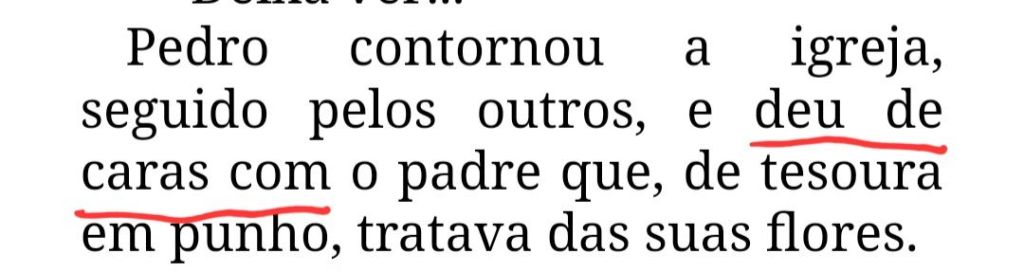
As usual, I’m reading 12 books at once and consequently not getting through any of them very quickly but here’s another nice expression I found today in a book I’ve been reading for a disgracefully long time.
The meaning is pretty obvious from the context. “Dar de caras com…” means to run into someone unexpectedly. It’s similar to “come face to face with” in English but seems to be slanted in the direction of an unexpected encounter rather than being any situation where you’re confronting someone.
While researching, I came across a couple of other dar/cara pairings with slightly different meanings so I’ll get those down in the same blog post just to keep my thoughts organised.
Dar a cara means to take responsibility. I guess the nearest English equivalent would be “face up to”. Linguee gives a few examples, so here’s one. “A União Europeia precisa de dar a cara aos seus desafios”.
Dar com a cara na porta is like “bater com o nariz na porta”. The idea is that you’ve gone to a shop and found it’s closed so instead of the door opening for you, you smack into the glass, face first. I think more figuratively it can describe any other situation where you ask for something and find that there’s no chance whatsoever.
I’ve tried to take these examples from European portuguese. I found a few examples of some of these being used in slightly different ways by Brazilians but let’s keep it simple eh?
Phrase spotted in the wild. “Já não diz coisa com coisa”. Dizer (or falar) coisa com coisa is almost always used in the negative sense. It means you’re talking in a disconnected way, or just generally not making sense.
Not to be confused with “não estar com coisas” which means you don’t hang about, you act promptly.
I spotted this phrase in a book I’m reading, referring to “uma comissão de oficiais técnicos”. The speaker starts his rant by exclaiming “Baboseiras!” which I took as being related to “babar” (to drool) which it is, and so he obviously doesn’t have a high opinion of these people. OK, so I’m not expecting anything good, but what does it actually mean?
Mangas-de-alpaca were sleeves worn by clerks on their lower arms to protect their clothes from getting scratched and ink-stained during service. By extension, the term can be used pejoratively to describe a bureaucrat or a pen-pusher in general.
Whether or not you use hyphens is usually important and the AO tends to be quite prescriptive. I’ve used hyphens here because that’s how Priberam spells it but neither Wikipedia or the book use hyphens, so I’m not really sure who’s correct!
New favourite expression just dropped. I was talking about a song from the eighties called “There’s No-one Quite Like Grandma”. If you’ve never heard of it, rush to listen, because it kept “Stop the Cavalry” by Jonah Lewie off the top slot in 1980, and you’re probably hearing that a lot in the run-up to Christmas, so you’ll want to know what you’re missing. Anyway, the expression, used to describe the soloist was “sopinha-de-massa” – Noodle soup. It just means someone who lisps and can’t pronounce their etheth… I mean their esses properly. As about 80% of all british comedians have pointed out, Lisp has always been a terrible word since people who have one can’t even say it. How much harder is it to say “Thopinha-de-matha?
If you’re curious, the more proper term for a lisp, used by speech therapists (this lady, for example), is “Sigmatismo” which isn’t much better!
The guy is talking about places in the world that are used as placeholders for “a long way away” like Timbuktu or Outer Mongolia in english.
I know the phrase No cu de Judas* exists, which is equivalent to phrases like “the back of beyond” or “the arse end of nowhere”, but it’s a little unsatisfying because – well, firstly because he is talking about real places in the world that are thought of as far away, but it’s worse than that because he mixes up the idea of… well, tell you what, rather than blather on, here’s how I asked about it on Reddit, and I’ll tell you the answers afterwards. I had a bad case of morning head when I wrote it so the grammar is probably not great:
Vi um vídeo no YouTube sobre “Timbuktu”. Em inglês, se quisermos falar de algures que fica longe, falamos de ‘timbuktu’ (no Mali) ou de ‘Outer Mongolia’ (ou seja Mongólia), ambos dos quais ficam longe de nós e funcionam como marcadores de ser longe da civilização. Segundo o narrador, cada país tem a sua própria noção de onde fica este sítio remoto.
É confuso porque o narrador mistura duas ideias: (1) Longe de aqui, e. (2) Num sítio remoto, onde é difícil chegar de qualquer ponto de partida.
Eu sei que existe a expressão “no Cu de Judas”, que significa mais ou menos “num lugar distante” mas não sei se isso é o único exemplo.
Bonus question: além disso, sei que existe um lugar verdadeiro nos Açores chamado “Cu de Judas”. Mas qual existia primeiro? O lugar foi nomeado por causa da expressão ou o lugar já existia e a gente começou a dizer “o meu primo está sei lá onde, talvez no Cu de Judas” e a expressão desenvolveu daí?
I got a few answers, and u/Butt_Roidholds gave me a really good list, and I’ve added a few from other people. Obviously quite a lot of these are even ruder than “No Cu de Judas” so don’t go blurting them out in front of your maiden aunt. Italics = additions or notes that weren’t part of the main list)
na Cochinchina; (This is the only one that refers to a real place, I think: Cochin China = the southern part of Vietnam, so I think it’s probably the only legit answer to the question the guy is posing in the video.)
onde o diabo perdeu as botas; (I also heard “onde Judas perdeu as botas”)
onde o vento faz a curva;
para lá do sol-posto;
nos cornos da lua;
nos quintos do caralho (ou simplesmente nos quintos);
no fim do mundo;
nos confins da terra (ou simplesmente nos confins);
nos andurriais (normalmente alude a sítios ermos ou caminhos inviáveis);
em cascos de rolha (normalmente alude a sítio rural);
Parvónia (normalmente alude a sítio rural);
em Santa Cona dos Assobios; (if you’re not sure what that means, I’ll tell you: it means “In Saint Cunt of the Whistles”. I mean… that’s quite an expression!)
onde os grelos batatam;
No caralho mais velho;
Na casa do caralho;
Onde Cristo não passou.
*”In Judas’s arse”. There’s a book called this by António Lobo Antunes but I’ve never read it. Ines Rebelo tortures her boyfriend on camera by asking him to try and guess the meanings of a few portuguese phrases, including this one… he’s (ahem) pretty wide of the mark (at around 11:45)
Well, this is a bit worrying. I’ve just written a blog post about the expression “Conhecer de Ginjeira”. When I went to tag it, my WordPress site seemed to recognise the expression, so I looked it up and found I’d already written the same explanation just a few months ago, in July. I often feel like my memory is declining in my late middle age, which is a cause for concern in a lot of ways, and definitely makes learning a language an uphill struggle. But to have researched and written a blog post just 15 weeks ago and to have zero recollection of having done so… Oh lord, my braincells are an endangered species. Anyway, for what it’s worth, here’s the November version of July’s article.
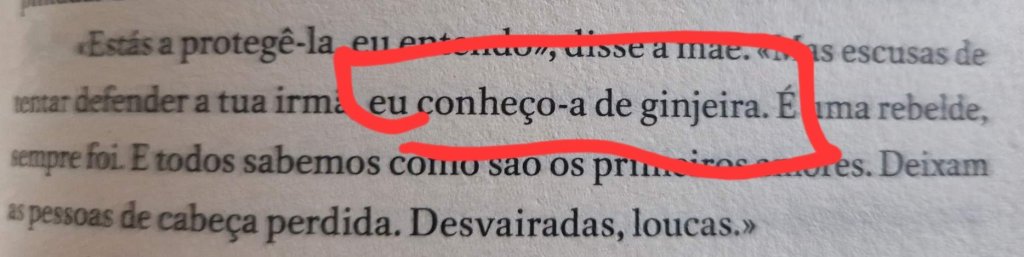
I came across an expression I didn’t recognise today: Conhecer de ginjeira.
It seems like not very much is known about the origins. An answer on the always-reliable Ciberduvidas says that it’s usually mildly negative, maybe implying you know their tricks and won’t be taken in by the. It goes on to suggest it is probably a rural expression meaning you’ve known them since you were young enough to pick ginjas (sour cherries) together. Like a lot of -eira words – pereira, maceira, nogueira, bananeira – a ginjeira is the tree on which the fruit grows.
The origin doesn’t quite fit this case because the speaker is the mother of the person under discussion, but that’s fine, expressions often take on a life of their own.
I just came across a baffling expression in an exercise “Dando uma no cravo, outra na ferradura”. It didnt help that I assumed cravo had its ordinary meaning: carnation. But the word actually refer to a kind of nail. So… What’s it all about? Giving it one on the nail and one on the horseshoe is meant to invoke a blacksmith or farrier hitting the nail with one stroke and then missing and instead hammering on the horseshoe with the next.
Figuratively, it means someone who’s vacillating, hedging their bets, making an argument but also waffling and saying the opposite. Here’s the Wikipedia entry if you’re interested.






 Luso
Luso 