Posted in English

The Dar Is Rising

Alguns exemplos do cadernos de exercícios surpreenderam-me. Vamos dar uma espreitadela…

  • “Dar por bem-empregado” – confused me because bem-empregado can be one of those expressions like bem-feito, where it’s used to mean the person got what they deserved, but most of the translations in linguee are more straightforward but it makes sense that they think their money was well-spent.
  • “Dar de si” – Usually means “give of oneself” ie, to be generous, but Priberam gives the more figurative “a bar, ceder, desmoronar”
  • “Não se lhe dar” Um… Tricky one. There are almost no examples of this in linguee and Priberam doesn’t have it. The ever useful Guia Prático de Verbos com Preposições has dar-se a meaning to care about or make use of so não se lhe dar (where lhe is an indirect object, só it’s like “a ele”) could mean he wasn’t interested in. The fact that this example is negative, where e the Guia’s example is positive needn’t necessarily matter but but doesn’t seem super clear to me.
  • “Dar a saber” straightforward – to make someone know something. Inform them, in other words.
  • “Dar certo” Easy – to turn out right
  • “Dar para trás” Easy – to go backwards*
  • “Dar as caras” I’d never heard of this one (as far as I remember). Mostly it gets translated as”show your face” ie, turn up, but there’s a dúvida linguística on FLiP that has it meaning something more like “come face to face with”. In both cases, you’re meeting someone, so it isn’t so different, but bear in mind it can have slightly different meanings. In the flip example, if you translated it as “turned up with a lion”, well, that would be a power move in any business meeting where you wanted to intimate the person into lowering the price, but that’s not really what it means.
  • “Não se dar por achado” Another new one, and I don’t see it being used much but yeah, it means pretend not to hear something, or to pretend to be busy with something else so that you don’t notice the person.

Oh shit, I meant to write all this on Portuguese. Meh, never mind, it made me think about the expressions so with a bit of luck il remember them now.

*… Is what it means in some contexts anyway, and I’m sure it’s what it meant in the example I did, although I am informed that it can also means “knock someone back” ie, gently turn down their romantic advances!

Posted in Portuguese

Matemática no ensino secundário vai mudar em setembro de 2024 – ECO

Coloquei esta ligação na pasta de rascunhos em 2022 mas olhe, cá estamos em Setembro de 2024* – mês a qual a atualidade se refere. Se não me esforçar por escrever alguma coisa, o blogue atrasar-se-á ainda mais e eu farei figura de urso.

Segundo uma notícia do site Sapo, a proposta entraria em vigor em Setembro de 2024 (e entrou mesmo? Confesso que não sei). Anteriormente, havia quatro cursos de matemática, um por cada uma das disciplinas académicas: artes, ciências, humanidades e cursos profissionais, mas muitos estudantes odeiam a matemática, ou pelo menos fazem pouco dela. Quando a aula começa, fazem biquinho e até fazem frente ao assunto. Uma experiência negativa neste assunto, acima de tudo é capaz de lhes fazer a vida negra.

As propostas têm como objetivo uma melhor taxa de sucesso neste assunto e também mais foco em áreas práticas da vida tal como salários, descontos e estatísticas. Ou seja, os aspectos mais fáceis. Não sei se fizeram escola (prometo que este trocadilho não é de propósito!) mas acho que há perigo de perder algo nos níveis mais altos da competência matemática, ou seja que os mais capazes perderão o desafio que eles precisam para serem excelentes no seu campo. Talvez os membros façam vista grossa aos defeitos do plano, mas por outro lado, talvez esteja tudo tranquilo agora e os defeitos tenham ficado resolvidos. Ou pelo terceiro lado, talvez não acabassem por ser aceites e o plano inteiro foi por água abaixo.

Estou a fazer uma tempestade num copo de água? (faço figas)

* The last 3 hours!!!

Posted in Portuguese

Escreva uma História Sobre o Seu Bairro

…using expressions using the verb “dar” (I have added a few that weren’t in the book)

No ano passado, eu e alguns vizinhos estabelecemos uma associação de moradores no nosso prédio. Principalmente queríamos dar andamento às reparações que andavam atrasadas. Uma mulher que mora no terceiro andar recentemente deu à luz um par de gémeos mas teve de descer as escadas porque o elevador tinha dado o berro. E uma mulher com doença mental mora num apartamento onde entra a chuva pelo teto, e havia montes de problemas menos graves mas ainda chatos. A empresa responsável não dá troco nos nossos: promete sempre acertar estas coisas mas não dá conta do recado

Queríamos dar a mão aos vizinhos mais vulneráveis e, em geral,  não aceitar este serviço pouco satisfatório.

Infelizmente, acho que tivemos de dar o braço a torcer: além do trabalho em si dar água pela barba, há quem ache que estamos a dar graxa aos funcionários da empresa em vez de gritar com eles. Mas prefiro tratar os outros com respeito por mais chato que sejam!

Também há quem só queira dar com a língua nos dentes. Uma senhora que odeia o seu vizinho,  que fuma um cachimbo de água na sala de estar dele. Vejo bem quão nojento é este comportamento, mas não está connosco: e demos-lhe para trás. Não estamos aqui para arbitrar entre os vizinhos. Aconselhámo-la a falar com ele, ou fazer uma queixa oficial, mas realmente, para mim, quero mandá-la dar uma volta ao bilhar grande. Espero que os dois dêem a mão à palmatória, mas parece-me pouco provável que dê certo, porque ela dá ares de Hyacinth Bucket e ele não dá ouvidos a ninguém. 

Sou introvertido, mas o meu papel de secretário coloca-me no centro das atenções e muitas vezes não dou uma para a caixa.

Posted in English

Interesting Things I Found in “A Noite” by José Saramago.

“O isco, o anzol e a chumbada”: I think I’ve seen this before but it jumped out at me because we have a bit of intra-family rivalry over the Connections game in the New York Times and on the day I read this, there had been a trap involving the words “hook”, “line” and “sinker”, which is what this means of course

Let the dust settle. Easy.

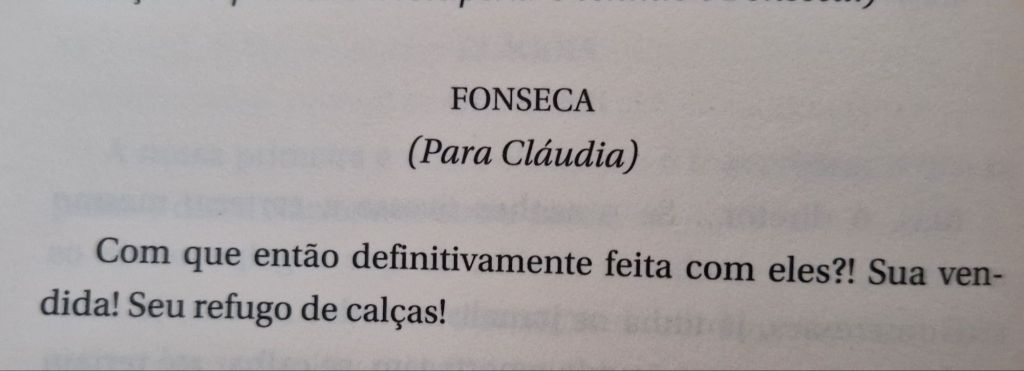
I had to ask around about this one*. The speaker, Fonseca, is siding with management and Claudia is much more supportive of the coup that is in progress as they’re talking. He obviously blames her (rather unjustly, as far as I can tell) for what is going on, but one way or the other, they are definitely forming into rival camps, according to whether or not they’d support the revolution, so there’s a lot of class animosity behind the words, which is why he’s being such a twat.

He calls her “Sua vendida” (you traitor, you person who has sold herself) and then, slightly confusingly, “Seu refugo de calças”. You what now? You pile of leftover, defective trousers? I asked reddit what was going on. He’s calling her a refugo, and she’s wearing trousers, so he’s more or less saying “your a junk heap on legs” or “you’re a walking pile of garbage” or words to that effect.

As soon as I was told that, I asked myself whether there was a bit of machismo entering into the equation. The play takes place in the seventies, and I wondered if, by referring to her stereotypically male clothes, he was implying some sort of lack of femininity, ugliness, dowdiness, lesbianism, or something like that. I dunno. I suggested it and people didn’t seem convinced, but maybe they’re young and don’t know what people were actually like in the seventies. I do, and I can 100% imagine that. I don’t know, Portugal isn’t Britain, but I’m not ruling it out.

Anyway, don’t worry about her, the revolution wins in the end. Whoops! Spoilers!

*UPDATE

In a shocking turn of events, it turns out that the assembled wise owls of Reddit might have misled me about “refugo de calças”. I probabky should have guessed. The suggestion above is a bit modern-sounding. It’s a remendo – a patch – on some trousers that would otherwise have fine in the bin because they’re worn out in the crotch. So by implication, it’s the lowest if the low. This definitely sounds more in keeping with the general tone. Thanks to Cristina for pointing this out.

Posted in English

What the hell is this?

Esta gente nova não tem ponta por onde se lhe pegue! Francamente!

This sentence flummoxed me for two reasons. Firstly because the overall gist didn’t seem to make any sense and secondly the grammar was baffling. I had to ask an expert to explain some it to me.

It’s from Uma Aventura nas Férias da Pascoa, and the lady who’s speaking is exasperated that some kids are making a lot of noise outside her door. The “Francamente!” is there to underscore her disapproval.

Let’s do the grammar first.

So firstly, obviously, we have the usual anglophone confusion of “gente” meaning people but it’s a singular word because of course it is. That’s pretty basic though, so didn’t throw me too badly.

“Pegue” is subjunctive present. Why? Good question. It seems to be a statement about the general qualities of something, nested in a dependent clause, but it doesn’t fit neatly into my subjunctive flowchart, even though it’s recognisably the same kind of sentence structure as sentences that do. I think that’s because “por onde” (“at where”) is doing the job that would normally be done by “que”. [Caveat – I’m pretty sure I’m right about this but didn’t specifically ask so I might be misunderstanding why they’ve used this tense]

And finally, the pronouns, se and lhe right after each other. Lhe means “them” but it is singular because – again – it’s referring to gente, and se is present as an indefinite pronoun*, which is a hard concept to grasp in English. I’ve had a stab at it in this post, but I’m sure it wouldn’t hold up to much scrutiny from an expert.

So if you were to translate it word-for-word in the most literal way possible, the whole sentence is something like “These young people don’t have a place at which one might get hold of them”. Well, that could refer to something that’s so dirty that we’re afraid to touch it for fear of getting our hands dirty, but here it’s referring to people so it must be some sort of expression, right?

The expression “não ter ponta por onde se lhe pegue”,  or “estar sem ponta por onde se pegue” or variations of either, seem to be translated as “to be utter nonsense” on bab.la, and I can see it used in roughly the same way in a few places around the interwebs.

What would be an equivalent expression in English? Since it’s talking about getting a hold of something, I guess something like “I can’t get a handle on it” would be pretty close. It’s not an exact equivalent though, since if you “can’t get a handle on” something in English, you’re leaving open the possibility that you just aren’t clever enough to understand, whereas this is more in the direction of “it can’t be understood, because it doesn’t make any sense”.

More than anything else, what impressed me is that it has been ages since I have come across a sentence that has caused me this much puzzlement, and yet this is a book written for children!

Well done, you’ve made it this far. Reward yourself with this music video.

*I has a query about this so here’s a bit of self-justification! First of all, I wrote “impersonal” in the first draft of this which isn’t quite the right word so I’m sorry I got that wrong. “One” is an indefinite pronoun and in very correct, posh english you use it… ahem… or rather “one uses it” as a neutral pronoun when one wants to use a verb in a very general way, without having anyone specific in mind. I think that’s the closest analogue of what “se” is doing here. Priberam defines it as a “pronome indefinido” (4th and 5th definitions here) and this page gives more detail although confusingly refers to it as a partícula (particle) which I think is incorrect. Or at least in english a pronoun isn’t a particle, but maybe portuguese grammarians have a slightly different taxonomy…?

Posted in Portuguese

Expressions of Expiration

Após ter escrito um blogue sobre expressões para descrever a morte em inglês, decidi voltar ao assunto com um resumo das expressões equivalentes em português. Roubei-as todas de um podcast mas vou parafrasear as definições para fazer um treino mental! A maioria são eufemismos, mas também existe a palavra “disfemismo” que é o oposto, e provavelmente existe em inglês mas nunca se usa, portanto é quase desconhecida, mas quer dizer uma expressão propositadamente irónica ou crua para distrair da realidade da morte quando perdemos alguém.

On of my subscribers reading today’s blog

Então, vamos a isto!

A hora dela tinha chegado – temos esta expressão em inglês também. Significa que a hora da morte da pessoa já chegou

Estar com os pés para a cova – estar quase a morrer

Abotoar o paletó – uma expressão brasileira. Um paletó é uma espécie de casaco largo com bolsos que se usa por cima de outra roupa. Podemos imaginar um cadaver vestido de “fato domingueiro.***

Dormir o sono eterno – esta não precisa de mais explicação, acho eu

Morar para a companhia dos pés juntos – uma expressão militar: uma companhia é um grupo de soldados

Bater as botas – Ainda que já conhecesse esta expressão, eu não sabia que tinha raízes na vida militar: bater as botas é o ato de bater com os calcanhares quando um soldado sai da presença de um superior.

Bater a caçoleta – provavelmente é oriundo da mesma fonte: uma caçoleta é uma arma de fogo.

A última morada – o cemitério, obviamente!

Estar nas Malvas e Jardim das Tabuletas – também se referem ao cemitério. O primeiro enfatiza a presença de uma flor chamada malva (o que nós ingleses chamamos “mallow“) enquanto a segunda faz referência às peças de madeira ou de pedra (lápides), entalhadas com os nomes dos falecidos.

Entregar a alma ao Criador – Uma expressão religiosa, clara

O catolicismo também nos deu Ir desta para melhor e Ir para a terra da verdade* – ambas razoavelmente compreensíveis sem explicação

Esticar o pernil – Este disfemismo faz referência à matança de um porco(!) que, na hora da sua morte, dá um coice reflexivo.

Dar o peido-mestre – é uma versão disfemístico do mais certo “Dar o último suspiro” o que será familiar entre os leitores anglófonos!

Fazer Tijolo(s) – o autor do texto deixou o melhor para o fim: após o grande terramoto de lisboa, os portugueses daquela época precisaram de barro para fazer tijolos. Incluído nesta busca de materiais foi um campo de terra argilosa onde os colonialistas** muçulmanos enterraram os seus mortos antes da reconquista. Os ossos deles (que naquela altura tinham à volta de quinhentos anos!) fizeram parte dos tijolos, e a expressão faz referência a essa profanação.

* This one came up in a previous blog post when I was trying to learn poems by heart. I was studying Rustica by Florbela Espanca and I was confused by her direction of travel. The line was Quando descer à “terra da verdade”… and I mused “I’m not sure what the land of truth means here(…). If it’s heaven, why is she descending and not ascending? I’ve read the bible and spent a lot of time in church but this makes no sense to me I’m afraid.”

**I originally wrote “colonistas” but note that this word doesn’t seem to mean the same as colonist in English. It’s a near synonym of colonialista. I changed it to the more common version, although I think colonizador is probably the word I should have used…?

***Not in the original text, but priberam also has “vestir o paletó de madeira” which is probably what I should have used in place of my earlier blog title “sobretudos de madeira” and might be an explanation of “abotoar o paletó” as well, instead of the one I’ve given in the text (which I found online somewhere…)

If you’d like to know more about this, the original podcast episode is here

Thanks to Cristina of Say It In Portuguese for correcting this text.

Posted in English

Only a Gingeira Can Call Another Ginjeira Ginjeira

Well, this is a bit worrying. I’ve just written a blog post about the expression “Conhecer de Ginjeira”. When I went to tag it, my WordPress site seemed to recognise the expression, so I looked it up and found I’d already written the same explanation just a few months ago, in July. I often feel like my memory is declining in my late middle age, which is a cause for concern in a lot of ways, and definitely makes learning a language an uphill struggle. But to have researched and written a blog post just 15 weeks ago and to have zero recollection of having done so… Oh lord, my braincells are an endangered species. Anyway, for what it’s worth, here’s the November version of July’s article.

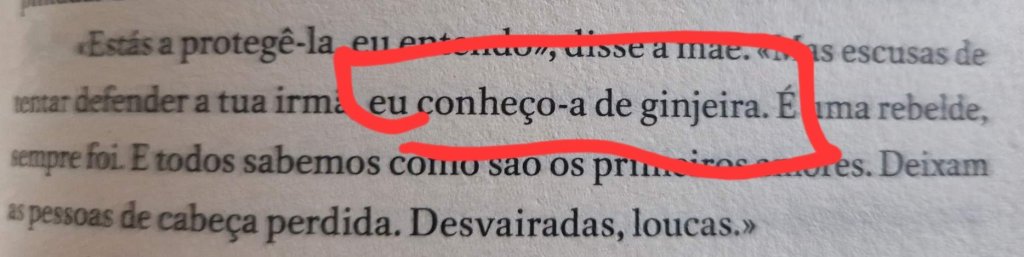
I came across an expression I didn’t recognise today: Conhecer de ginjeira.

It seems like not very much is known about the origins. An answer on the always-reliable Ciberduvidas says that it’s usually mildly negative, maybe implying you know their tricks and won’t be taken in by the. It goes on to suggest it is probably a rural expression meaning you’ve known them since you were young enough to pick ginjas (sour cherries) together. Like a lot of -eira words – pereira, maceira, nogueira, bananeira – a ginjeira is the tree on which the fruit grows.

The origin doesn’t quite fit this case because the speaker is the mother of the person under discussion, but that’s fine, expressions often take on a life of their own.

Posted in English

Quem Sai Aos Seus Não Degenera

I came across this fairly baffling sentence in an exercise. What on earth can it mean? Googled it to see if I could find anyone using it and apparently, yes, it’s an expression, the gist of which is that, if you follow your parents’ guidance you won’t go far wrong in life. There’s an example here, referring to sporty kids following in the footsteps of their sporty parents.

Posted in English

Doppelganger

I was intrigued by this dialogue in the audiobook I’m listening to, “Filho de Mil Homens” It’s a boy asking about his dad.

O António perguntava “E era parecido comigo?”

Ela dizia “Cara de um, focinho do outro”. Riam-se, puxava-lhe pelo nariz, beijava-o na testa”

Cara de um, focinho do outro: Face of one, snout of the other?

What’s going on? I thought at first that the second person was saying “you have the face of one parent and the nose of the other” , but that didnt seem right, and sure enough, after some thought, I realised they were saying “You’re exactly like your dad”. The cara (face) of the dad is like the focinho (literally an animal snout, but colloquially, a face) of the child.

I like this expression, it’s really cute!

There’s a similar expression someone told me about while I was asking about this: “Cuspido e escarrado” – literally “spat and spat”. Wait, the portuguese have two words for spitting? Apparently, yes, but we have expectorate, gob, hawk and flob, so that’s no surprise.

But why? Why, if you were trying to come up with an expression meaning “exactly the same as someone”, would you bring gobbing into the equation?

In many ways, it’s like the English expression “Spitting Image”, or “Spit and Image”, which are corruptions of “Spirit and image”. Cuspido e escarrado doesn’t imply that saliva makes you resemble another person, it’s a corruption of “esculpido em carrara” – Sculpted in Marble.