Posted in English

Podding Along

I’ve mentioned the podcast Say It In Portuguese a few times, mainly because its creator, Cristina, coached me through C1 and C2, but also before that, because it’s just a very good podcast for more advanced learners who want to explore the huge range of expressions in Portuguese.

Anyway, I wrote a blog post recently about the expression “Cuspido e Escarrado” and joked that I was copying the style of the podcast, and… Long story short, it ended up being an episode! I adapted it for the format, and put a sound effect in place of the gif, and it sounds OK, though I say so myself. It’s here if you want to listen:

Say it in Portuguese: Cuspido e Escarrado

By the way, full disclosure, when I was looking around for the blog post that became the podcast, I found an older post where I’d mentioned the phrase earlier. It was only as a sidebar to a post discussing a different expression, “Cara de um, focinho do outro“. I’d completely forgotten about this. Having a terrible memory makes it hard to learn languages but it does have the advantage that I can be surprised by a new and interesting fact even after having written a blog post about it!

Anyway, in the earlier blog, I’d given a slightly different explanation: that it comes from. “esculpido em carrara” but the sources I looked at this time around described that origin as “less likely” which is why I didn’t mention it in the later one.

In truth, these sorts of etymological explanations are a lot of fun to speculate about but often they are just attempts by modern speakers to explain the inexplicable. Sometimes expressions are just weird and they don’t make sense, so it’s best to treat the explanations with caution!

Anyway, now that I’ve recorded a podcast about it, hopefully I’ll remember it this time, but don’t be surprised if I write another blog about the same expression next year and seem just as amazed by it then as I was last week!

Posted in Portuguese

Matemática no ensino secundário vai mudar em setembro de 2024 – ECO

Coloquei esta ligação na pasta de rascunhos em 2022 mas olhe, cá estamos em Setembro de 2024* – mês a qual a atualidade se refere. Se não me esforçar por escrever alguma coisa, o blogue atrasar-se-á ainda mais e eu farei figura de urso.

Segundo uma notícia do site Sapo, a proposta entraria em vigor em Setembro de 2024 (e entrou mesmo? Confesso que não sei). Anteriormente, havia quatro cursos de matemática, um por cada uma das disciplinas académicas: artes, ciências, humanidades e cursos profissionais, mas muitos estudantes odeiam a matemática, ou pelo menos fazem pouco dela. Quando a aula começa, fazem biquinho e até fazem frente ao assunto. Uma experiência negativa neste assunto, acima de tudo é capaz de lhes fazer a vida negra.

As propostas têm como objetivo uma melhor taxa de sucesso neste assunto e também mais foco em áreas práticas da vida tal como salários, descontos e estatísticas. Ou seja, os aspectos mais fáceis. Não sei se fizeram escola (prometo que este trocadilho não é de propósito!) mas acho que há perigo de perder algo nos níveis mais altos da competência matemática, ou seja que os mais capazes perderão o desafio que eles precisam para serem excelentes no seu campo. Talvez os membros façam vista grossa aos defeitos do plano, mas por outro lado, talvez esteja tudo tranquilo agora e os defeitos tenham ficado resolvidos. Ou pelo terceiro lado, talvez não acabassem por ser aceites e o plano inteiro foi por água abaixo.

Estou a fazer uma tempestade num copo de água? (faço figas)

* The last 3 hours!!!

Posted in English

Interesting Things I Found in “A Noite” by José Saramago.

“O isco, o anzol e a chumbada”: I think I’ve seen this before but it jumped out at me because we have a bit of intra-family rivalry over the Connections game in the New York Times and on the day I read this, there had been a trap involving the words “hook”, “line” and “sinker”, which is what this means of course

Let the dust settle. Easy.

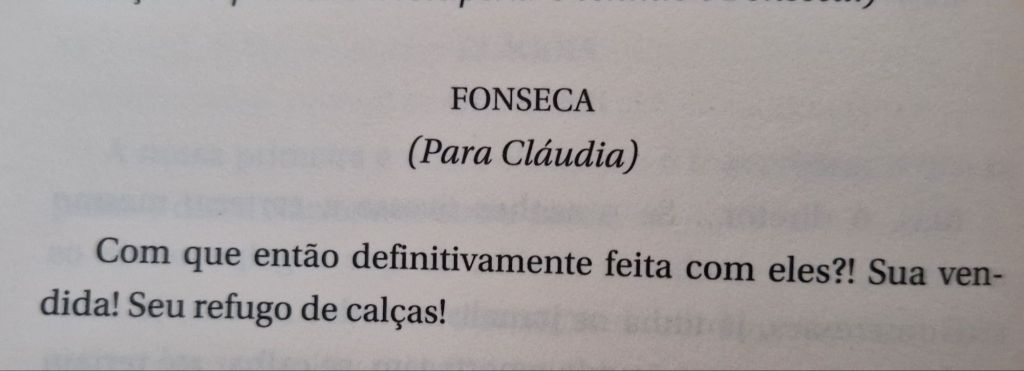
I had to ask around about this one*. The speaker, Fonseca, is siding with management and Claudia is much more supportive of the coup that is in progress as they’re talking. He obviously blames her (rather unjustly, as far as I can tell) for what is going on, but one way or the other, they are definitely forming into rival camps, according to whether or not they’d support the revolution, so there’s a lot of class animosity behind the words, which is why he’s being such a twat.

He calls her “Sua vendida” (you traitor, you person who has sold herself) and then, slightly confusingly, “Seu refugo de calças”. You what now? You pile of leftover, defective trousers? I asked reddit what was going on. He’s calling her a refugo, and she’s wearing trousers, so he’s more or less saying “your a junk heap on legs” or “you’re a walking pile of garbage” or words to that effect.

As soon as I was told that, I asked myself whether there was a bit of machismo entering into the equation. The play takes place in the seventies, and I wondered if, by referring to her stereotypically male clothes, he was implying some sort of lack of femininity, ugliness, dowdiness, lesbianism, or something like that. I dunno. I suggested it and people didn’t seem convinced, but maybe they’re young and don’t know what people were actually like in the seventies. I do, and I can 100% imagine that. I don’t know, Portugal isn’t Britain, but I’m not ruling it out.

Anyway, don’t worry about her, the revolution wins in the end. Whoops! Spoilers!

*UPDATE

In a shocking turn of events, it turns out that the assembled wise owls of Reddit might have misled me about “refugo de calças”. I probabky should have guessed. The suggestion above is a bit modern-sounding. It’s a remendo – a patch – on some trousers that would otherwise have fine in the bin because they’re worn out in the crotch. So by implication, it’s the lowest if the low. This definitely sounds more in keeping with the general tone. Thanks to Cristina for pointing this out.

Posted in English

What the hell is this?

Esta gente nova não tem ponta por onde se lhe pegue! Francamente!

This sentence flummoxed me for two reasons. Firstly because the overall gist didn’t seem to make any sense and secondly the grammar was baffling. I had to ask an expert to explain some it to me.

It’s from Uma Aventura nas Férias da Pascoa, and the lady who’s speaking is exasperated that some kids are making a lot of noise outside her door. The “Francamente!” is there to underscore her disapproval.

Let’s do the grammar first.

So firstly, obviously, we have the usual anglophone confusion of “gente” meaning people but it’s a singular word because of course it is. That’s pretty basic though, so didn’t throw me too badly.

“Pegue” is subjunctive present. Why? Good question. It seems to be a statement about the general qualities of something, nested in a dependent clause, but it doesn’t fit neatly into my subjunctive flowchart, even though it’s recognisably the same kind of sentence structure as sentences that do. I think that’s because “por onde” (“at where”) is doing the job that would normally be done by “que”. [Caveat – I’m pretty sure I’m right about this but didn’t specifically ask so I might be misunderstanding why they’ve used this tense]

And finally, the pronouns, se and lhe right after each other. Lhe means “them” but it is singular because – again – it’s referring to gente, and se is present as an indefinite pronoun*, which is a hard concept to grasp in English. I’ve had a stab at it in this post, but I’m sure it wouldn’t hold up to much scrutiny from an expert.

So if you were to translate it word-for-word in the most literal way possible, the whole sentence is something like “These young people don’t have a place at which one might get hold of them”. Well, that could refer to something that’s so dirty that we’re afraid to touch it for fear of getting our hands dirty, but here it’s referring to people so it must be some sort of expression, right?

The expression “não ter ponta por onde se lhe pegue”,  or “estar sem ponta por onde se pegue” or variations of either, seem to be translated as “to be utter nonsense” on bab.la, and I can see it used in roughly the same way in a few places around the interwebs.

What would be an equivalent expression in English? Since it’s talking about getting a hold of something, I guess something like “I can’t get a handle on it” would be pretty close. It’s not an exact equivalent though, since if you “can’t get a handle on” something in English, you’re leaving open the possibility that you just aren’t clever enough to understand, whereas this is more in the direction of “it can’t be understood, because it doesn’t make any sense”.

More than anything else, what impressed me is that it has been ages since I have come across a sentence that has caused me this much puzzlement, and yet this is a book written for children!

Well done, you’ve made it this far. Reward yourself with this music video.

*I has a query about this so here’s a bit of self-justification! First of all, I wrote “impersonal” in the first draft of this which isn’t quite the right word so I’m sorry I got that wrong. “One” is an indefinite pronoun and in very correct, posh english you use it… ahem… or rather “one uses it” as a neutral pronoun when one wants to use a verb in a very general way, without having anyone specific in mind. I think that’s the closest analogue of what “se” is doing here. Priberam defines it as a “pronome indefinido” (4th and 5th definitions here) and this page gives more detail although confusingly refers to it as a partícula (particle) which I think is incorrect. Or at least in english a pronoun isn’t a particle, but maybe portuguese grammarians have a slightly different taxonomy…?

Posted in English

Mangas-de-Alpaca

I spotted this phrase in a book I’m reading, referring to “uma comissão de oficiais técnicos”. The speaker starts his rant by exclaiming “Baboseiras!” which I took as being related to “babar” (to drool) which it is, and so he obviously doesn’t have a high opinion of these people. OK, so I’m not expecting anything good, but what does it actually mean?

Mangas de Alpaca

Mangas-de-alpaca were sleeves worn by clerks on their lower arms to protect their clothes from getting scratched and ink-stained during service. By extension, the term can be used pejoratively to describe a bureaucrat or a pen-pusher in general.

Whether or not you use hyphens is usually important and the AO tends to be quite prescriptive. I’ve used hyphens here because that’s how Priberam spells it but neither Wikipedia or the book use hyphens, so I’m not really sure who’s correct!

Posted in English

Sopinha de Massa

New favourite expression just dropped. I was talking about a song from the eighties called “There’s No-one Quite Like Grandma”. If you’ve never heard of it, rush to listen, because it kept “Stop the Cavalry” by Jonah Lewie off the top slot in 1980, and you’re probably hearing that a lot in the run-up to Christmas, so you’ll want to know what you’re missing. Anyway, the expression, used to describe the soloist was “sopinha-de-massa” – Noodle soup. It just means someone who lisps and can’t pronounce their etheth… I mean their esses properly. As about 80% of all british comedians have pointed out, Lisp has always been a terrible word since people who have one can’t even say it. How much harder is it to say “Thopinha-de-matha?

If you’re curious, the more proper term for a lisp, used by speech therapists (this lady, for example), is “Sigmatismo” which isn’t much better!

Posted in English, Portuguese

Talking Timbuktu

So I saw this video on Youtube the other day

The guy is talking about places in the world that are used as placeholders for “a long way away” like Timbuktu or Outer Mongolia in english.

I know the phrase No cu de Judas* exists, which is equivalent to phrases like “the back of beyond” or “the arse end of nowhere”, but it’s a little unsatisfying because – well, firstly because he is talking about real places in the world that are thought of as far away, but it’s worse than that because he mixes up the idea of… well, tell you what, rather than blather on, here’s how I asked about it on Reddit, and I’ll tell you the answers afterwards. I had a bad case of morning head when I wrote it so the grammar is probably not great:

Vi um vídeo no YouTube sobre “Timbuktu”. Em inglês, se quisermos falar de algures que fica longe, falamos de ‘timbuktu’ (no Mali) ou de ‘Outer Mongolia’ (ou seja Mongólia), ambos dos quais ficam longe de nós e funcionam como marcadores de ser longe da civilização. Segundo o narrador, cada país tem a sua própria noção de onde fica este sítio remoto.

É confuso porque o narrador mistura duas ideias: (1) Longe de aqui, e. (2) Num sítio remoto, onde é difícil chegar de qualquer ponto de partida.

Eu sei que existe a expressão “no Cu de Judas”, que significa mais ou menos “num lugar distante” mas não sei se isso é o único exemplo.

Bonus question: além disso, sei que existe um lugar verdadeiro nos Açores chamado “Cu de Judas”. Mas qual existia primeiro? O lugar foi nomeado por causa da expressão ou o lugar já existia e a gente começou a dizer “o meu primo está sei lá onde, talvez no Cu de Judas” e a expressão desenvolveu daí?


I got a few answers, and u/Butt_Roidholds gave me a really good list, and I’ve added a few from other people. Obviously quite a lot of these are even ruder than “No Cu de Judas” so don’t go blurting them out in front of your maiden aunt. Italics = additions or notes that weren’t part of the main list)

  • na Cochinchina; (This is the only one that refers to a real place, I think: Cochin China = the southern part of Vietnam, so I think it’s probably the only legit answer to the question the guy is posing in the video.)
  • onde o diabo perdeu as botas; (I also heard “onde Judas perdeu as botas”)
  • onde o vento faz a curva;
  • para lá do sol-posto;
  • nos cornos da lua;
  • nos quintos do caralho (ou simplesmente nos quintos);
  • no fim do mundo;
  • nos confins da terra (ou simplesmente nos confins);
  • nos andurriais (normalmente alude a sítios ermos ou caminhos inviáveis);
  • nas berças (normalmente alude a sítio rural);
  • em cascos de rolha (normalmente alude a sítio rural);
  • Parvónia (normalmente alude a sítio rural);
  • em Santa Cona dos Assobios; (if you’re not sure what that means, I’ll tell you: it means “In Saint Cunt of the Whistles”. I mean… that’s quite an expression!)
  • onde os grelos batatam;
  • No caralho mais velho;
  • Na casa do caralho;
  • Onde Cristo não passou.

*”In Judas’s arse”. There’s a book called this by António Lobo Antunes but I’ve never read it. Ines Rebelo tortures her boyfriend on camera by asking him to try and guess the meanings of a few portuguese phrases, including this one… he’s (ahem) pretty wide of the mark (at around 11:45)

Posted in English

Ouro Sobre Azul

Well this is a new one. What does it mean? It was sent to me in an email and it’s interetsing because what the person seemed to mean by it is not exactly clear from the explanation Ciberdúvidas gives. First, here’s Ciberdúvidas

‘Numa distribuição circular das cores verificamos que o amarelo se opõe ao azul assim como o vermelho se opõe ao verde. Por esse facto, o contraste entre o azul e o amarelo bem como o contraste entre o vermelho e o verde são os mais bem definidos.
Como o ouro brilha, o contraste é ainda mais impressionante. Esta combinação era muito frequente no vestuário das rainhas e até dos reis desde o Renascimento aos finais do século XVIII.’

in Ciberdúvidas da Língua Portuguesa, https://ciberduvidas.iscte-iul.pt/consultorio/perguntas/ouro-sobre-azul/13660 [consultado em 29-11-2023]

Image by davidzydd on Freepik

So, basically, the first two sentences explain that Gold and Blue are opposite each other in a colour wheel so they are a strong contrast and they stand out well. So… it means it’s a contradiction then? the exact opposite? That didn’t seem to be what my email correspondent meant. But the second part of the text gives more of a clue: the fact that the yellow pops out so well makes it a popular combination in royal clothing (remember the Queen’s controversial hat a few years ago?). So that might mean it’s something different but in a good way.

And sure enough, if you look up the phrase on reverso-context, it gives most of the translations as something like “the icing on the cake”: something that would be a nice, striking addition to an already good thing, which I think is how it seemed to be being used. I think this is a rare example of Ciberdúvidas not being very helpful, but maybe that’s because they assume the person asking the question already knows the definition so it didn’t need spelling out. Fair enough!

Posted in English

Quem Sai Aos Seus Não Degenera

I came across this fairly baffling sentence in an exercise. What on earth can it mean? Googled it to see if I could find anyone using it and apparently, yes, it’s an expression, the gist of which is that, if you follow your parents’ guidance you won’t go far wrong in life. There’s an example here, referring to sporty kids following in the footsteps of their sporty parents.

Posted in English

Doppelganger

I was intrigued by this dialogue in the audiobook I’m listening to, “Filho de Mil Homens” It’s a boy asking about his dad.

O António perguntava “E era parecido comigo?”

Ela dizia “Cara de um, focinho do outro”. Riam-se, puxava-lhe pelo nariz, beijava-o na testa”

Cara de um, focinho do outro: Face of one, snout of the other?

What’s going on? I thought at first that the second person was saying “you have the face of one parent and the nose of the other” , but that didnt seem right, and sure enough, after some thought, I realised they were saying “You’re exactly like your dad”. The cara (face) of the dad is like the focinho (literally an animal snout, but colloquially, a face) of the child.

I like this expression, it’s really cute!

There’s a similar expression someone told me about while I was asking about this: “Cuspido e escarrado” – literally “spat and spat”. Wait, the portuguese have two words for spitting? Apparently, yes, but we have expectorate, gob, hawk and flob, so that’s no surprise.

But why? Why, if you were trying to come up with an expression meaning “exactly the same as someone”, would you bring gobbing into the equation?

In many ways, it’s like the English expression “Spitting Image”, or “Spit and Image”, which are corruptions of “Spirit and image”. Cuspido e escarrado doesn’t imply that saliva makes you resemble another person, it’s a corruption of “esculpido em carrara” – Sculpted in Marble.