Posted in Portuguese

Joaninha 🐞

My pitch for the subject of Marco Neves’ next book:

Bom dia! O meu Instagram hoje apresentou-me uma boa surpresa: um homem a falar sobre os nomes dos insectos coleópteros da família dos coccinelídeos – ou seja, da joaninha – em vários países.

O vídeo explica que, em muitos idiomas, a palavra que descreve a este besouro tem um significado religioso. “Vaca de deus” é comum, e até a nossa “ladybird” significa a ave da nossa senhora! Mas o homem coloca a “joaninha” portuguesa no grupo de “outras figuras religiosas”, o que me fez pensar sobre quem foi essa Joana. Não há Joana nenhuma na Bíblia. Uma santa? Joaninha d’Arc? Não, demasiado francesa. Santa Joana Princesa? Pode ser, mas não vejo nada na página da Wikipedia.

Fiz uma pesquisa, e confesso que não passei horas vasculhando todas as esquinas da Internet, mas por exemplo, o Ciberdúvidas não sabe, o Stackexchange também não. Nem o wiktionary, nem a Wikipedia, nem o Priberam menciona a origem.

Este blogue faz a mesma pergunta e nos comentários alguém diz que o inseto tem várias alcunhas regionais, como por exemplo “Bicho de São João” (na Madeira) e “Bicho de Nossa Senhora”. É interessante que “João” é parecido com “Joaninha”. Talvez os madeirenses sejam os que melhor sabem, mas não vejo uma teoria convincente da origem da palavra.

E tu, caro leitor/ cara leitora? Sabes? Deixa um comentário lá em baixo 👇

PS he mentions BCMS and I hadn’t a clue what he meant. It’s this.
Posted in English

The Saud And The Fury

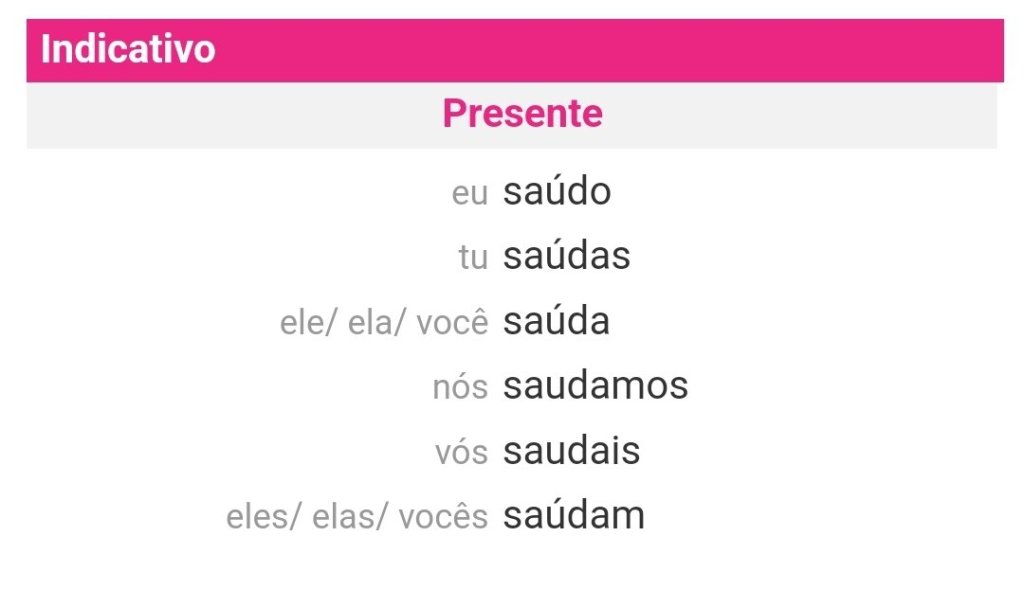
I had to use the verb “Saudar” in a sentence the other day. I don’t use it often and I was surprised to find that in the present tense most of the conjugations put an accent over the U:

This looked a bit weird to this foreigner. The first syllable or Saudar is pronounced to more-or-less rhyme with “loud” but saúdo is more like sa-OOD-oh, so it isn’t just cosmetic, it changes the sound of the root of the verb.

Not only is this not how conjugations usually work, it made me wonder whether there was any link to the word “saúde” (health). I asked in the portuguese fórum, but now I think of it, I probably should have just opened wiktionary. Basically, yes, they are distant cousins.

Saúde is from the Latin word for health or safety: salus.

Saudar is from salutare, meaning to protect, or to save. Well, it’s a verb form, but salutare and salus are certainly linked.

So in other words, although they have different meanings, they come from the same basic Latin root, with the L disappearing and the T gradually getting worn away to a D. Disappearance of soft sounds like Ls and Ds, and conversions of hard sounds like T and P to softer equivalents like D and B are both fairly common paths for Latin words becoming portuguese. So Potere in Latin became poder in portuguese, Sapere became saber, Salire became sair, videre became ver and so on.

Incidentally, saudade sounds like it’s in the same sort of area. Is that another long-lost cousin of Saudar and saúde? No, it used to be spelled Soudade, but it’s spelling changed over the yeas. It actually comes from the Latin Solitatem, meaning it’s related to Solitude in English and Soledad in Spanish.

Posted in English

Aliens: Spoiling It For Everyone

The night before last, Mrs L suggested we watch a film called Arrival, starring Amy Adams as a brilliant linguist supported by Jeremy Renner as Jeremy Renner and Forest Whittaker chewing the scenery in a very enjoyable way (him and Jeff Goldblum: as far as I’m concerned, they should be in everything)

Anyway, this isn’t a blog about movies, so why am I mentioning it? Well, Amy Adams starts her first scene in a lecture theatre with the opening lines of a lecture she’s about to deliver about Portuguese and why it sounds so different from other romance languages. I was all like…

But sadly at this point the movie was ruined for me when a siren sounded, heralding the arrival of twelve alien space ships who have come to… Well, I’d best not let slip any spoilers, but suffice to say they hadn’t come to help answer the question, and Amy Adams found her priorities had shifted somewhat so she didn’t even move on to the second paragraph.

I hunted around and found a reddit discussion about the lecture. I think there’s a lot of copy/pasting from Wikipedia going on here, coupled with some diversionary chatter from Brazilians who don’t see what all the fuss is about because everyone in South America sounds more-or-less the same, but it’s good to know I’m not the only one who wanted more. Maybe one day there’ll be a director’s cut with the whole lecture included. I live in hope.

Posted in English

May I Be Of Assistance? 

I’ve always thought of the verb Assistir as a straightforward false friend, meaning, as it does, to attend or spectate at an event, and has nothing to do with helping or supporting any way. But today I was reading the book “Trilby” by George Du Maurier, written at the back end of the nineteenth century and I came across this sentence

And, indeed, here was this immense audience, made up of the most cynically critical people in the world, and the most anti-German, assisting with rapt ears and streaming eyes at the imagined spectacle of a simple German damsel, a Mädchen, a Fräulein, just “verlobte”—a future Hausfrau—sitting under a walnut-tree in some suburban garden

That really sounds like a very Portuguese use of the word “assist”. So I looked in my trusty Chambers and it turns out that assist had, in Shakespeare’s day, much the same meaning as its cognate does in Portuguese. What’s more, when I checked the priberam online dictionary I found that Assistir has several senses, including the British one. They give as it’s synonyms Ajudar, Socorrer and Cooperar.

So what we have is a word with two distinct meanings, in the process of diverging, where one sense is dominant in English and the other in Portuguese, but while the lesser sense is still used in Portuguese, the lesser sense in English has all but faded away to nothing.

Posted in English

Portugal Is Not The Only Fruit

I saw something really interesting online the other day. Someone shared a link from imgur showing all the different words used for “orange” in languages in and around Europe.

The word for the fruit “orange” in various European languages
NgdlZRyl

Notice anything? I’m looking at the green ones, mainly. These are countries with strong Arabic influences or strong Greek ones. And… They all seem to be close variants of “Portugal”. This aroused my curiosity, so I did what any self-respecting inhabitant of the twenty-first century would do: I looked it up on Wikipedia.

According to this section, the origin of the name of the country is from the Latin “Portus Cale” – the port of Cale, where Cale is probably a Celtic name for something-or-other. It evolved into Portugal between the seventh and ninth centuries when the country had been conquered by an Arabic-speaking army and was part of the land known as الأندلس (Al-Andalus). I can’t help feeling like the similarity of “Portus Cale” to their word for a small fruit might have influenced the colonists’ pronunciation of the name of their new possession. Citrus fruits do grow in the area, so maybe if there were a lot of orange groves around it might have been a pretty good fit to call it the orange region. A few centuries later, after the reconquista rolled back the invaders, the name lives on.  A place named after orange groves isn’t far-fetched. Orange County in California got its name the same way, although California hasn’t been conquered by Muslims, whatever Donald Trump might tell you.

I have absolutely no idea if there’s any truth in this. Fact-checking was never my strong point. It would be an odd linguistic legacy. Portuguese does have some inheritances from Arabic (there’s a list here if you’re interested) but their word for Orange (“laranja”) não é um deles. And yet, it just seems too… well, too right.