Nos últimos dias, completei o puzzle, ouvindo mais áudio português, incluindo alguns episódios do Assim e Assado com Marco Neves e Sam the Kid. É uma série ótima!
Terminei um livrinho e estou quase a chegar ao fim da coleção de contos que estava a ler em Lisboa.
Tenho 6 exercícios do PEF no saco.
Finalmente, criei um cartão de Bingo com várias palavras para usar na próxima aula. Acho que sou capaz de terminar o PEF amanhã, e depois passo para o primeiro modelo.
Ouvi uns podcasts, li o álbum de Tamara Alves, e vi não só um quarto d’Os Gatos Não Têm Vertigens, mas o filme inteiro, com subtítulos. O diálogo é muito rápido, e há pessoas de várias gerações a falar cada um à sua maneira – adolescentes a usar palavrões e calão, bêbados a gritar e velhos a murmurar ternamente um ao outro. Precisei dos subtítulos mas em breve espero que continue sem a “muleta” do texto!
Dei por várias coisas interessantes que não tinha percebido antes, como por exemplo “Balelas”, que significa “mentiras” ou algo semelhante.
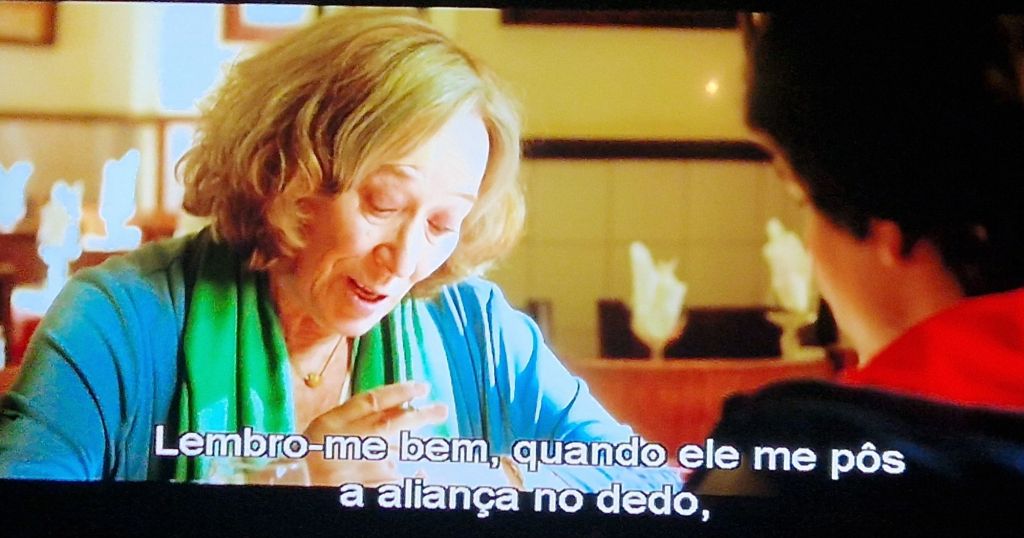
Simpatizo com a Dona Rosa nesta cena. O genro dela é um idiota.
Também vim a saber* que “aliança” não só significa um compromisso entre dois países ou grupos para colaborar um com os outros mas também é o anel que simboliza um casamento.
O filme também me lembrou desta canção que já ouvi, porque a Catarina gosta dela. Um dos protagonistas, o Jó, vai com a Rosa numa barca pois ela queria espalhar as cinzas do seu marido mas uma vez que é** ilegal, Jó tem de distrair um homem que está por perto. Pede-lhe lume*** e fala com ele sobre o futebol mas o homem está a ouvir a canção Não Venhas Tarde de Carlos Ramos na Rádio Amália.
Gosto do facto da protagonista ser uma velha. Acho que há poucos filmes que ousam destacar atores mais velhos em papéis como este. A outra personagem, Jó, é secundária e, no início do filme, é mesmo chato. É membro de um grupo de jovens criminosos que lhe roubaram a mala, e é assim que o Jó vem a conhecer a Rosa. Não é muito simpático de todo, mas a Rosa, que é uma pessoa com uma história longa e interessante, vê algo nele que a incentiva a lhe dar um hipótese de redenção.
O Jó tem de superar a sua relação com os seus amigos, que não servem para nada, e com o seu pai, que é um filho**** de puta, mas afinal a Dona Rosa tem razão: o puto consegue endireitar-se e acaba por ser escritor.
O filme não é perfeito mas é mesmo bom e gostei mais desta vez do que quando o vi a primeira vez, anos atrás.
Também curti este trocadilho.
Ao fim do dia, fiz o exercisio de Puzzle Brain, ouvindo o Quarto Livro de Crónicas de António Lobo Antunes enquanto fazia um Puzzle de mil peças. Que malandrice! Segundo o Goodreads o livro, tem 328 páginas mas o audiolivro não dura mais de uma hora! Então, não é a obra completa. Mas por outro lado, é um pouco deprimente e não preciso de mais!
Amanhã, exercícios! Bora lá!
*Shout out to 2021 Colin, who wrote this article that I came across today and had forgotten all about.
**Surprised this wasn’t subjunctive after “uma vez que”. It seems like it depends slightly on how hypothetical you’re being.
*** “Lume” Not “um lume” – too literal translation from “Hev yew got A loight boy?” (This guy is long overdue for a revival IMHO)
****Embarrassingly I wrote uma filha de puta. Have I really sunk so low that I am making nouns agree with other nouns? Dear oh dear.
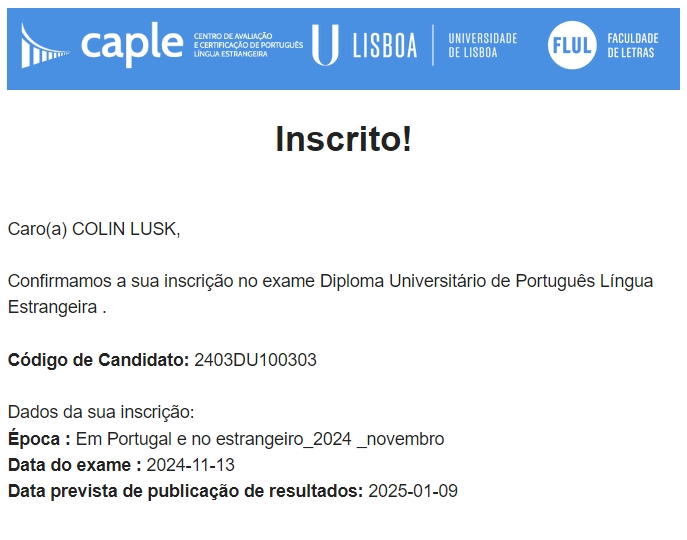
OK, the exam is on the 13th of November. To be honest, I wish I’d gone for May next year, but here we are… I’m going to be taking another of the Say It In Portuguese CAPLE Exam preparation courses. I need to use the remaining time wisely so I’m going to try and cut out a lot of unnecessary stuff, put a few things on hold till the second half of November to make more time for learning, especially listening and speaking (using some of the techniques this fella lays out in this video) and I’ll add this lot to my Planner app:
Raw Exam Prep
Do the exam modelos Cristina gives me
Go through the list of key structures in the C2 syllabus here, and try and figure out what I need to work on, possibly in the lessons
Just general tidying
I have some lists of structures I often get wrong and structures that get used a lot in portuguese that I never use because I keep forgetting about them, so try and make sure I get as many of them as possible into blog posts instead of just treading the same old familiar linguistic pathways that I rely on in everything I write.
Try and bribe my wife to speak to me in her beguiling madeiran accent. Poached eggs will probably work. She loves a good poached egg.
General Input
Reading – I have an english book I am committed to reading for family book club and a couple of audiobooks that I am already part way through, but when those are finished, no new english books, just portuguese ones. Probably not many though, because I don’t really need much practice – just bedtime reading, and just things that seem like they will expand my brain. Like I have a Gil Vicente play in BD form, but I looked at it earlier and it’s much too archaic so I’ll save it for after the exam.
Podcasts – Portuguese only till after the exam. I might even unsubscribe to some of the english language ones to remove temptation.
Eat-Rep exercises – I’m going to drop some of the morning quizzes I do and watch a quarter of Os Gatos Não Têm Vertigens instead – that’s about two watches per week. try to do some “scratching” in the first weeks and move toward “copycat” exercises in later weeks.
Exercises
This weekend
Start final chapter of Português em Foco
“Puzzle Brain” activity – listen to portuguese audio while doing a jigsaw
W/E 27-10-2024
Finish Português em Foco exercises in the main book (meant to do these before Lisbon really, but…)
Start the (self marked) grammar exercises in the Caderno de Exercícios
W/E 03-11-2024
Finish the grammar exercises in the Caderno de Exercícios
“Scuba Diving” exercises with text and audio of “Amor de Perdição”
W/E 10-11-2024
Non-thorough run through of the paper exercise books I have, looking for grammar exercises that look like they might be beneficial.
The remainder of the vocabulary and verb tenses sections of Português Outra Vez, (the expressões section is rubbish and I can’t be bothered with it)
The C1 sections of “Vamos Lá Continuar” and
Some of the more challenging exercises from Qual é a Dúvida. I finished this book ages but there were some exercises that left me floored, so I’ll be interested to see if I find them just as hard the second time around!
Exam Week!!!!
I’ll keep this free for whatever I think needs shoring up
I mentioned a while ago that I was starting the Say it in Portuguese CAPLE Exam Prep course. I thought it would be worth taking a really focussed course to try and get myself match fit instead of winging it. In case anyone is in the same boat, thinking of taking it for a future exam, here’s what it’s like:
The course took place over 4 weeks because that’s how long I had from enquiring to the date of the exam. Following an introductory meeting, Cristina offered a range of three options, based on what I said my weak points were. There were different levels/prices, depending how much support I wanted and I went with the middle one. I won’t say what the prices were in case it’s a trade secret, but I’d definitely call it very good value.
As you might already know, there are four sections in the exam*, and I felt reasonably comfortable with the reading comprehension but decidedly iffy about some of the others, so the really important stuff for me was in the form of four weekly drops of one sample paper from the written part of the exam and a recording and set of multiple choice questions from the aural comprehension section. I completed them in my own time and emailed them back. Very detailed feedback would then arrive the following day for me to work through.
On Fridays we had an online meeting where we’d go through some of the homework feedback and also did a simulated parts 1 and 2 of the “produção e interação orais” exam format. Mistakes made in the meeting would prompt more feedback via email, including actually recording the lesson and doing a step-by-step feedback recording that I could listen to and hear my mistakes.
Cristina does other courses and she’s also host of one of the earliest portuguese podcasts, so she’s an experienced teacher, but I think I was one of the early adopters on this specific DAPLE course, and there were a couple of teething troubles – a few typos in the questions – which I fed back and will no doubt have been corrected by the time the next person takes the course. In the post-exam debrief, I also suggested she might change the order the aural papers were given in, since I think the first one was a real past paper and the later ones were close simulacra. They were very good recordings and sounded almost exactly like real exam questions, but the questions were a tiny bit less ambiguous and tricksy, so I thought maybe it would be better to start with those and finish on the real past paper.
The course definitely boosted my confidence and helped me approach the exercises in a more controlled, less panicky way. Yeah, the exam could have gone better, but it could have gone worse too, and it definitely would have if I hadn’t done the course! I would definitely recommend it to anyone planning on taking a CAPLE exam, especially if you’ve never taken one before and are not familiar with the format.



 Luso
Luso 