A minha esposa enviou-me este vídeo interessante sobre o crioulo que surgiu em Macau. Para quem não saiba, Macau é uma ex-colónia portuguesa na costa da China perto da Hong Kong e tendo o mesmo estado de “Região Administrativa Especial” no sistema politico daquele país.
O crioulo está quase extinto nos dias que correm, com a grande maioria dos seus falantes idosos e/ou bilingues. Noutras palavras, tem um número de utilizadores aproximadamente igual ao da Língua Corniça. O vídeo é ótimo e inclui exemplos de nativos de Macau a falar o idioma.
Confesso que não sabia nada da ilha de Curaçau, mas achava que, tendo uma cedilha no seu nome, seria um vizinho do Brasil e uma ex-colónia do império português. Mas apareceu no app Worldle há dois dias e… Uau, que surpresa linguística!
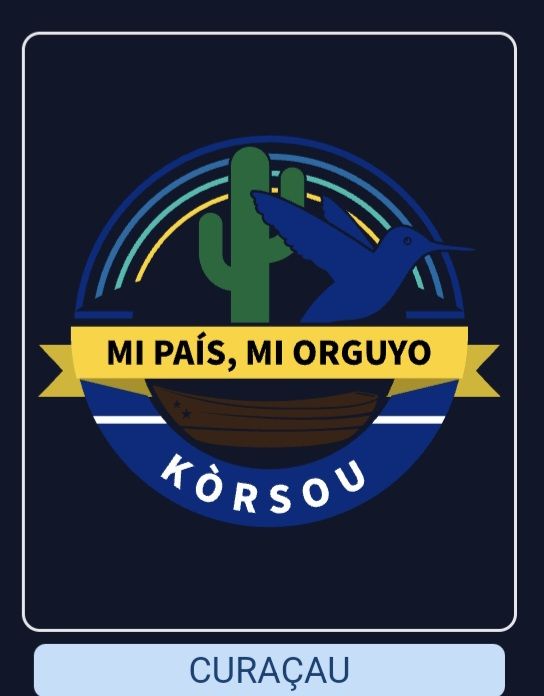
O brasão da Curaçau.
“Mi país, mi orguyo” cheira a espanhol, ainda que não seja: os espanhóis escrevem “orgulho” como “orgullo”, porque odeiam o “H”. E… Kòrsou??? O ò nem sequer existe no teclado português!!!
Pedi ajuda ao professor Wikipedia. A ilha fica perto da Venezuela e os aruaques nativos viram* a passagem assistiram às idas e vindas** de todos os impérios europeus ao longo dos anos. Os portugueses baptizaram-na*** como Curaçao (de “curar”**** porque os marinheiros doentes foram deixados na ilha para recuperar) mas os espanhóis também a visitaram a caminho de quem sabe onde. Mais tarde, a ilha mudou de mão entre os neerlandeses, os britânicos e os franceses. Hoje em dia, a influência mais forte é a dos Países Baixos, e a língua falada lá e nas ilhas vizinhas (Aruba e Bonaire, daí a designação “Ilhas ABC”) é um crioulo chamado Papiamento, de base luso-espanhol com muitas palavras neerlandesas.
*messed this one the first time. I would sincerely like to travel back in time, find the man (it must have been a man, and I bet he had a beard) who invented the conjugations of ver and vir, and nail him to a tree.
**even with the corrected error, the crossed-out passage still isn’t great so this bold text was suggested as an improvement.
***one of those words I know when reading but seldom remember when writing or speaking: batizar in place of “dar nome a” or “nomear”, is more common in Portuguese than baptise is in English, maybe because of differing religious histories or maybe just because it sounds better.
****Don’t read too much into this though. Is there actually a word “Curaçau” or perhaps in more modern orthography “Curação” meaning an act or effect of healing? No. No, these is not: that would be “Cura”. “Curaçãu” does exist as a word in Priberam, but it only refers to the orange liqueur of that name, which comes from the island.
Então, ainda não falei da rainha, Cesária Évora? Tive a sorte de assistir a* um espetáculo dela em… hum… 2001, se não me engano. Naquela altura, não falava nem uma palavra de português mas mesmo se falasse não me teria ajudado porque a maior parte da obra dela está em Crioulo Cabo-Verdiano. Fomos com a tia da minha esposa. A minha esposa nasceu no Cabo Verde e viviu lá durante os seus primeiros anos, antes da família dela ter voltado para a Madeira. A cantora tinha uma maneira muito relaxada de se apresentar na sala de concertos. Não parecia ser muito animada. Só cantou de pés descalços**. Havia uma mesa no centro do palco e, durante o seu intervalo, a banda continuou a tocar enquanto ela sentou-se numa poltrona, acendeu um cigarro, deitou um pouco de vinho num copo*** e ficou tranquila, nem sequer olhando o público durante 3 ou 4 minutos até à abertura da próxima música.
Queria fazer uma tradução da sua canção “Angola”, que é empolgante, mas claro que preciso da ajuda de um português que entenda o crioulo. Roubei as letras deste site, mas acho que o homem que fez esta tradução parafraseou um pouco. Por exemplo, aquela primeira linha tem uma conjugação do verbo “viver”, sem dúvida. Acho que ela diz “Essa vida boa que os senhores estão a viver”. Existem vários sites online onde se explicam estas línguas parecidas com o português padrão – por exemplo, aqui está a descrição de “nhôs” no Infopedia . E tenho as minhas dúvidas sobre a interpretação de “Ami nhos ca ta matá-me” porque parece-me tão descabido no contexto… mas tenho de confiar no tradutor porque ele afirma que é fluente!
A música é linda. Eu não sei nada de teoria da música e se calhar, estou completamente errado, mas parece-me influenciado pela música do Brasil, com um ritmo sincopado que me lembra o**** Samba, mas é mais do que só uma cópia: muito mais. Tem um som único, e a voz dela é… Ouso dizer “ouro sobre azul”? O efeito da voz e da música é esmagador!
*I need to smack myself in the head with a frying pan a few times till I remember to put the “a” after “assistir”
**I’m only talking about the concert but I could easily have said the same about her career.
***I really screwed this sentence up – I tried to use the verb “derramar”, which isn’t even the right verb (it means spill) but then I managed to get it even wronger and wrote “derrubar”. I think deitar is the right verb even though it sounds weird – I usually associate it with laying something down or chucking it away. I also wanted to express the idea that she poured out a few sips worth, but that didn’t go any better. Hopefully this works. the easy way would be to say “encheu um copo” because why wouldn’t you want to fill it all the way up? But I was trying to be more specific than that. Sigh. This seems like a very basic thing to be confused about when I’m meant to be at C1 level.
****Not “do Samba”: “it reminds me of” doesn’t have de, whereas “i remember” does – so the preposition use is pretty much the opposite of english, really!
Crioula
Português
Inglês
Ess vida sabe qu’nhôs ta vivê Parodia dia e note manché Sem maca ma cu sabura Angola angola Oi qu’povo sabe Ami nhos ca ta matá-me ‘M bem cu hora pa’me ba nha caminho Ess convivência dess nhôs vivência Paciência dum consequência Resistência dum estravagância
Essa vida boa que vocês têm Paródia dia e noite até de manhã Sem mágoas, com alegria Angola, Angola Oh que povo alegre A mim não me matam Venho com hora para partir A convivência na vossa vivência Paciência duma consequência Resistência duma extravagância
That good life you’re living Parodies, day and night, until morning Without pain, but with happiness Angola, Angola Oh what a happy people They don’t kill me I come when it’s time to be on the way The way living together is a way of life Patience of consequence Resistance of extravagance
Thanks to Cristina of Say it in Portuguese for correcting the text description above the video.
I’ve been talking online lately about variant spellings, mainly in Brazil but also in other countries. I guess I was trying to pick out, from the vast soup of different spellings on twitter, which are brazilian, which are the result of fusion of portuguese and african languages and which are just street slang or just some sort of online abbreviations, memes and what-have-you, but I was listening to a specific Cape Verdean album and went down a rabbit-hole as a result.
So… I was going to try and write a post about the portuguese language in the “Palop” (Países Africanos de Língua Oficial Portuguesa) in general, but decided I wasn’t really clever enough or patient enough to do it justice. So by way of example, decided to just write about a couple of songs on the album instead because it’s good and worth listening to even without using an interest in etymology as an excuse.
Sara Tavares is a portuguese singer of Cape Verdean descent. Wait, wait, stop the paragraph because there’s a cool linguistic diversion right there: if you look her up on wikipedia you’ll see that the portuguese way of saying “descent” is “ascendência”, not “descendência”, like the two languages are looking at the family tree from opposite ends!
Anyway, she’s been active since the mid nineties and collaborated with a lot of portuguese artisits like Buraka Som Sistema, Da Weasel and Nelly Furtado, as well as recording a song for the portuguese version of The Hunchback of Notre Dame. She’s won a load of awards and been nominated for a load more. A british music magazine called Taplas once said “If the sunlight had a sound, it would sound like the voice of Sara Tavares” which is a pretty great compliment.
Anyway, I’m happy to listen to her music even if I don’t understand it but I’d also quite like to understand it. Some of her songs are easier to understand than others though and there’s a reason for that.
Her latest album is called Fitxado which I think means Fechado (closed). The first song I heard from it was “Coisas Bunitas” – Coisas Bonitas (Nice Things)
Diz-me coisas bunitas
Sussurradas ao ouvido com sabor

Diz-me que a minha carapinha
te faz lembrar uma coroa de rainha
Tell me nice things, whispered in my ear with feeling. Tell me my hair looks like a queen’s crown. Why “Carapinha” for hair? It’s a specific word for thick, curly hair, particularly black people’s hair.
That’s all easy enough, but what about another of her songs, “Txom Bom”? No idea. What I think has happened is that she’s moved from portuguese to Cape Verdean Creole (Crioulo Cabo-Verdeano), which is rooted in portuguese but has become its own language. So… If Fitxado means Fechado then maybe that “TX” is equivalent to “CH” in other words too. Let’s look at the lyrics and see if there’s a clue:
Pe na txom, surrisu strela
“Pe na txom” = “pe na chom” = “pé na chão”? Foot on the floor? Well.. that makes sense. Chão is masculine so it would be no, not na in Portuguese but maybe that’s one of the areas where the two languages diverge?
And “surrisu strela” = sorriso estrela? star smile… hm… I can just believe that.
É pé na txom ki levanu fora
É pé na txom ki levanu dentu
É pé na txom ki levanu lonji
“É um pé no chão que leva fora / É um pé no chão que leva dentro / É um pé no chão que leva longe”…? Plausible… That would make Txom Bom “Good Floor” which sounds surprising, but there’s a neighbourhood in Santiago in Cape Verde called Txom Bom, so maybe it’s like a good place, some good land… something like that… I don’t know. I should probably ask my wife who was born there but she was a baby when she left so I doubt she’d had time to pick up much of the local language. And I’m sort of content not to know; I like crosswords, and the idea that there’s a word puzzle waiting to be solved intrigues me so I’m happy to wait for the light to dawn.
The lyrics are written out here if you want to see the whole thing.
 Luso
Luso 