Pedro from Portuguesepedia dropped me a line recently and asked if I would like to do some sort of affiliate partnership with him. I don’t, really, because I haven’t used his platform and don’t really want to be in a position where I’m advocating for a program I’ve never used*.
But in the interests of helping out someone who makes good content, here is a completely unpaid plug: have a look at his videos because they’re engaging and useful, no matter what stage you’re at in your Portuguese journey. The latest one is here and I think you can sort of swipe down from there. I have already mentioned them in at least one blog and on the online resources page because they’re just little short, practical snippets you can take and apply in your day-to-day life.
And if you happen to be looking for a new teacher and you like his style, and you wanted to go and have a look at his site well I’m not stopping you! Although the dips are probably a bit challenging for newbies, he seems to be pitching his course materials at people newer to learning, in the A1-B1 range as far as I can tell, so it’s probably a good option for new and intermediate learners.
*while I’m talking about this, here’s a brief reminder that I do use affiliate links for a couple of services I actually do use: namely, bookshops. I have written a post about what I will loosely call the Funding Model of this site here if you’re curious about my enormous riches.
OK, the exam is on the 13th of November. To be honest, I wish I’d gone for May next year, but here we are… I’m going to be taking another of the Say It In Portuguese CAPLE Exam preparation courses. I need to use the remaining time wisely so I’m going to try and cut out a lot of unnecessary stuff, put a few things on hold till the second half of November to make more time for learning, especially listening and speaking (using some of the techniques this fella lays out in this video) and I’ll add this lot to my Planner app:
Raw Exam Prep
Do the exam modelos Cristina gives me
Go through the list of key structures in the C2 syllabus here, and try and figure out what I need to work on, possibly in the lessons
Just general tidying
I have some lists of structures I often get wrong and structures that get used a lot in portuguese that I never use because I keep forgetting about them, so try and make sure I get as many of them as possible into blog posts instead of just treading the same old familiar linguistic pathways that I rely on in everything I write.
Try and bribe my wife to speak to me in her beguiling madeiran accent. Poached eggs will probably work. She loves a good poached egg.
General Input
Reading – I have an english book I am committed to reading for family book club and a couple of audiobooks that I am already part way through, but when those are finished, no new english books, just portuguese ones. Probably not many though, because I don’t really need much practice – just bedtime reading, and just things that seem like they will expand my brain. Like I have a Gil Vicente play in BD form, but I looked at it earlier and it’s much too archaic so I’ll save it for after the exam.
Podcasts – Portuguese only till after the exam. I might even unsubscribe to some of the english language ones to remove temptation.
Eat-Rep exercises – I’m going to drop some of the morning quizzes I do and watch a quarter of Os Gatos Não Têm Vertigens instead – that’s about two watches per week. try to do some “scratching” in the first weeks and move toward “copycat” exercises in later weeks.
Exercises
This weekend
Start final chapter of Português em Foco
“Puzzle Brain” activity – listen to portuguese audio while doing a jigsaw
W/E 27-10-2024
Finish Português em Foco exercises in the main book (meant to do these before Lisbon really, but…)
Start the (self marked) grammar exercises in the Caderno de Exercícios
W/E 03-11-2024
Finish the grammar exercises in the Caderno de Exercícios
“Scuba Diving” exercises with text and audio of “Amor de Perdição”
W/E 10-11-2024
Non-thorough run through of the paper exercise books I have, looking for grammar exercises that look like they might be beneficial.
The remainder of the vocabulary and verb tenses sections of Português Outra Vez, (the expressões section is rubbish and I can’t be bothered with it)
The C1 sections of “Vamos Lá Continuar” and
Some of the more challenging exercises from Qual é a Dúvida. I finished this book ages but there were some exercises that left me floored, so I’ll be interested to see if I find them just as hard the second time around!
Exam Week!!!!
I’ll keep this free for whatever I think needs shoring up
I mentioned a while ago that I was starting the Say it in Portuguese CAPLE Exam Prep course. I thought it would be worth taking a really focussed course to try and get myself match fit instead of winging it. In case anyone is in the same boat, thinking of taking it for a future exam, here’s what it’s like:
The course took place over 4 weeks because that’s how long I had from enquiring to the date of the exam. Following an introductory meeting, Cristina offered a range of three options, based on what I said my weak points were. There were different levels/prices, depending how much support I wanted and I went with the middle one. I won’t say what the prices were in case it’s a trade secret, but I’d definitely call it very good value.
As you might already know, there are four sections in the exam*, and I felt reasonably comfortable with the reading comprehension but decidedly iffy about some of the others, so the really important stuff for me was in the form of four weekly drops of one sample paper from the written part of the exam and a recording and set of multiple choice questions from the aural comprehension section. I completed them in my own time and emailed them back. Very detailed feedback would then arrive the following day for me to work through.
On Fridays we had an online meeting where we’d go through some of the homework feedback and also did a simulated parts 1 and 2 of the “produção e interação orais” exam format. Mistakes made in the meeting would prompt more feedback via email, including actually recording the lesson and doing a step-by-step feedback recording that I could listen to and hear my mistakes.
Cristina does other courses and she’s also host of one of the earliest portuguese podcasts, so she’s an experienced teacher, but I think I was one of the early adopters on this specific DAPLE course, and there were a couple of teething troubles – a few typos in the questions – which I fed back and will no doubt have been corrected by the time the next person takes the course. In the post-exam debrief, I also suggested she might change the order the aural papers were given in, since I think the first one was a real past paper and the later ones were close simulacra. They were very good recordings and sounded almost exactly like real exam questions, but the questions were a tiny bit less ambiguous and tricksy, so I thought maybe it would be better to start with those and finish on the real past paper.
The course definitely boosted my confidence and helped me approach the exercises in a more controlled, less panicky way. Yeah, the exam could have gone better, but it could have gone worse too, and it definitely would have if I hadn’t done the course! I would definitely recommend it to anyone planning on taking a CAPLE exam, especially if you’ve never taken one before and are not familiar with the format.
Here’s my review of the Portuguese for Foreigners Online Self Study course for level C1, also known as DAPLE, offered by Camões Instituto da Cooperação e da Língua. I finished the course on Saturday so it seems like a good idea to get it out of my head and onto a blog post while it’s still fresh.
What’s she even doing?
The Instituto offers courses at all levels of the CAPLE framework from A1 (beginner) to C2 (God-mode). It also caters for different kinds of packages: this review is just the self study option, but for a further €140, I could have gone the de luxe route and added some tutor interaction. See here for more details about the options. I haven’t done any of the other courses so I don’t know whether or not my opinion of this one applies equally to the whole range. I mean I guess so, but who knows?
The obvious attraction of doing a course created by the organisation that designed the exam curriculum, is that you’re getting it “straight from the horse’s mouth”. You know that they will be teaching subjects the exam board think are important at this level so there’s a good chance they will come up in the exam. That’s great, and I think it’s undoubtedly one of the strongest selling points of the course: it gives you a road map of what you need to know. And it doesn’t just teach you about grammar and vocabulary, it tries to weave those together with the major themes you need to know about. The topics for each of the twelve units are
Ourselves and others – interpersonal interactions
Carpe Diem – enjoying free time
A healthy mind in a healthy body
From the field to the city – different ways of life
Thinking about the future – training and professional development
Giving new worlds to the world – immigration and emigration
Science and religion – allies or enemies?
New information technologies – solitary closeness and collective isolation
Portugal and my country – festivals and traditions
Portugal and the arts
Portugal today
Portugal and the world
I think the course is definitely worth doing for this reason alone: insofar as learning a new language entails learning about the culture, the place and the people, it’s useful to have someone walk you through how Portugal sees itself and its place on the world. Whenever I see lessons about Portuguese culture it tends to be Fado, recipes for cod, o Galo de Barcelos, and all that tourist-friendly stuff. Interesting, no doubt, but this course gets down into how trust works in neighbourhoods where shopkeepers know their neighbours and extend credit where it’s needed, and what is it that makes such trust possible; the migrant experience and the role of Portugal and its former colonies in the wider world. In other words, it goes deeper. It also gives you tools to be able to describe challenges that all countries face, like the rise of social media, the decline of religion and the challenges of international cooperation.
How does this map onto the exam itself? Well, the cultural knowledge will come in handy in the fourth (spoken) part, which seems to be where you’re most likely to describe your knowledge of some cultural or social trend. Even though you’re not speaking in the course, you’re getting used to thinking about the ideas and making use of the vocabulary.
As for the other three sections*, there are audio/video components that are going to be useful in developing your listening skills for the aural comprehension. It’s far, far easier than the aural comprehension section of the exam because of the time available and the relatively simple questions you’re asked, so don’t get lulled into a false sense of security. Likewise, the written comprehension is quite a bit easier than in the exam. OK, the way I’m talking, I expect it sounds like I got full marks and I definitely didn’t, but I feel like I lost more marks through carelessness than because I was unable to interpret an ambiguous or tricky question.
When it comes to the written work, there are some exercises based on grammar but they’re quite minimal. Each new structure it introduces is covered in a very basic way and the students is only really expected to do one question for each, which isn’t really enough to push it into your long term memory.
So summing up: It was €180 well spent, but it’s not a perfect course. But I could have guessed that. No one learning tool is ever going to tick all the boxes and we always need to look at multiple sources. This one has no speaking component, but I could have got that by signing up for the premium course. Or I could use an online tutor on a site like italki or Polytripper or even just ask around on one of the many Facebook groups for Portuguese learners like this one (European only but heavily moderated) or this one (freer and easier but includes Brazilian Portuguese). It’s a little weak on grammar, but that’s what exercise books are for, and a book won’t mark you down if you accidentally make a typo or if spellchecker changes your right answer to a wrong answer. The book I’m about to start using (Português Outra Vez) doesn’t have any audio component but it’s very text-heavy so I’m expecting it to be able to boost my grammar levels up a notch or two using it.
So if you’re considering going in for one of the exams, definitely consider one of these courses as a sort of route map, but don’t make it the whole of your learning plan: be prepared to take notes for further study afterwards. You’ll probably need it.
*=If you haven’t already taken an exam, have a look at one of my descriptions of the exam process for more background on what is in each section. Here’s the B1 exam, for example.
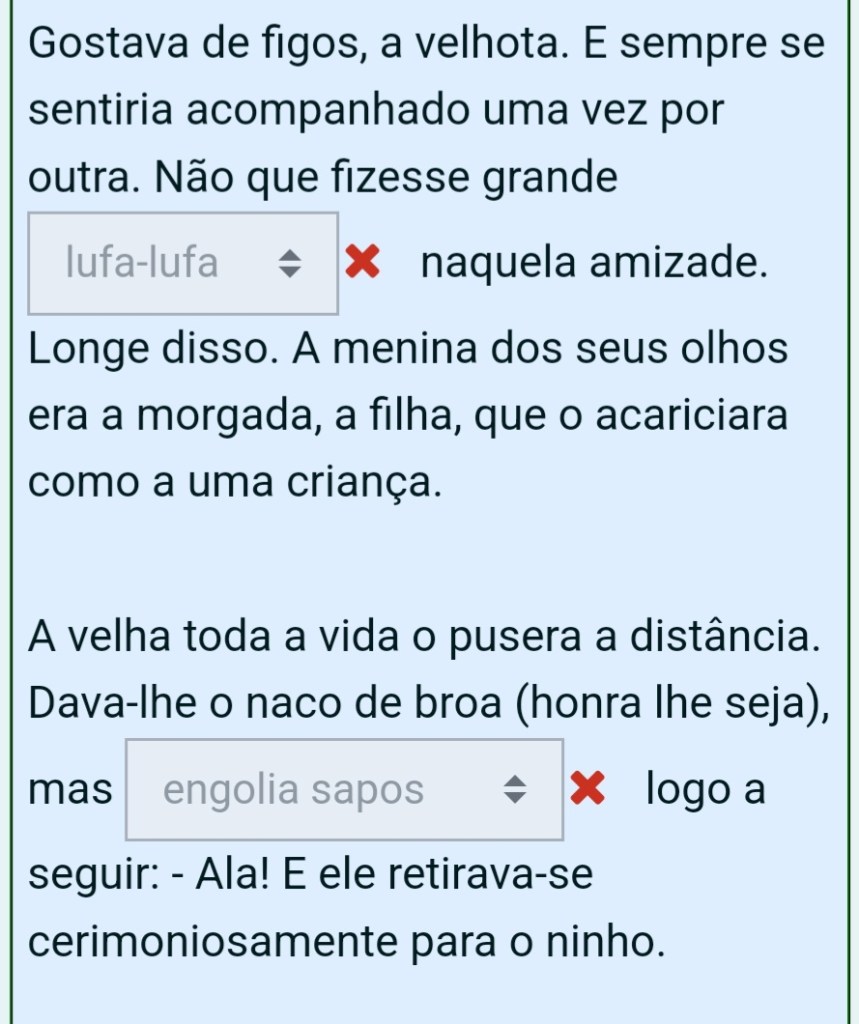
I found this exercise very, very hard. Even when I got the results back, I still couldn’t make sense of why the right answers were the right answers. I asked about it and got an answer but before I read it I’m going to write out a translation and try to sort it out in my own head… OK, what have we got?
She liked figs, the old woman. And he’d always feel himself accompanied from time to time. Not that she made a big ________ in that friendship. Far from it. The Apple of her eye was the only daughter, the child who had patted him when she was little.
And options for that space are “lufa-lufa” (being busy with lots of tasks), “finca-pé” (a firm stance) and bate-papo (chit-chat)
And then…
The old lady, all her life, had kept him at a distance. She gave him a loaf of bread (honor indeed!) but she _______ straight afterwards: – get away! And he took himself away cerimoniously to his bed.
And options for that one are “engolia sapos” (swallowed frogs – meaning did something she really didn’t want to do), “borrava a pintura” (smudged the painting) or… Something else, i can’t remember.
Uyth, in the Portuguese subreddit, explained that this is from a book called Bichos by Miguel Torga, which is embarrassing because I’ve read that and I still didn’t get it! It’s a very difficult book though, so it’s no wonder it was chosen for an advanced course like this. When I read it I felt all at sea and I only really managed to follow two or three stories.
Anyway, in the first case, finca-pé was the right answer because taking a firm stance on friendship means making an effort to keep it going. And in the second case, borrava a pintura – smudged the painting – means she undid the effects of something good she’d done. So after giving the animal (a donkey, if I remember rightly) the lump of bread, she chases him away.
OK, I can see that. Wow, so hard though! Some of the exercises were super-easy, so this one came as a real shock!
Random witterings based on the subjunctive exercises in the C1 course. Notes below. Thanks to Cataphract for correcting the original
Ainda que tenha tentado muitas vezes entender os tempos verbais mais… Profissionais, digamos assim, deste* idioma, continuo confuso. Já fiz um exercício** hoje de manhã, chumbei (quarenta e dois por cento, que desgraça!) e fiz novamente. Apesar de ter revisto as respostas todas, não conseguiria passar, nem que*** a nota das escolhas múltiplas tivesse aumentado, porque as respostas escritas permaneceram cem por cento erradas (o site não mostra exemplos correctos deste tipo de questão, o que não é muito prestável!).
Decidi deixar o exercício para amanhã. Entretanto, se revir**** as informações sobre os significados, e os graus de probabilidade das várias estruturas (“mesmo que”, “caso” e os outros marcadores que introduzem o modo conjuntivo), talvez fique mais capaz de lidar com este curso do caraças!
*=idioma is one of those Greek derived words that ends in a but is still masculine.
**=for some reason my spellchecker got it into its head that this word was spelled with an s so it kept changing it. Luckily in Android there’s a way of holding down your thumb on a predicted word and telling it never to predict that again, so I’ve done that now.
***=This pair of words, “nem que” comes up a fair bit in this exercise and I hadn’t really been conscious of it before. It means “even if” and its one of those constructions that needs a subjunctive verb.
****=review. I wrote “rever” which os the infinitive but this is a future subjunctive and it looks like the infinitive of a totally different verb!
I’m on day 66 of my epic quest for C1 competence. I’ve finished Português Atual (which is one of the books reviewed on this page) and signed on for the Instituto Camões course. They are the people responsible for administering the exams so I feel like this is “straight from the horse’s mouth” as it were, but I wish they’d work on the website a bit more because all I’ve learned so far is how to say “page loading”.
I’ve been thinking for a while about writing a post on the course I’m taking about the history of Portugal, but today’s Twitter news has made me finally stretch my thumbs to do it now because… Wow, I was not expecting this!
The course is bi-weekly, presented online by the Bertrand chain of bookshops. I missed the first one so I’ve only actually attended one class so far. It’s taught by a woman called Raquel Varela, who is Portuguese, and a Brazilian guy called Roberto Della Santa. I was a bit non-plussed by the session I attended. It was about the origins or liberalism and the unification of the national market in the 19th century but there weren’t many references to actual historical events; the bulk of the lesson was given over to explaining Marx’s theories about capitalist production. OK, well, Marx does set out to explain historical processes so yeah, fine, but it seemed likes strange digression for a course on Portuguese history, going into abstract realms of economics and historiography without much reference to the real sequence of events. It felt more like a come-to-Jesus, or rather, a come-to-Karl… appeal than a lesson. That’s OK though, I’ve studied Marx at uni, and I’m quite happy to listen to other people’s points of view. I’d have asked a question if my grasp of the language was more secure but no, not today!
I’m not complaining – I enjoyed it. I hope the remainder of the course will be less abstract though.
Anyway, fast forward to today. I open twitter and there’s a tweet right at the top of my feed with a link to an article and a picture that looks familiar. It takes a while to realise it’s one of the course teachers, Raquel Varela, and the article is about a petition signed by “more than a hundred intellectuals” in support of academic freedom in general and of her specifically. It turns out she is quite a well-known figure. This surprised me because the price of the course is so low I’d assumed the teachers were just keen amateurs they dragged in from the store’s popular history counter. I wasn’t expecting star power! Its like attending a year-long study group at your local Waterstones for a hundred and forty quid and finding it’s being run by Simon Schama. You’d go “bloody hell, i wasn’t expecting this!” She’s a kind of public intellectual, attached to the Universidade Nova de Lisboa, author of several books and occasional TV pundit. She’s taken a lot of fairly controversial positions, not least on covid, but that’s another story for another day.
Anyway the reason she was in my twitter feed was to do with a public hoo-ha that has been going on for a couple of weeks now. It started when rumours began appearing on social media that her academic CV had been inflated by repeating items multiple times to make it seem like she had more academic clout than she really has. I don’t know where these rumours came from originally but she refers to them in her blog in July, describing them as a “campaign of defamation”. The matter came to a head around the 20th of September when the newspaper Público reported that the Instituto de História Contemporânea had withdrawn its support for her candidacy in a scheme run by the Fundação para a Ciência e a Tecnologia called the Concurso de Estímulo ao Emprego Científico Individual after checking the allegations and finding that she appeared only to have published about half as many articles as she claimed. Now, I know inflating your cv is not exactly uncommon, but integrity is a big deal in academic circles, especially when you are using your track record as a platform for competing against other academics as in this case.
Varela didn’t take this lying down, instead using her legal right of reply to demand (the verb is “exigir”) an apology from Público,
This brings us back to the present day where Sapo’s i online site reports on the letter of support from a hundred or so writers and academics. Their petition refers to a “campaign of character assassination”, involving Público, which it accuses of “promiscuity” with anonymous sources spreading misinformation. It also mentions other, more unpleasant allegations in “ultra-Conservative” sources and throws in a reference to “o crescimento de fake news e da extrema-direita”. In one particularly weird flourish of denunciation they say “Este é um caso exemplar de como o nepotismo dentro de um sector da academia e a necrofilia de alguma imprensa procura silenciar uma intelectual”. Wait… What? Nepotism? Necrophilia? Calm down lads.
The effect seems to be to associate the (perfectly legitimate, it seems to me) story in Público with some more shadowy stuff online, implying they are somehow part of a co-ordinated smear campaign. This seems a little unfair, since whatever the online muckrakers are doing, Público are at least reporting on matters of public record: either her CV is padded or it isn’t, and that question is being adjudicated by the relevant scientific bodies. Whether they find in her favour or not is up to them but fairness and transparency seem to be essential in upholding trust in the scientific process. Mixing it up with conspiracy theories doesn’t help either side.
Anyway, I will certainly carry on attending the course and I’ll enjoy it a lot more knowing the backstory!
Portugalist is a sort of lifestyle and travel site with an informal, magazine vibe aimed at english-speaking visitors and residents in Portugal. I’ve tended not to pay much attention to it since I don’t travel much and don’t live there. I’ve just spent some time poking around though, and I must say, there’s some good stuff on there. Their bread-and-butter content is practical and seems very up-to-the-minute: how to get a covid vaccine, navigate finances and bureaucracy and so on. For those of us exiled beyond the sea and just wanting to learn the language, they have a modest-sized language section which doesn’t have much direct learning material but acts as a directory out to other sites and channels where you can find the right course.
Here are a few things I liked, in case you’re not already familiar with it



 Luso
Luso 