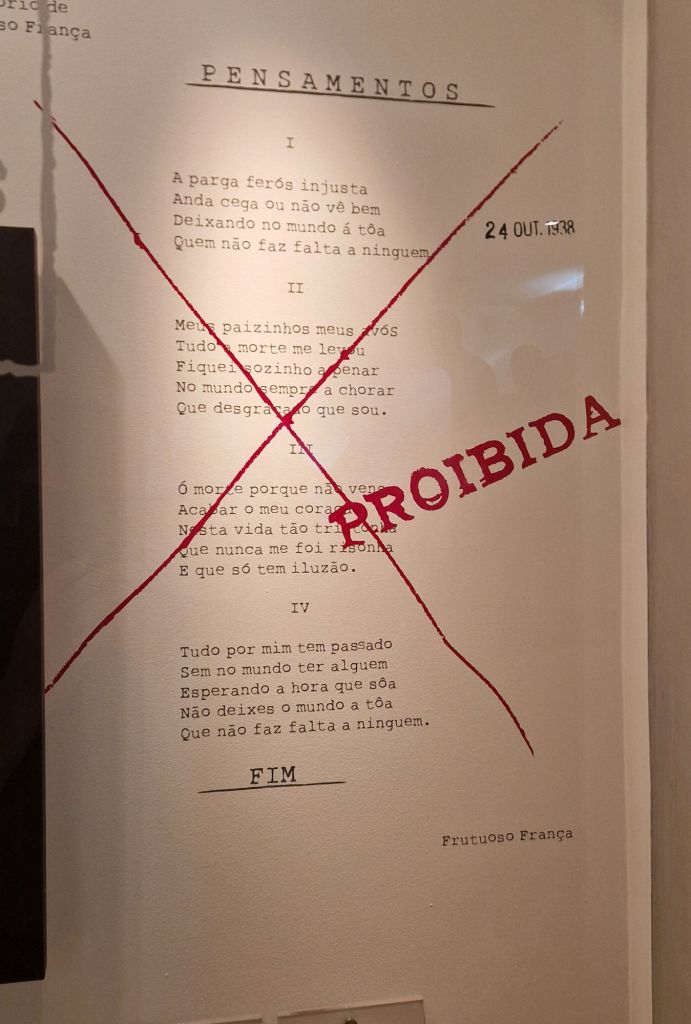
Following on from the last post – this picture I took at the Museu do Fado contains Fazer falta, and it’s prohibited so I am drawn to translate it…. Pre-AO spelling though so ironically it’s just as illegal now as it was then 🙂
The fierce, unjust heap
Is blind or doesn't see well
Randomly leaving in the world
People who won't be missed
My parents, my grandparents
Death has taken everyone from me
I was left alone, suffering
In the world, always crying
What an outcast I am
Oh death, why don't you come for me
To stop by heart
In this sad life
That was never cheerful for me
And only has illusion
Everything is over for me
Without having anyone in the world
Weighting for the hour that sounds
Don't leave the world at random
That nobody will miss
It’s interesting isn’t it? First of all, that first word, parga, is quite unusual. It’s a heap of stored hay and grain stored away from the weather (silage?). I wonder if it had some other meaning on the 1930s. Alternatively, it might even be a typo, because praga (plague) would make a lot of sense.
I’m also interested in the slight shift in wording between the last two lines of the first verse and the last two of the last. I wonder what difference it makes. I feel like there’s a shift in emphasis there but I can’t quite put my finger on it.
Summary of an article in Observador with notes at the bottom
Este artigo no site do jornal Observador lembra-nos que determinadas temas surgem em todas as sociedades modernas hoje em dia. Há quem prestam atenção às letras de cancões infantis e detetam os traços de um passado mais cruel que a presente. O artigo fala destes traços sob a rubrica de “politicamente incorreto” mas para ser mais exato, as letras contêm referencias a violência domestica, crueldade para com os animais* e racismo. Há muitos exemplos no artigo, alguns triviais (tal como “atirei o pau ao gato”) e alguns mais nojentos.
Claro que cancões, rimas e brincadeiras que fazem parte da cultura de cada pais contém ecoas de uma época menos simpática e não queremos reforçar a opinião que assedio contra mulheres é aceitável por exemplo. E é evidente que qualquer professor de pré-escola que ensinasse aos alunos aquela lengalenga** sobre “o preto do Guiné” perderia o emprego e poucas pessoas sentiria simpatia nenhuma. Isso não se trata de uma questão de o que é que é politicamente correto, nem de censura, nem até de branqueamento*** mas sim de não repetir os insultos do passado nas orelhas dos estudantes negros em 2021.
Mas por outro lado, as tentativas bem-intencionadas para tornar as letras mais aceitáveis dá frequentemente em cancões pirosas e sem esforço. Até certo ponto, um bocadinho de choque, um pedaço de horror nos nossos contos de fada e nas cancões não magoa ninguém. Isso do gato não vão tornar ninguém psicopata, e não é preciso entrar em pânico ma afinal concordo com Dora Batalim: “mais vale não a cantarem, têm muitas por onde escolher”, ou seja, estas rimas racistas merecem desbotar e desaparecer. Não precisamos deles.
*=”crueldade para com os animais” is an interesting contruction. There are two prepositions in there. Literally, it would be “cruelty for with the animals”, which sounds weird to anglophone ears, but does seem to be legit. A bit of research and a question on a r/Portuguese shows that it’s a prepositional phrase meaning “in relation to” – Ciberdúvidas article here. It appears in the wikipedia article about cruelty but the main title of the article is just “Crueldade Com Animais” so obviously both make sense. By the way, it’s worth noting that brazilians spell “pára” (meaning “stop”) without the accent and in theory portuguese people should spell it that way too now, but it’s the most-ignored aspect of the Acordo Ortográfico because it’s so confusing. However, you might come across a phrase like “para com isso” which means “stop that”, so try not to get confused if you do!
**=I struggle to come up with a good translation for “lengalenga”. I’ve seen it explained as a kind of rhyming mnemonic, but I don’t think it’s that: it seems to refer to repetitive chants like rhymes that aren’t quite nursery rhymes – like “ip dip sky blue, it is not you” or “i see England, I see France, I see Colin’s underpants”. That kind of thing, I believe.
***=hm, branqueamento = whitewashing or sanitising something but in the context of imposing racist songs on black students it sounds like a pun which wasn’t my intention when I wrote it

 Luso
Luso 