I hope its clear from the review, but in case it isn’t, this is a great book to read, but don’t spend time studying the grammar because it’s a million miles from anything you’ll want to write in a PT-PT exam. See this post for the most glaring example but it’s not the only thing by any means.
Raramente leio livros brasileiros porque português brasileiro é tão diferente. Ainda por cima, o português neste livro é longe do padrão de português brasileiro: há montes de calão, expressões regionais e gramática específica à região onde a história tem lugar. Mas apeteceu-me ler porque ouvi tantas coisas boas sobre este autor e esta obra sobretudo. O livro conta a história dum grupo de jovens e meninos abandonados que moram num trapiche(1). Recordei-me dos “Lost Boys” de JM Barrie (o líder ate se chama Pedro, a versão português de Peter) ou as carteiristas do Fagin no Oliver Twist de Dickens. Mas o tom do romance é mais escuro.
São criminosos, temidos pela gente da cidade, mas ao mesmo tempo, são crianças que sentem saudades da segurança e da felicidade de um lar e uma família. São sempre à procura de uma “mãezinha” e querem ir brincar no carrossel. Sem hipótese de viver como crianças, tornaram-se homens, mas não só homens: criminosos. Roubam viúvas, exploram pessoas simpáticas, lutam com navalhas e punhais. A personagem principal, com quem o autor pretende nos simpatizemos, até viola uma rapariga, o que é contado de maneira gráfica, e fica surpreendido quando depois ela o pragueja.
Ao longo dos meses, as personagens andam pelos seus percursos – há tragédia e redenção, mas o pano de fundo contra o qual o enredo se desenrola é a violência e caos na sociedade brasileira nos anos trinta do século XX, e o autor retrata esta sociedade muito nitidamente. É um livro virtuosístico.
(1) Entendi esta palavra como “armazém” mas ao que parece, tem um outro significado em PT-BR: um cais. Acho que armazém faz mais sentido neste contexto porque não consigo imaginar dezenas de pessoas a dormir num cais! Mas vou ver o filme em breve e espero entender melhor depois.
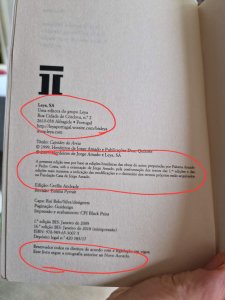
The book I’m reading right now is a classic Brazilian book, “Capitães da Areia” by Jorge Amado, about a group of street kids in Salvador da Bahia in the 1930s. My edition was published by a portuguese company called LeYa, and advertised under the government’s Ler+ initiative. At first, I thought someone at the publishing house had tweaked the language to make it more understandable to portuguese readers. Let me explain why, and why I was wrong.
As you probably know, (check here if you don’t) Brazilians typically address each other as “você” in their conversation and change the verb endings accordingly. “Tu” is more common in Portugal.
What’s weird about this book is, the characters all address each other as “tu”, after the European style, but the verb conjugations all use the você form. This looked like a mistake to me, so I went online to ask if maybe someone had screwed up at LeYa HQ.
Here’s my question in portuguese, and I’ll put a summary of the answer down below in English.
Estou a ler um livro brasileiro chamado Capitães da Areia, mas ao que parece a editora, Leya, mudou determinadas frases para soarem mais naturais a um leitor europeu. O resultado é… Surpreendente. Ou pelo menos eu fiquei surpreendido. Há montes de diálogo onde o pronome é “tu”, como se usa em Portugal, mas o verbo fica na terceira pessoa como se seguisse o pronome “você”
“Tu quer me fazer um favor”
e
“Tu liga para guarda?”
e
“Tu sabe, Sem-Pernas, que ele é um bicho calado”
Isto tudo está errado ou eu estou a enlouquecer? Ou… Talvez haja uma explicação melhor. É normal em PT-BR? A maior parte da história parece-me como o original (calão e vocabulário brasileiros, “trem” em vez de “comboio”, etcetera. Até há um daqueles “us” com hum… Umlaut… (Google) Trema! U com trema, que nem sequer existe em PT-PT, nem antes do AO nem depois.
Many of the replies said yes, this was a horrible disgrace, but there were quite a few brazilians who told me that all this is normal: it’s just a dialect spoken in some parts of southern Brazil. Besides, they added, the street kids haven’t really had the benefits of education, so it’s no surprise that they don’t have immaculate grammar.
There are a couple of ways of approaching the question of how to define good use of a language. The first is prescriptivism, which says there is one correct way of speaking and anything that deviates from it is wrong. The second is descriptivism, which starts from the premise that if people are speaking in a non-standard way and being understood by the people around them then they are just speaking a different version of the language, using different rules, and the linguists’s job is to describe what they’re doing, not to tell them they’re wrong. Most linguists and dictionary writers tend to be descriptivists on principle* with some exceptions**. I tend to be mostly descriptivist until someone tells me that ‘literally’ can mean ‘figuratively’, at which point I reach for my kalashnikov.
So, for example, you could argue that Brazilian portuguese is bad portuguese because it has diverged from the standard form of the language, spoken in Lisbon. But you could equally well say the same about Madeiran portuguese, or. Scouse English. In fact, if you wanted to be very hard-line about it, you could say portuguese is badly-spoken Latin since it has deviated from the language the Romans brought there in the third century BC.
Let’s say, for the sake of argument, that portuguese is it’s own language now, and that Brazilian portuguese is one among many dialects of Portuguese spoken in Portugal and it’s former colonies. But what about within Brazil? Is this Salvador de Bahia variant a separate dialect that has diverged and formed its own rules or are it’s speakers just hicks whose babbling would be scorned by educated people in Rio, let alonwle Coimbra?
The answer probably depends on your personality and your politics, but for me, as a learner, I just have to appreciate the book for what it is: a milestone of literature in portuguese. Let the linguists argue over the details.
If you’re studying a language, you should probably think like a prescriptivist because the people marking your work will be following a standard. If you use a você verb ending with someone you’ve addressed as tu, they won’t treat that as a delightful regional variation, they’ll just deduct marks. I made this point in what I thought was a light-hearted way to a strong descriptivist who told me “right and wrong don’t exist” when it comes to questions of language, but I got downvoted, suggesting most people disagreed. 😂
Cancelled for my prescriptivist tendencies
* If you haven’t read “The Meaning of Everything” by Simon Winchester I can recommmend it, and it addresses why early lexicographers made this choice.
**There have been some famously sarcastic and biased definitions in English dictionaries in the past. More recently, prescriptivist tendencies have come out in attempts by activists to get the meanings of words changed in order to short-circuit debate and bring about social change in a more top-down way. The most famous was this one in the aftermath of the George Floyd murder.


 Luso
Luso 