Posted in English

Goodbye Memrise, Hello Anki

I occasionally witter on about vocabulary apps. Followers of this saga will know I used to be a fan of Memrise when it was a straightforward flashcard app, but as they have developed it into a more rounded app they have quietly jettisoned “Mems” and moved away from the whole idea of flashcards. Flashcard decks created in the old system are now almost impossible to find and they are due to be thrown under a bus at the end of this year. Ho hum. I installed Anki Pro instead. It’s a much better flashcard app, with a much better spaced repetition system, but I was a bit cheesed off because, although I’d learned most of the Memrise courses, I had a few I’d made that I wanted to carry on with and I couldn’t really be bothered creating them all again from scratch.

Anyway, I recently came across this app, developed by some helpful dude, that lets you download old courses in a format that allows them to be imported into Anki.

The process for downloading the Memrise course is pretty straightforward – just follow the instructions on the page. Importing them seems more of a hoo-ha, but luckily I don’t really have any fancy bells and whistles like mems or audio. Also, Anki Pro* seems to be a bit easier to use than normal Anki, so it was a doddle. I’ll list the steps I used below.
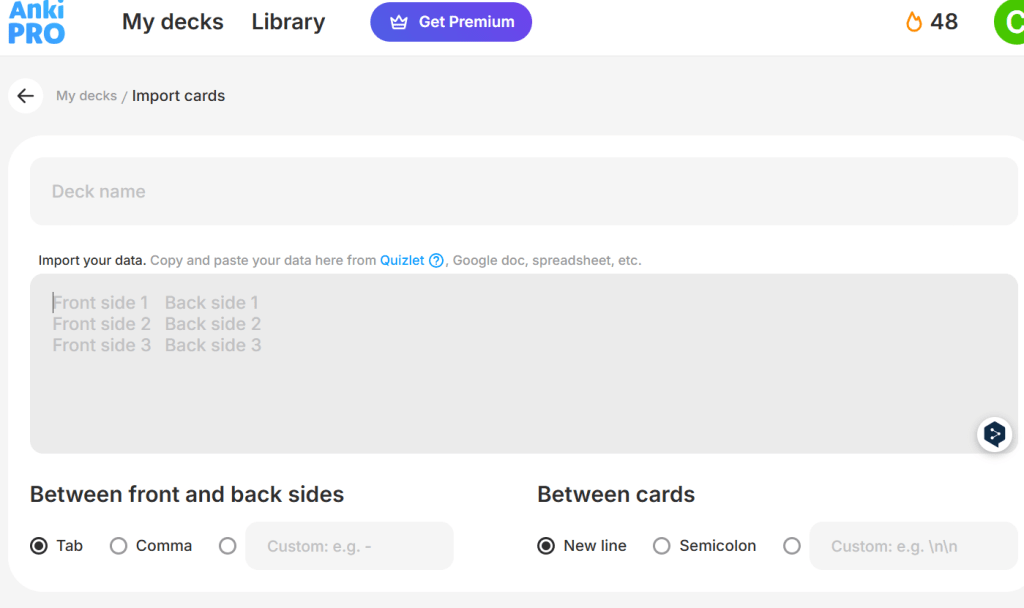
Basically it’s just

  • Log into Anki Pro
  • Go to this screen (which you get to by creating a new deck then choosing “import cards!” and then “csv”)
  • Write the name of the course in the top box
  • Open the csv file you downloaded from Memrise. It will probably open in something like Microsoft Excel or whatever equivalent you have.
  • You can ignore everything but the first two columns
  • OPTIONALLY swap the two columns around. Why would you want to do this? Well, I prefer Anki to show me an english word like “babble” and then I type in “balbuciar” as a response. But when I opened the csv it had english words on the left and portuguese on the right, so I had to swap them around, otherwise it would have made me type english answers to portuguese prompts, Boooo!
  • Copy and paste the whole block of cells containing the words and their translations from the csv into the lower box on the memrise screen.
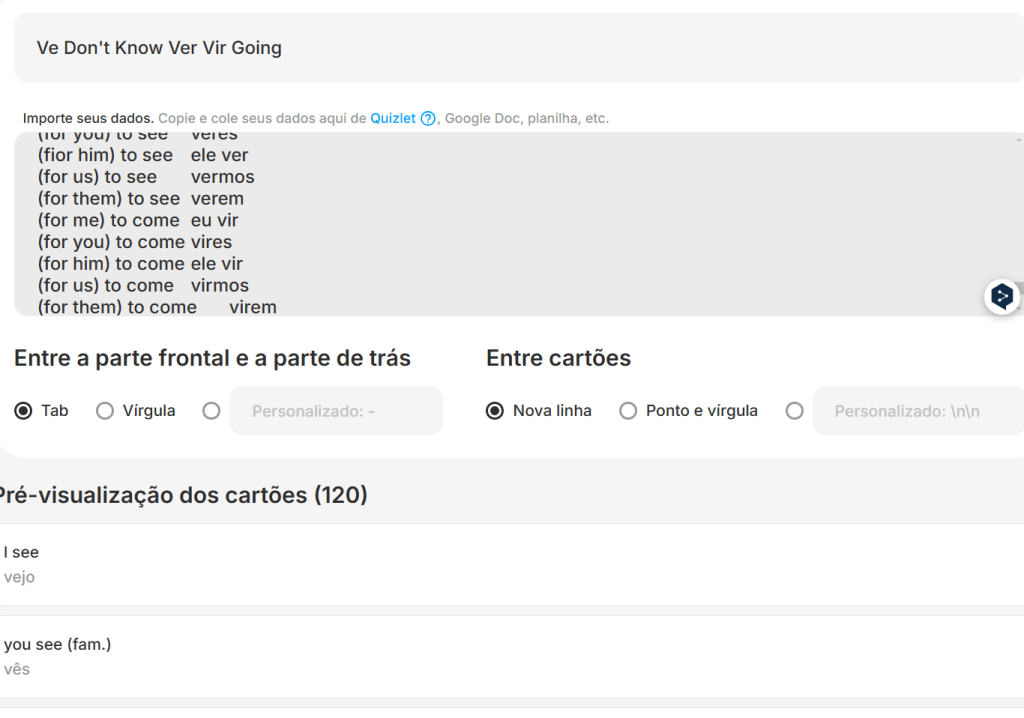
  • It will automatically take the pairings and create a course from them – check the image below, showing a course for remembering the various conjugations of ver and vir. You can see at the bottom of the picture, what it is interpreting as the prompt and answer and it seemed to get them all right first time, which is nice!
  • Make any changes you want to make (There’s a typo in the screenshot – “fior” instead of “for”, because it was like that in Memrise, and I was able to tweak that)
  • Click import

I’ll attach a csv of the ver-vir course hir i mean her, I mean here, in case you want to try it for yourself before investing the time in installing the tool. I thought it was extremely useful though and am going to hit his “buy me a coffee” link as soon as I finish this post. Buying people coffees is always a good idea! (here’s mine in case you are good at taking hints! 😊)

*Why is it called that by the way? It doesn’t cost money so what makes it more Pro than normal Anki? Oh never mind, it’s just one of life’s mysteries, I suppose!


Posted in English

Papa’s Got a Brand New Flag

Geography quiz

I can’t remember if I’ve mentioned this app before but I’ve been using it much more consistently this year. I added it to my daily to do list and I’ve stuck to that as a habit along with my other wake up games, Termo and Quina. 20 questions per day until I have it down cold. I am trying to boost my knowledge of flags, boost my geography and of course learn the portuguese spellings of these places. Of course you’ll only get the portuguese lesson if you go into the settings and set the game language to portuguese. Impressively, you can choose between Portuguese Portuguese and Brazilian Portuguese.

My flag knowledge is pretty terrible, but iI think I’m a lot better at geography. I have my weak points though. There are lots of little republics in Europe that I know exist but don’t know how they fit together. I learned the map of Europe by doing a Jigsaw of European countries at primary school but… Well, a lot of those wooden shapes have been cut up into mush smaller pieces now! Central Asia is a bit of a blur, and most of the western part of Africa is a mystery too. I’m OK on the rest of Africa, or at least I thought I was, but I was a bit embarrassed to realise Swaziland had changed its name to Eswatini. I know Rwanda is a country and Kigali isn’t. Therese Coffey, take note!

Most of the spellings are pretty similar in portuguese, or they change in fairly predicatable ways. So for example, if you knew you wanted “Slovakia” but you didn’t know how to spell it in portuguese, you could make a fair guess: not many words begin with “S” followed by a consonant in portuguese, so it would probably have an E at the start (like “Espanha”).

Eslovakia.

Hm, well K isn’t very portuguese either so let’s lose that and put QU on its place.

Eslovaquia.

Close, but it wouldn’t be quite right either because it would be stressed on the penultimate syllable: eslovaQUIa. That would sound weird, so to make it right you’d need to whack an accent on the A.

Eslováquia. Boom!

Some are very different though. The most surprising one, for me, is Algeria which in portuguese is Argélia – the R and L swap places from one language to the other.

I’m really enjoying it. I grew up on Every Boy’s Handbook, before the Internet turned our brains to mush, and this sort of thing – flags and maps and all that boyscout stuff – seems like Proper Knowledge, and I’m glad there are apps that help me banish my ignorance. The fact that it’s building my Portuguese vocabulary is certainly a bonus.

Posted in Portuguese

That Complaint Email In Full

(Tch – embarrassing typo in the title of the first version of this – I need to get better at proofreading)

Well, I said I’d write an email to complain about Biblio so here it is

Exmo Senhor(a)

Fico muito contente por ver que existe uma aplicação portuguesa que disponibiliza* audiolivros portuguesas fora do controlo das grandes empresas americanas. Espero que esteja a ser bem sucedida. Já ouvi metade de um livro e quero vos informar sobre um pequeno defeito que, se fosse acertado, tornaria a aplicação mais útil para os leitores.

Parece que a app não tem permissão de continuar quando uma notificação toca ou quando o sistema operativo põe o ecrã em suspensão. Não sei especificamente como, mas o audiolivro sempre pára depois de um ou dois minutos. Tenho de tocar no ecrã para pôr a narração de volta em andamento. Isso é chato porque quero colocar o meu telemóvel no bolso enquanto estou a caminhar ou a fazer jardinagem, mas não é possível com a vossa aplicação.

Espero que este problema seja fácil de remediar porque quero comprar mais livros no futuro.

Obrigado.

Com os melhores cumprimentos,

*=related to that false friend I mentioned the other day of course. Disponibilizar = to make available

Posted in English

My Dinner With André

I’ve been having a whirlwind romance with Andre Ventura, the Nigel Farage of Portugal. It’s taken my breath away.

It’s all thanks to a game called André Ventura Dating Simulator.

It’s a pretty simple game that starts with the player being rescued from a car crash by Ventura and exchanging phone numbers. It then takes you through a series of days in which you can work to earn money, go to the shopping mall, or call your man to go on a date. At the mall, you can buy accessories for your Ventura, such as sunglasses and hats. On the dates, you can chat, question his choice of venues, and deal with various enemies who appear, such as gypsies and antifa members. You can play as yourself, although if you are a male it’ll send you away with “Bro, sai daqui. O André Ventura não gosta de paneleiros”. That sets the tone, really: the game is sending up his actual attitudes so it warns you right at the start to expect racist, sexist and homophobic language throughout.

Playing games is, of course, a bit silly, but we can’t study vocabulary all the time. Most of us have apps on our phone that we use to pass the time on lunch breaks or on public transport, so having a Portuguese game to play is good way to keep your brain in Portuguese mode without a huge commitment of energy. I doubt this one is going to be an addiction because the joke is bound to wear thin after a while but I’ll play it a few times and see where it takes me.

Posted in English

Practice Portuguese

It seems like there’s a lot going on at Practice Portuguese, everyone’s go-to European Portuguese resource. The lads are now both full-time on the project as paid work, freeing up time for their non-paid work: dadding.

But even better, they’ve got a new app out that makes it easier to use their content on a phone. This could be a real game changer for a lot of people. At the moment it’s only in beta but I’ve downloaded it and it looks good.