I mentioned António Zambujo’s recently acquired brazilian hat yesterday, and it reminded me of this video where he’s singing with this choir of practitioners of Cante Alentejano, who wear traditional dress, including a very distinctive hat. Why Cante and not Canto? It’s just a regionalism. I’ve been meaning to do a proper post about Cante Alantejano for a while now and I must get around to that. Anyway, here we go…
Português
Inglês
Trago Alentejo na voz Do cantar da minha gente Ai rios de todos nós Que te perdes na corrente Ai rios de todos nós Que te perdes na corrente
I carry Alentejo in my voice From the song of my people Oh the rivers that belong to us all You can lose yourself in the current Oh the rivers that belong to us all You can lose yourself in the current
Ai planícies sonhadas Ai sentir de olivais Ai ventos na madrugada Que me transcendem demais Aí ventos na madrugada Que me transcendem demais
Oh, plains of my dreams Oh the feel of the olive groves Oh the winds at dawn That are too overwhelming Oh the winds at dawn That are too overwhelming
Amigos, amigos Papoilas no trigo* Só lá eu as tenho E de braço dado contigo a meu lado É de lá que eu venho E de braço dado Cantando ao amor Guardamos o gado, papoilas em flor Que o vento num brado Refresca o calor E de braço dado, contigo a meu lado Cantamos o amor
Friends, friends Poppies in the wheat Only there do I have them And arm in arm with you at my side It’s there that I come from And arm in arm Singing of love We tend the cattle, poppies in bloom The wind in a howl Cools the heat And arm in arm, with you at my side We sing of love
Ai rebanhos de saudades Que deixei naqueles montes Ai pastores de ansiedade Bebendo água nas fontes Ai pastores de ansiedades Bebendo água nas fontes
Oh flocks of longing That I left in those mountains Oh shepherds of unease** Drinking water in the springs Oh shepherds of unease Drinking water in the springs
Ai sede das tardes quentes Ai lembrança que me alcança Ai terra prenhe de gente Nos olhos duma criança Ai terra prenha de gente Nos olhos duma criança
Oh place of warm afternoons Oh the memories that come over me Oh land, giving birth to a people In the eyes of a child Oh land, giving birth to a people In the eyes of a child
*Adoro esta rima
**O que mais me surpreendeu é que achei “ansiedade” uma palavra mais “intraduzível” neste contexto do que a famosa “saudade”. Consigo imaginar a emoção de uma pessoa longe da sua terra: homesickness, sorrow, sadness, longing, não há problema com saudade. Mas “ansiedade” é cognata com a nossa “anxiety” o que é completamente fora da questão. Que mais? Linguee oferece vários alternativos, tipo “stress”, “trepidation”, “angst”. “Anticipation” é uma tradução muito comum: já ouvi montes de booktubers a falar da sua ansiedade por ler o novo livro numa série qualquer. A palavra serviria se o narrador fosse a caminho de casa mas não é. Optei por “unease” mas não estou cem por cento satisfeito!
O Instagram mostrou-me este anúncio sobre um concerto de Maria Luisa Jobim, a filha do Tom Jobim, que é quase um deus no mundo musical. Ela também canta muito bem, como podem ouvir neste vídeo, e compõe música e toca varios instrumentos.
O seu convidado é o cantor português António Zambujo, cujo nome tem a grafia certa no anúncio, mas nota-se que no site do Jazz Café, tem um chapéu brasileiro em vez do acento agudo português.
Pergunto-me como ocorreu este erro. Será que o realizador dos concertos é brasileiro e não sabe como se escreve em Portugal? Ou os donos da sala de concertos em Londres assumiram que o nome dele se escreve da mesma maneira como Antônio Jobim?
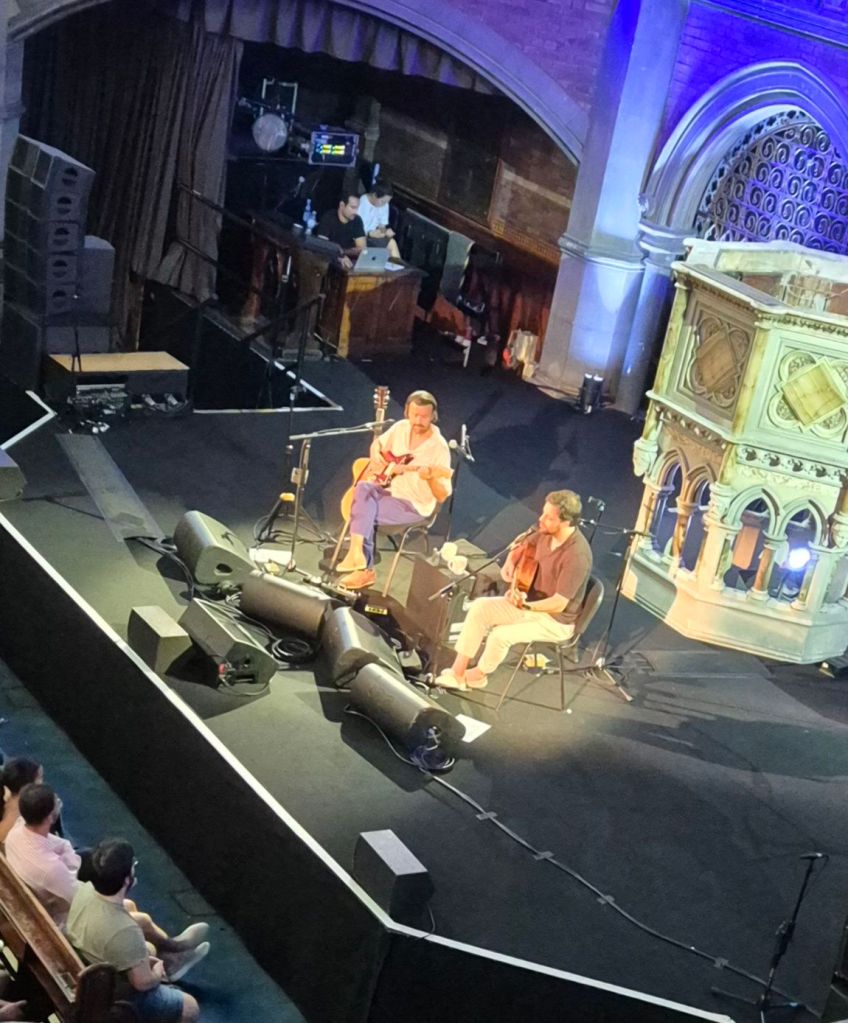
Eu e a minha esposa estamos no Union Chapel, uma igreja que também serve para sala de concertos . Os cantautores Miguel Araújo e António Zambujo estão a cantar juntos. Estamos no intervalo entra a primeira metade e a segunda.
Já cantaram um dos meus favoritos, “nos desenhos animados“, dos azeitonas mas admito que não conheço as canções todas.
Acima de tudo, estou super feliz porque um homem aproximou-se de mim e falou comigo em português. Isso quase nunca acontece e eu fiquei tão surpreendido que não entendi o que ele disse! Achei que ele me estava a dizer que esperava alguém, mas não, perguntou se eu estava. Que vergonha.
Já falei destes gigantes da música portuguesa, mas para fechar com chave de ouro esta série sobre música portuguesa em Londres, deixa-me lembrar-te que António Zambujo e Miguel Araújo vêm tocar ao Union Chapel, um dos palcos mais bonitos e pacatos de Londres em Julho. Já vimos o Zambujo no mesmo sítio há alguns anos e o Araújo em… hum… noutro sítio qualquer e gostámos de ambos imensamente, portanto estamos muito entusiasmados com a hipótese de ver os dois juntos este ano.
I’ve already done a translation of an Antonio Zambujo song – Flagrante – but it was in the context of a grammar lesson so I thought I’d come back and have a go at one of his others – Pica do Sete. I mainly chose it because it always bothers me. I think he’s singing about a woman who’s punching his ticket but in the video the woman is a passenger and he’s… well, stalking her, really. And at the end there’s a male conductor, so maybe she’s supposed to be narrating? I dunno, maybe spending some time really getting into the lyrics will straighten it out in my mind.
First of all, the title. As far as I understand it, “o Sete” is the number 7 tram. Pica is a bit trickier and I suggest being careful how you use it because it can mean lots of different things including a spliff (in portugal) or a penis (in brazil) so you know… handle the word with care! Anyway, in this context, it’s the ticket inspector. I think it comes from the verb picar which means to puncture something. You can read more about the life of a “pica” on Lisbon trams in this really good blog post written at around the time the song was released.
Portuguese
English
De manhã cedinho Eu salto do ninho e vou pra paragem De bandolete à espera do sete Mas não pela viagem Eu bem que não queria Mas um certo dia vi-o passar E o meu peito cético Por um pica de elétrico voltou a sonhar
Early in the morning I jump out of my nest and go to the tram stop Wearing an Alice band, waiting for the number 7 But not for the journey I didn’t really want it But one day I saw him pass by And my skeptical heart* Went back to dreaming about a tram conductor
A cada repique Que soa do clique daquele alicate Num modo frenético O peito cético toca a rebate Se o trem descarrila o povo refila e eu fico num sino Pois um mero trajeto no meu caso concreto é já o destino
Every time the bell rings When that clipper makes its clicking sound In a frenetic way The skeptic heart sounds the alarm If the tram derails, the people complain and I’m quite happy** Because, in my case, the route is the destination.
Ninguém acredita no estado em que fica o meu coração Quando o sete me apanha Até acho que a senha me salta da mão Pois na carreira Desta vida vão Mais nada me dá a pica que o pica do sete me dá Que triste fadário e que itinerário tão infeliz Cruzar meu horário com o de um funcionário de um trem da carris
Nobody believes the state my heart gets into When the number seven picks me up Until I think the ticket will jump out of my hand Because in the path That this life takes Nothing pierces me like the conductor on the number 7 What a sad fate, what an unfortunate timetable To cross my schedule with that of a tram employee
Se eu lhe perguntasse Se tem livre passe pró peito de alguém Vá-se lá saber talvez eu lhe oblitere o peito também Ninguém acredita no estado em que fica o meu coração Quando o sete me apanha Até acho que a senha me salta da mão Pois na carreira desta vida vão Mais nada me dá a pica que o pica do sete me dá
If I asked him If he had a free pass for someone’s heart Who knows, maybe I’ll invalidate*** his heart too Nobody believes the state my heart gets into When the number seven picks me up Until I think the ticket will jump out of my hand Because in the path That this life takes Nothing pierces me like the conductor on the number 7
Ninguém acredita no estado em que fica o meu coração Quando o sete me apanha Até acho que a senha me salta da mão Pois na carreira desta vida vão Mas nada me dá a pica que o pica do sete me dá Mas nada me dá a pica que o pica do sete me dá
Nobody believes the state my heart gets into When the number seven picks me up Until I think the ticket will jump out of my hand Because in the path That this life takes Nothing pierces me like the conductor on the number 7 Nothing pierces me like the conductor on the number 7
* The actual word is “chest” (peito) but “skeptic btreast” sounds weird
** Refilar and Sino both have multiple meanings. I originally thought the passengers are leaving the tram and queuing for the next one, but she is staying in, ignoring everything (metaphorically under a glass bell jar) because she wants to stay where she is. That doesn’t seem to case. Refilar usually means to grumble and complain and that’s what it means here. “Estar num sino” just means to be well-disposed and calm, according to this page. It doesn’t seem to be a very well-known expression though, judging by people’s reactions when I asked.
***Obliterar obviously sounds like obliterate and usually means the same but one of the meanings Priberam gives is to invalidate something by means of a stamp or a mark or by piercing it – so basically what a tram conductor does to a ticket then!
OK, well I think we can be pretty sure that the narrator of the song is the female passenger and she’s got the hots for the male conductor. The singer is just voicing her interior monologue, not stalking her. I’ve highlighted the two words that give the clue: she says she’s wearing a bandolete – an alice band or hairband. Well, men can wear those but it’s unusual, and the woman in the video has one but Zambujo doesn’t. Then fuurther down he says “um pica” not uma pica, so it’s a male conductor.
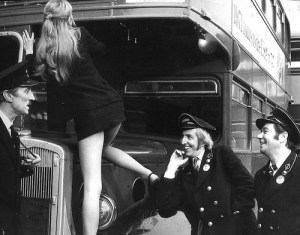
If I were portuguese and wanted to study the equivalent male phenomenon, I guess I’d have to analyse the old sitcome “On the Buses”. Coincidentally, I’ve recently watched my first episode of that. My daughter is obsessed with Reece Shearsmith at the moment and apparently they are planning to do an On the Buses parody in the current series of Inside Number 9. I’m old but even I’m not old enough to remember it when it was first broadcast.
Further musings about the expression “estar num sino”
I gently pointed out in reddit that it was surprising that quite a well-known song had an expression in it that hardly anyone understood and people seemed to be fine with not knowing what he was in about. Obviously there are plenty of songs in English that are the same (try listening to the lyrics of “Whiter Shade of Pale” sometime for example) so it’s not really surprising, but I thought it was fun to ask if people were actually listening to the lyrics.
Fiz uma pergunta ontem sobre a letra de uma música do António Zambujo. Há uma expressão na canção que diz “Fico num sino” que mal entendi*. O que mais me marcou foi o facto de os** respondentes também não saberem o significado da frase. Mas… É uma canção bem conhecida não é? Será que grande parte das pessoas ouviram a música e pensaram “Pois é, está presa*** numa campainha. Faz todo o sentido”
* mal entendi meaning I barely understood it. Maybe should have written “entendi mal” (i misunderstood it) or não entendi (i didn’t understand it) to be more accurate.
**de and os are separate here because “o facto de” is a sort of standalone expression.
*** apesar do cantor ser masculino a narradora da canção não é.
Closely related to the post about vir and chegar: what’s the difference between “vir a saber” and “vir saber”? Well, I’m glad you asked!
Vir a saber, as you’ll know if you read “The Spy Who Chegged Me” is a way of saying that you came to know something, perhaps in a slightly roundabout way, by chance, but the light dawned and then you knew.
Vir Saber is more like “I came to find out”.
This is good because I had been wondering how to interpret a line in one of the poems (it’s a song, actually: Flagrante by Antonio Zambujo) that I learned a week or two back. the people in the next room either “finally got to know about us” or “came to find out about us”. Well, now I know so here we go with a translation of the whole thing
Portuguese
English
Bem te avisei, meu amor Que não podia dar certo Que era coisa de evitar
I gave you fair warning, my love That this wasn’t going to turn out well And it was something best avoided
Como eu, devias supor Que, com gente ali tão perto Alguém fosse reparar
Like me, you have to suppose That with people so nearby Someone was going to notice
Mas não Fizeste beicinho E como numa promessa Ficaste nua para mim
But no You made a pouty face And as if in a promise Got naked for me
Pedaço de mau caminho Onde é que eu tinha a cabeça Quando te disse que sim
Bit of a wrong turn Where was my head at When I said yes to you
Embora tenhas jurado Discreta permanecer Já que não estávamos sós
Although you had sworn To remain discreet Since we weren’t alone
Ouvindo na sala ao lado Teus gemidos de prazer Vieram saber de nós
Hearing in the room next door Your moans of pleasure They came to find out about us
Nem dei pelo que aconteceu Mas mais veloz e mais esperta Só te viram de raspão
I didn’t even know what had happened But being faster and smarter They only caught a brief glimpse of you
A vergonha passei-a eu Diante da porta aberta Estava de calças na mão
I went through the shame In front of the open door With my trousers in my hand
It’s great isn’t it! Lots of really good stuff in there. The one line that I really had trouble understanding was the first line of the last stanza “A vergonha passei-a eu” which seems like he’s saying “I passed her the shame” as if he were trying to blame it all on the girl, but that doesn’t make sense for all sorts of reasons. The “-a” on the end of passei is actually referring to “a vergonha”. So it’s like “The shame, I passed through it”. Normally in conversation you’d say “passei pela vergonha” but poetic license applies. Here’s the full thing. I’ve probably posted it on here before but I just love it so much it’s worth repeating.

 Luso
Luso 