
Posted in English

Interesting Things I Found in “A Noite” by José Saramago.

“O isco, o anzol e a chumbada”: I think I’ve seen this before but it jumped out at me because we have a bit of intra-family rivalry over the Connections game in the New York Times and on the day I read this, there had been a trap involving the words “hook”, “line” and “sinker”, which is what this means of course

Let the dust settle. Easy.
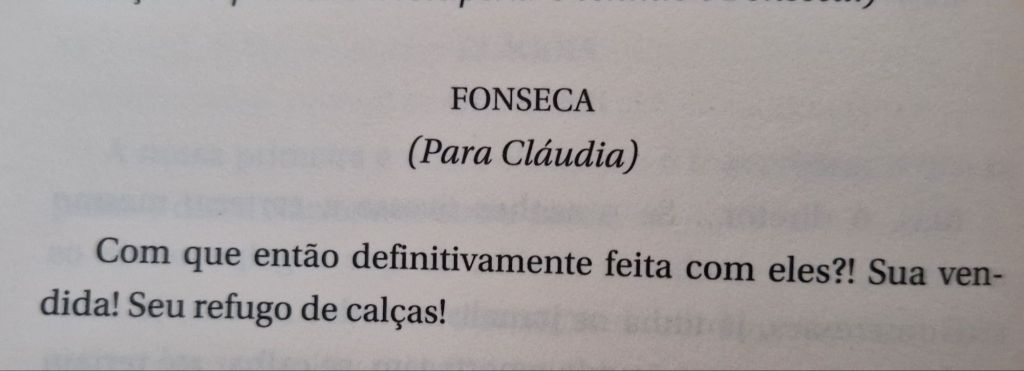
I had to ask around about this one*. The speaker, Fonseca, is siding with management and Claudia is much more supportive of the coup that is in progress as they’re talking. He obviously blames her (rather unjustly, as far as I can tell) for what is going on, but one way or the other, they are definitely forming into rival camps, according to whether or not they’d support the revolution, so there’s a lot of class animosity behind the words, which is why he’s being such a twat.

He calls her “Sua vendida” (you traitor, you person who has sold herself) and then, slightly confusingly, “Seu refugo de calças”. You what now? You pile of leftover, defective trousers? I asked reddit what was going on. He’s calling her a refugo, and she’s wearing trousers, so he’s more or less saying “your a junk heap on legs” or “you’re a walking pile of garbage” or words to that effect.

As soon as I was told that, I asked myself whether there was a bit of machismo entering into the equation. The play takes place in the seventies, and I wondered if, by referring to her stereotypically male clothes, he was implying some sort of lack of femininity, ugliness, dowdiness, lesbianism, or something like that. I dunno. I suggested it and people didn’t seem convinced, but maybe they’re young and don’t know what people were actually like in the seventies. I do, and I can 100% imagine that. I don’t know, Portugal isn’t Britain, but I’m not ruling it out.

Anyway, don’t worry about her, the revolution wins in the end. Whoops! Spoilers!

*UPDATE

In a shocking turn of events, it turns out that the assembled wise owls of Reddit might have misled me about “refugo de calças”. I probabky should have guessed. The suggestion above is a bit modern-sounding. It’s a remendo – a patch – on some trousers that would otherwise have fine in the bin because they’re worn out in the crotch. So by implication, it’s the lowest if the low. This definitely sounds more in keeping with the general tone. Thanks to Cristina for pointing this out.

Posted in Portuguese

A Noite – José Saramago

A Noite ' Saramago

A Noite é o… Hum… Sétimo Livro de Saramago que já li, mas é diferente dos outros porque é uma peça de teatro. A ação passa-se no escritório da redação do Jornal de Lisboa nos anos setenta. Durante o primeiro ato, conhecemos as personagens, os seus cargos na empresa e as suas atitudes face ao governo de Marcelo Caetano. Um rádio está a tocar em* pano de fundo. Após algum tempo ouvimos “E Depois do Adeus” de Paulo de Carvalho, e começamos a perceber (se ainda não soubéssemos) em que noite especifica a peça é passa-se. Mais tarde ainda, a abertura do “Grândola Vila Morena” toca, o que causa o editor do turno de noite gritar “Desliga-me isso” e as luzes apagam-se, deixando o palco na escuridão.

No segundo ato, os jornalistas ouvem os boatos da revolução que está em curso, e tentam averiguar os factos. Uma clivagem abre-se entre os apoiantes do regime (principalmente os gestores, o editor e o diretor) e os socialistas (os trabalhadores na sala de impressão**, alguns jornalistas) que vêem com entusiasmo a ditadura a chegar ao fim.

O caos daquela noite é muito bem ilustrado, e o autor também retrata as divisões no país daquela época pelo exemplo de uma empresa cuja estrutura espelha a estrutura da sociedade. Para mim, o pior do livro é o desfecho: achei o coro de vozes demasiado óbvio, como se fosse uma propaganda, mas suponho que, da perspetiva de 1979 (quando a peça se estreou) era importante defender a liberdade, contra quem ainda tinha saudades da PIDE, e talvez seja por isso que às últimas 2 páginas da peça faltam uma certa sutileza visto por gente moderna!

*Em, not no. In background, not in THE background

**A Gráfica would also work for print room

Thanks as ever to Cristina of Say it in Portuguese for the help

Posted in Portuguese

Bater umas Chapas 📷

Encontrei mais uma expressão idiomática desconhecida. Adivinhei o significado pelo contexto: tirar umas fotografias. O livro é “A Noite” de José Saramago que conta a história dos jornalistas na sede de um jornal durante a noite na qual o Movimento das Forças Armadas executaram o seu golpe do estado em 1974, e o Baltasar é um fotógrafo.

Mas acho que esta é uma expressão que não vou sacar durante o exame C2 porque é antiga, mas acima de tudo porque há uma outra expressão que é muito parecida mas cujo significado pode provocar uns risinhos se fizer um errozinho…