Posted in English

Only a Gingeira Can Call Another Ginjeira Ginjeira

Well, this is a bit worrying. I’ve just written a blog post about the expression “Conhecer de Ginjeira”. When I went to tag it, my WordPress site seemed to recognise the expression, so I looked it up and found I’d already written the same explanation just a few months ago, in July. I often feel like my memory is declining in my late middle age, which is a cause for concern in a lot of ways, and definitely makes learning a language an uphill struggle. But to have researched and written a blog post just 15 weeks ago and to have zero recollection of having done so… Oh lord, my braincells are an endangered species. Anyway, for what it’s worth, here’s the November version of July’s article.

I came across an expression I didn’t recognise today: Conhecer de ginjeira.
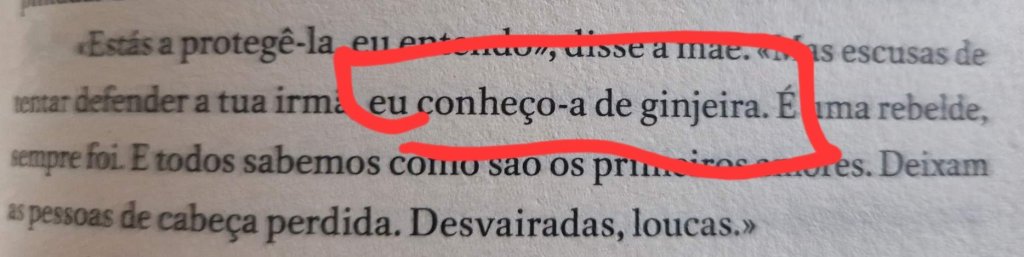
It seems like not very much is known about the origins. An answer on the always-reliable Ciberduvidas says that it’s usually mildly negative, maybe implying you know their tricks and won’t be taken in by the. It goes on to suggest it is probably a rural expression meaning you’ve known them since you were young enough to pick ginjas (sour cherries) together. Like a lot of -eira words – pereira, maceira, nogueira, bananeira – a ginjeira is the tree on which the fruit grows.

The origin doesn’t quite fit this case because the speaker is the mother of the person under discussion, but that’s fine, expressions often take on a life of their own.

Posted in English

Qual É A Dúvida

I’ve just finished Qual É A Dúvida and I was really impressed. I’d spent a lot of time bogged down in a really tedious, repetitive exercise book beforehand and I could never motivate myself to open it, so switching to this was a real breath of fresh air. It’s got 25-35 questions in every 2 page section. Its purpose is to focus on some of the trickier aspects of grammar that you might have found hard when you learned about them. As such, it isn’t a textbook and doesn’t give very detailed explanation of each topic because it assumes you’ve already learned it and just need to practice some examples to get the hang of the. So you get a super-basic summary of the rule or difference it’s trying to highlight and then it leaves you to fill in the spaces. It covers relatively basic stuff from B1 up into some really twisty grammar for C2 level.

I found it challenging in places, but even in the easy pages, I never really felt like I was wasting my time.

It’s really one of my favourite books so far, and I have marked some of the harder pages to review again later.

I’ll put the first contents page below so you can see what it’s hitting at the intermediate level, but the whole thing spans three pages.

Strong recommendation if you’re intermediate/advanced. And if you’re looking to load up on textbooks, remember I have a special page for that and it’s here.

Posted in English

Lisbon by Neill Lochery

I’ve had the audiobook of Lisbon by Neill Lochery on my listening list for a while now and finally got around to it simply because I had started Enquanto Salazar Dormia by Domingos Amaral And wanted a little more background about wartime Lisbon to give me the context.

Lisbon - War in the Shadows of the City of Light, by Neill Lochery.

I learned a lot! I’d always known Portugal had a slightly odd place In World War 2 History: Salazar, as a fascist, was probably more inclined towards Hitler’s world view, but Portugal and Britain have been allies since way back. I also knew we hadn’t always been good allies (see this post about the portuguese national anthem starting life as a diss track about the treacherous land-stealing British empire).

What I hadn’t realised was how many different schemes and counter-schemes were swirling around the capital, or how delicate was the balance that kept the Iberian peninsula out of the war.

Nor had I any idea that part of Portugal’s reason for distrusting Britain was that Neville Chamberlain had offered Angola to Hitler as part of his appeasement negotiations. Or about the delicate situation regarding Wolfram (Tungsten) mining that was necessary for both sides’ war effirts. At one point, a network of SOE agents had recruiters portuguese sub-agents and poised then to blow up mining infrastructure and assassinate some key people in the event that Portugal was invaded by Spain at the behest of the nazis and there wasn’t a padeira around to hold them back.

It’s absolutely amazing. I love all that stuff.

Posted in English

Manuel Cardoso Brings His Comedy Show to London

This event, happening in London next week, looks like it could be fun. The guy is a comedian who does sketches, and he’s put together a show about bad behaviour (“red flags”) which he’s touring around 10 cities including London.

I assume he’s still going to be speaking portuguese in the London gig… It’s a bit confusing though because he’s given it a title in english and there are no warnings to say it’s in portuguese, so aren’t there likely to be punters who just see it in the What’s On pages, fancy a night out and just buy a ticket on the off-chance? The fact that there are no warnings make me wonder if he’s doing an english version. On the other hand, the online ticket purchase is all in portuguese, so… assuming that’s the only way to get one, hopefully that will keep the riff-raff out and it’ll be safe to do the portuguese show for teh portuguese crowd. Anyway, I’m crossing my fingers. It’s on the day before the exam so I am counting on it being equal parts funny and challenging!

I’ve seen quite a few of his videos and he’s very good, but comedy is always tricky since there tends to be a lot of slang, fast talking and references to events that maybe don’t make sense to outsiders. An hour and a half of that might be pretty challenging if I lose the thread of what he’s talking about! Anyway, I’ll listen to a few more of his videos and try to get really familiar with his accent and the kinds of things he talks about.

You can book tickets on this page (which,just to thicken the plot even further, has a description in both languages!)

Posted in English

Punning with the Brazilians

I really like being able to make puns in another language. That’s me, the first comment u der the main post.

As you probably know, or can probably guess a Centavo is a hundredth of a Real (Brazilian currency)

I think the people following up are mocking the collapse of the Argentinian Peso. It’s lost more than half it’s value in the last year including a sharp drop-off when the sensible candidate got knocked out if the election race.

Posted in English

Underlining

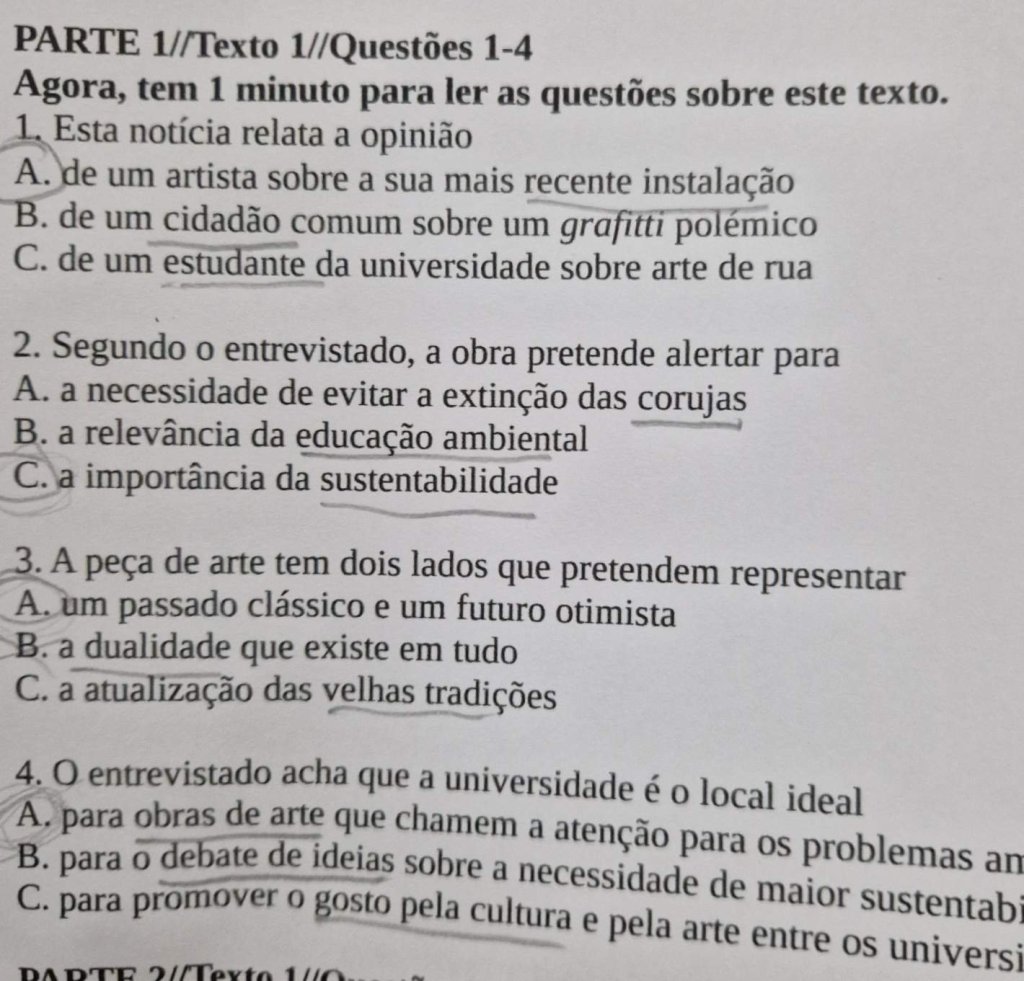
I have been practising Compreensão do Oral tests recently. They’re th hardest part of any CAPLE exam because even if you have read the answers, you still find yourself having to parse each one while trying to listen to what the recording is saying. This is nigh on impossible, and so it’s easy to drop marks.

What I’ve been finding works really well is to use the minute to scan each answer and underline one or two words that act as key words for the whole thing. That way, when the speaker answers the question, you only need to look at he underlined words. If its more ambiguous, maybe it’ll need more work, but over all, I find I can answer without wasting so much time, which means I don’t end up feeling left behind and panicky.

I find it works pretty well. I’m not getting perfect marks or anything but I feel much more in control and I am definitely going to use this in the DAPLE exam itself.