Posted in English

Giving Face

As usual, I’m reading 12 books at once and consequently not getting through any of them very quickly but here’s another nice expression I found today in a book I’ve been reading for a disgracefully long time.
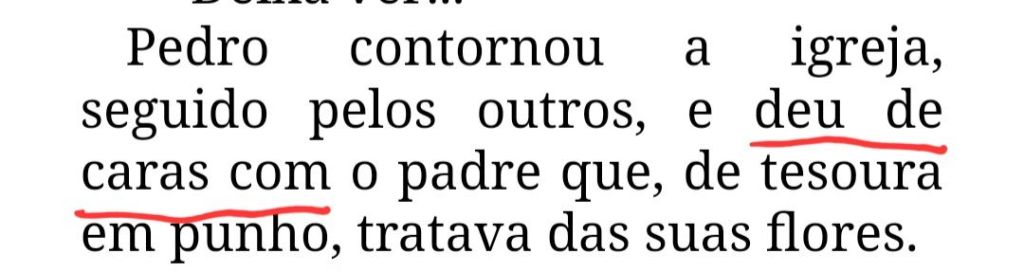
The meaning is pretty obvious from the context. “Dar de caras com…” means to run into someone unexpectedly. It’s similar to “come face to face with” in English but seems to be slanted in the direction of an unexpected encounter rather than being any situation where you’re confronting someone.

While researching, I came across a couple of other dar/cara pairings with slightly different meanings so I’ll get those down in the same blog post just to keep my thoughts organised.

Dar a cara means to take responsibility. I guess the nearest English equivalent would be “face up to”. Linguee gives a few examples, so here’s one. “A União Europeia precisa de dar a cara aos seus desafios”.

Dar com a cara na porta is like “bater com o nariz na porta”. The idea is that you’ve gone to a shop and found it’s closed so instead of the door opening for you, you smack into the glass, face first. I think more figuratively it can describe any other situation where you ask for something and find that there’s no chance whatsoever.

I’ve tried to take these examples from European portuguese. I found a few examples of some of these being used in slightly different ways by Brazilians but let’s keep it simple eh?

Posted in English

Coisas

Phrase spotted in the wild. “Já não diz coisa com coisa”. Dizer (or falar) coisa com coisa is almost always used in the negative sense. It means you’re talking in a disconnected way, or just generally not making sense.

Not to be confused with “não estar com coisas” which means you don’t hang about, you act promptly.

Posted in Portuguese

Teoria das Colheres

Antes do natal, escrevi um prefácio (em inglês) de uma opinião sobre um livro português, na qual utilizei a expressão “If you’ve got the spoons”

Not that kind of Spoons (photo by Philafrenzy)

Este modo de falar é muito moderno mas o conceito é bastante simples e até nós, homens de meia-idade devemos conhecer o sentimento. Christine Miserandino, uma escritora e ativista americana usou a expressão “teoria das colheres” para ilustrar a sua experiência de viver com lúpus, uma doença grave que provoca cansaço excessivo.

Ela sentia-se como se tivesse um conjunto de colheres, e cada vez que tem de fazer alguma coisa ou ler alguma coisa ou pensar nalguma coisa, isto “custa” um determinado número de colheres. Ela tem de pensar “e se não tiver colheres suficientes para cumprir as tarefas todas do meu dia-a-dia?” Se não, talvez fosse melhor guardar as colheres por enquanto e “gastá-las*”em algo mais importante.

Não tenho lúpus mas esta descrição é perfeitamente nítida. Às vezes, novas tarefas e novas atividades entram nas nossas vidas, mas para ocupação já basta a nossa**. Se isto acontecer, segue o conselho reserva as tuas colheres para usar mais tarde.

*I think usar is a more sensible verb to use here and I was advised to change it. I actually decided to stick with gastar but put scare quotes around it because i was following on from “custar” in the previous sentence and the idea that she is “buying” a activities from a fund of energy but I’m probably talking rubbish since if Miserandino wanted you to “spend” the spoons she probably would have called it coin theory, not spoon theory wouldn’t she? Oh well…

**Hm… I worry this sounds like I am minimising lupus in some way. Not the intention obviously – I’ve really just tacked this paragraph on as an excuse to use that phrase from yesterday!

Thanks as ever to Cristina of Say It In Portuguese for her patient corrections.

Posted in English

Junk in the Trunk

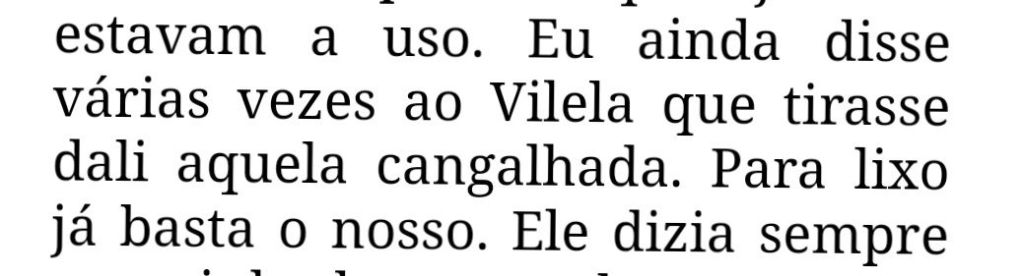
Here’s a little snippet from the book I’m reading at the moment. It’s a children’s book, similar to the Famous 5, about a pair of twins and their friends who have gone to stay with their tia Judite on her farm for the holidays, where they have an adventure. In the snippet they are asking the lady of the house where she got the load of manky old mattresses in the celeiro (grain storehouse). Why do they want to know? Read the book and you’ll find out. There’s a treasure map involved.

I was mostly interested in the phrase “Para lixo já basta o nosso” which is obviously something like “We have enough junk of our own”. I love little scraps of useful sentencecraft like this. It seems hard to think of a situation I can use it in but I’ll try!

The previous sentence contains another new bit of vocabulary: cangalhada, which is a “conjunto de trastes velhos”. And what, pray, is a traste? Well luckily priberam let’s you click on any word on its pages so I found out it’s a piece of furniture of little value. So basically a cangalhada is a load of old junk.

Quite enjoying the book. There’ll be a review soon enough, but it’s a solid short novel, not as childish as I was told. Well, I mean it is, in that the story is quite straightforward, but it’s properly written. They aren’t spoonfeeding the kids with babyish sentences and easy words!

Posted in Portuguese

Missa do Parto

Além de vermos filmes parvos* em casa hoje, vimos uns vídeos portugueses, incluindo este, gravado perto do Funchal onde existe uma tradição chamada “Missa do Parto”. Este é um ritual religioso e comunitária que comemora os nove dias antes do natal. Os cidadãos vão a pé para a igreja às… Sei lá… Talvez cinco de manhã, cantando e tocando instrumentos. Celebram uma missa, e depois ficam perto da igreja, cantando, comendo e bebendo enquanto o sol nasce e depois arrancam para o trabalho.

*Honestly, so bad. We really embraced the horrible, made for Netflix holiday romance this year.

Posted in English

Tão gostoso!

My wife is making me watch this Madeiran cooking channel. I was unsure at first because the accent and the regionalismos were hard to get past, but it’s great. She’s hamming it up a bit, apparently: she’s playing a character of an old-time islander. I guess in English terms it’d be like someone doing a strong Welsh accent.

The food looks flippin’ great though: traditional and full of delicious calories. The camera work is fantastic and I would give my right arm for her massive clay mixing bowl. And although I hardly understand her dialogue I’m enjoying trying.

Also sort of hoping Mrs L will cook some of these things…

Posted in English

Well This Looks Interesting

It came up in my YouTube feed and I’ve no idea how I’m going to be able to watch it but I’m definitely going to try. The empty nest theme strikes a chord since our baby left home for uni this year. Speaking of which, she’s coming home for Christmas later today and I’m a very happy daddy!