Esta manhã, como todas as outras, acordei às cinco. Tomei o pequeno-almoço de oito ovos crus e um copo de sumo de laranja. Vesti uns calções, uma t-shirt, meias curtas e sapatilhas de corrida (deixei-as na cadeira a noite passada). Saí do apartamento e corri uma maratona (uma corrida que consiste em quarenta e dois vírgula dois quilómetros). Voltei duas horas mais tarde, espremi o suor da minha t-shirt e comi o segundo pequeno-almoço de mais quatro ovos.
Passei o resto da manhã a fazer flexões com um saco de areia nas minhas costas para fazê-las de forma mais difícil. Depois do almoço (mais onze ovos… e uma uva para os hidratos de carbono) e ler algumas paginas de “Level Up Your Life” de Steve Kamb para a motivação, comecei de fazer os exercícios verdadeiros: halterofilismo. Corri para o ginásio (só fica a vinte quilómetros do meu prédio), levei o haltere maior e ergui-o em cima da minha cabeça com uma mão. Como em todos as tardes, fiquei no ginásio durante cinco horas. Fiz duzentos agachamentos de forma correta, trezentos supinos, mil duzentas e quinze elevações, duas horas a saltar à corda e uma hora de treino intervalado de alta intensidade. Depois disto, bebi um shake de proteínas e fiz os meus alongamentos.
Se tivesse uma fotografia deixaria-a aqui mostrar os meus músculos enormes e barriga definida mas não tenho. Desculpe. Em vez disto, há uma imagem doutro homem que é quase tão forte como eu.
This was originally on iTalki but it’s not possible to write a proper corrected version. Thanks to my teacher, Sophia for correcting my terrible errors.
Fiquei feliz de encontrar o livro audível de Amor de Perdição de Camilo Castelo Branco, disponível de fazer o download gratuitamente em Librivox ontem. Librivox é um projecto voluntário para narrar vários livros de domínio público e distribui-los na internet. Há também outras obras Portuguesas, incluindo Os Lusiadas mas parecem narradas por Brasileiros, assim evito os seus sotaques pelas razões habituais. Espero ouvir isto cedo!
O Comentário em Librivox diz:
Amor de Perdição é uma das obras mais marcantes de Camilo, um dos mais importantes e proliferos romancistas portugueses. Inspirado nos amores de Romeu e Julieta, Camilo conta-nos a história do amor proibido de seu tio Simão, de intrigas, crimes e desespero. Mas a história relata-nos também o seu próprio sofrimento, já que Camilo a escreve na Cadeia da Relação do Porto, onde está preso por um amor proibido
…or in English…
I was really pleased to come across a free download of the audiobook of Love of Perdition* by Camilo Castelo Branco on Librivox the other day. Librivox is a voluntary project to record audio versions of public-domain works for distribution via the internet. They have a few other Portuguese works too, including The Lusiads but they seem to be recorded by someone in Brazil so I’m avoiding the accent for the usual reasons. I’m looking forward to this though!
The Librivox blurb says:
Love of Perdition* is one of the most remarkable works of Camilo, one of the most important and prolific Portuguese novelists. Inspired by the loves of Romeo and Juliet, Camilo recounts the history of the forbidden love of his uncle Simão, of the intrigues, crimes and despair. But the story tells us also of his own suffering, because Camilo wrote it in the Cadeia da Relação in Porto, in which he is imprisoned for a forbidden love.
*=I believe it’s known as “Doomed Love” in the standard translation, actually.
Ontem, fui ao “Soho Teatro” no centro de Londres para ver uma comédia chamada “What if there is no toilet?” (“E se não há casas-de-banho?”). É um espectáculo duma comediante australiana que se chama Felicity Ward. Eu sei, parece um tema muito estranho para uma comédia, mas foi muito engraçado, e muito agradável. A Felicity Ward falou da sua vida com Síndrome do Intestino Irritável e a ansiedade de estar longe duma casa-de-banho e precisar de fazer coco ou xixi. No começo do espectáculo,
pude ver no palco uma sanita em vez duma cadeira, e em cada lado do palco, havia uma pirâmide de papel higiénico. A meio do espectáculo, ela abriu a sanita, e fora dela tirou uma garrafa de água, e começou a beber! Mais tarde, quando contou uma história embaraçosa, produziu umas folhas do papel higiénico de dentro da sanita e fez um bigode de papel higiénico para ela mesmo. Se alguns membros da audiência quisessem sair das suas cadeiras para usar a casa-de-banho, ela pediu-lhes fazer um sinal “T” com as suas mãos para indicar as suas intenções. Por isso, eles vieram a ser membros do “Team Toilet” (em inglês, isto é talvez equivalente a “Equipe do Banheiro”)
O que a Felicity Ward acha da vida em Inglaterra? Não pode acreditar como é difícil de procurar uma casa-de-banho pública. “Em Kings Cross, custa 50p para usar a casa-de-banho, mas apercebi-me que há dois pianos, para os viajantes usarem gratuitamente. Fiz xixi num piano”.
Reflections
This was quite a tricky one when I wrote it on iTalki because at least one of the people who helped correct it had underestimated how icky it was. When I said she took toilet paper out of the toilet, I guess it seemed like I meant she put toilet paper into the toilet, which, on the face of it, seems more likely.
In fact, even the translation of “toilet” is a bit tricky. I originally went with “E se não há sanitas!?!?” for the title. Sanita is the actual bit you sit on – the throne, if you like, but I think the feeling was “Casa-De-Banho” (the room the toilet is in) was the salient point. The trouble is, “house of bath” sounds a bit off to me. I dunno. The translators of the Bible had similar problems. In 1 Samuel 24, David goes into a cave to “cover his feet” (squat down for reasons you can imagine, in a way that will make his robes drape down over his feet). Obviously this phrase means nothing to a modern speaker of english, so various translators of the various versions of the Bible such as “relieve himself”, “make water” or “go to the bathroom”. I love the idea that, in the desert, hundreds of years before Christ, he’s going into a cave, flicking a switch and finding an avocado-coloured bathroom suite, tiles and a bog-brush.
Another contentious word was “cocô” which is the way the Brazilians write “poo”. M’wife tells me it’s “coco” in Europe, although, confusingly that also means “coconut”. I assure you, she wasn’t worried about needing a coconut. Does the orthographic agreement cover poo, I wonder?
I left “Equipe do Banheiro” as it was, as a translation of “Team Toilet”, even though it’s more of a Brazilian way of saying it, The European version suggested was “Equipe da Casa-de-Banho”. The reasons for choosing the Brazilian were (1) it sounds more like a team name and closer to the rhythm of “Team Toilet” and (2) Felicity Ward is Australian so she speaks a hideous, barbarous travesty of English* so why not translate her words in a hideous, barbarous travesty of Portuguese**?
*=joking, obvs***
**=joking again, obvs****
***=I probably shouldn’t over-explain but you know I’ll get hate mail if I don’t lay it out for the benefit of humourless people in Canberra
My Portuguese Teacher, Sophia, has a blog now, so if you’d like to get slightly more authoritative views on the language, you could do a lot worse than to pop over there and have a look.
It’s always a good idea to have some tricks up your sleeve for learning languages when you don’t feel like it, when you want to increase the density of [insert name of language here] in your life, or when you just want a change of pace. Here are a few of my favourites:
Trivia
I found it pretty hard to find good apps for learning European Portuguese, but it’s relatively easy to find good quiz apps and many of them have other language settings. I have a copy of Trivia Crack which I’ve set on Portuguese so I can enjoy farting about playing games and still be learning new words, phrases and pop culture references and (crucially) facts about Brazilian football. It has its drawbacks of course: most of the questions are written by Brazilians so you get quite a lot of Brazilian grammar in there, but still, it’s more educational than Angry Birds.
If you’re feeling feisty, there’s even a “translate questions” feature that lets you translate Portuguese (or whatever) questions into English.
Change the Way You Use The Web.
If you spend a lot of time online (ha ha ha, sorry, I’m kidding – obviously you do! It’s the twenty-first century and you probably haven’t left the house in weeks!) you can massively increase the amount of language in your life by tweaking the settings on your most-used websites. The obvious one for me is my Google Account settings, which affects all my search results, plus the menus in Google Chrome, names of folders etc in Gmail, spellcheck in Google Docs, names of days and months in Google Calendar and half a dozen other things.
I’ve also changed twitter, but that doesn’t do much except teach you some stupid pretend words like “tweetar” (shouldn’t that be “pipiar”???). I daresay if you use Facebook you could get some mileage out of changing the language settings in that. I would love to change Windows and MS Word too but that’s surprisingly hard to do.
Memrise
Memrise is really the only dedicated language-learning app worth having. What makes it different from other apps is that it keeps track of the words you’ve learned and returns to them a short time later, to jog your memory so that they really stick. There’s some science behind it apparently. I dunno. It works pretty well though.
The decks are made by users, so they vary in quality. Some are mildly irritating. For example, they will count something as wrong because you used a lower case letter instead of a capital, then in the next slide you’ll use a capital and it’ll mark it as wrong because now it wants a lower case. That doesn’t stop it being a kick-ass language-learning tool though. I usually have a go on it while I’m brushing my teeth at night and while I’m eating my breakfast in the morning.
As with most things, make sure you specify European Portuguese, not Brazilian.
Podcasts
If you’ve got some mindless task to perform, don’t listen to the new Kanye West album, listen to someone speaking your chosen language instead. Portuguese (as opposed to Brazilian) podcasts are hard to come by but you can find them if you look hard enough. Some of my favourites are:
Practice Portuguese These are produced by a native Portuguese guy called Rui and his Canadian friend Joel. They’re explicitly aimed at developing listening skills for the new learner. Unfortunately it doesn’t come out quite as regularly as I might hope, so I don’t think I can recommend you subscribe to the premium version [* UPDATE here *]
Caderneta De Cromos A series on Rádio Comercial about eighties pop culture, covering Star Trek, Pat Benatar, Ghostbusters, Space 1999, Rocky, Pac Man… What’s not to like?
O Novo Normal Bite-sized morsels of interesting things – you know, productivity tips, brain science and that sort of thing. Possibly not reliable but certainly interesting as a five-minute listen while the kettle boils.
Revista De Semana This is a podcast from RDP International, broadcasting to the Portuguese “Diaspora” and it’s interesting to me because it deals with the issues affecting Portuguese people around the world. The consulate in London comes up a lot (not in a good way) and recently there have been issues with some countries in Europe banning Portuguese children from speaking the language in the playground.
You could also look for “Grande História Universal das Traquitanas” which I’ve heard is very good but it doesn’t seem to be downloading when I try [*Another update: I’ve found a way of getting them: you have to open the page in Internet Exploder, not Chrome. .You still can’t subscribe, but you can download the episodes individually, so that’s my listening for tomorrow sorted out!*]
A lot of podcasts are quite hard to find in iTunes but I’ve found some interesting nuggets by looking on the websites of Portuguese broadcasting companies. Here’s Rádio e Televisão de Portugal’s for example. There is usually enough variety that you’re bound to find something that suits your interests and ability level.
Taking a left-turn at the traffic lights, there are some good, inspirational podcasts for language-learners in general. Have a look at “Actual Fluency” or “Creative Language Learning” in iTunes, for example. Personally, I can only take this kind of thing in small doses, but a little of it now and again is good. It reminds you that you’re not alone and it gives you some ideas from the hardcore language-ninjas.
Music
If podcasts aren’t your thing, there’s always music. I’m a bit ambivalent about music as a learning method. A lot of people recommend it, including my wife, but I often find it’s like watching as a stream of syllables rushes by at speed. I think unless you’ve taken trouble to read the lyrics written down beforehand and compare with a translation, it’s difficult to pick the words out and appreciate them. Of course, you can still enjoy the music, but understanding the music adds a whole other dimension.
If there’s one thing Portugal has lots of, it’s music. I’ve already mentioned (here) my favourite song at the moment is by Deolinda. I also loves me some Mariza
Some of the old Fado music is pretty powerful, especially if you get the right singer, and singers don’t get much more right than Amália Rodrigues
Label Your House
I mentioned, last week, posting post-it notes all over my house with the names of things on them. That’s quite a cleaver way of bumping up your vocabulary a bit without really trying, although with hindsight I wish I’d written the words in larger letters with a big fat marker, as I find myself peering at the post-its instead of having the words thrust in my face.
Lindsay Does Languages has a brilliant variant on this theme. I came across it earlier today and decided to incorporate it in my life as soon as I get a free minute (2019, I think). While you’re at it, have a look at some of the other articles on her site. They’re pretty good fun.
Films
If you’re clever enough to understand films made in your target language, that’s a great way to learn more. Me, I’ve looked at a few – like “A Costa Dos Murmúrios”, “Capitães de Abril” and “Ossos” but I found them too hard to follow.
Easier fare would be an English-Language film you’re seen before, dubbed into your target language. That usually means children’s animated films, since nobody ever dubs live-action movies. If you’re like me and learning Portuguese, try and check that the actors doing the voice-overs aren’t Brazilian. The last thing you want is all that Eejy Beejy Beejy thing that Brazilians do. We have three dubbed films in the house (*points* at the picture at the top of this section) and it’s good because my daughter likes watching them too. Turn on English subtitles if you are very new to the language, or Portuguese subtitles if you just want written clues to help you disentangle the words.
So once you’ve picked your book, what can you do with it? Well, as I see it, there are three styles of reading in another language, and I vary them depending on what I’m reading and what mood I’m in:
Slow Reading
This is the hardcore, grind-through-it-with-a-dictionary option. The aim is to translate every word and understand every sentence to know exactly what is being said and what tense it’s being said in. You’ll need a good dictionary for this of course, and you’ll need a lot of patience, usually, or at least you will if your vocabulary is as pitifully limited as mine is.
If you are a fan of kindles, this method becomes a lot easier because of course it has a built-in dictionary so you can just highlight the word and it’ll tell you the meaning. I’m not a fan of Kindles but I’ve used this and I can see the attraction.
Fast Reading
The aim with this one is only to practice your accent and your reading skills: read the text out loud and don’t worry too much whether or not you can understand it. Have someone listen to you and correct your pronunciation. Obviously the drawback of doing this with a book you’re actually trying to follow is that it become a black hole in the narrative, and you’ll have to go back and read it properly if you want to retain your grip on the plot, but if you’re reading a book of short texts like the running manual I mentioned in part 1, it won’t matter too much if you just read one section for phonetics, especially if it’s covering something you already know.
Half-and-Half Reading
I saved the best for last. I sometimes like to read the text at a sort of half-and-half pace, without looking up any of the words, but slow enough that I can follow most of what is being said. I use it as practice for understanding the language as a whole, following enough of what’s being said to draw out the general gist. I only really use a dictionary if there is one word that comes up over and over again, and seems key to the text, but other than that I just skip over the gaps in my understanding. It’s a bit like watching actors on stage under a strobe light. There are gaps in what you can see, but your mind fills it in. I don’t think I could read a whole novel like this, but at times it can be quite thrilling and a good alternative to the hard work of looking up every unfamiliar word, and it forces you to think of words in their wider context rather than as individual dictionary-entries. In short, it’s the nearest thing I can really get to “Thinking in Portuguese” producing a stream of language and trying to process it without really having time to translate it all.
Want to know more? If you’ve read this post and the preceding one and you are hungry for even more reading tips, there’s an article on FI3M about reading that has some interesting tips you could look at. Have a look here. And when you’re feeling suitably inspired, go and find out…
Where to Get Books in Portuguese
Amazon have a few of course, but they’re gits who don’t pay their taxes or their workers. Foyles has a better selection and, if you’re in the UK they’re pretty much just as fast
I like reading, and reading in Portuguese seemed like a good way to increase my vocabulary, but do you need to be fluent to read a whole book? I mean, there are a lot of words in a book, right? Well, no is the short answer. The trick is to think about what kind of book you want to read, and to have a flexible approach to how you read. Here are a few thoughts. Here are a few thoughts about different types of book.
Children’s Books
Books Like “Spot’s First Walk” (in Portuguese “O Primeiro Passeio Do Bolinha“) or “We’re Going on a Bear Hunt” (“Vamos à Caça do Urso“) are a good way for children to learn, for sure, because they have a lot of pictures, which not only makes them more interesting, but also give valuable context to help children (and you!) crack the code of the words and their meanings. There’s also a lot of repetition, which can be helpful. They are a bit limited though. In an average children’s book you’re only really getting a few dozen words, so you will probably want to move on to something a bit meatier fairly soon.
Comics and Graphic Novels
Now we’re talking! Comics retain the main benefit of children’s books – the illustrations – but they tend to be longer and have more variety in subject matter, meaning you can read horror stories, comedies or adventure stories this way. When I was learning French at school I cribbed a lot of good words and phrases from Tintin and Asterix comics, and I have continued that habit in Portuguese. Now, there are those who would tell you that Asterix books are children’s books and belong in the previous section. These people are fools and don’t know what they’re talking about. I’m pretty sure Goscinny and Uderzo only started writing the books as a gift to language-learners the world over.
I’ve really been enjoying the Walking Dead series in Portuguese. The european portuguese versions are easy enough to follow but be careful because there are some brazilian translations out there too, including on Kindle (serves me right for trying to read a comic on a Kindle, I suppose)
Novels You’ve Read in English
This can be a pretty good line of attack. You’ve read the book so you know the story and hopefully there won’t be too many surprises and that will save you a few trips to the dictionary. Be careful though: one of the unhappiest reading experiences I had was trying to read P G Wodehouse in Portuguese. I love P G Wodehouse, but what I like best is his playful use of language, and of course that doesn’t survive being translated slowly from Portuguese. It was a complete bust and I stopped after a couple of pages. Likewise, Harry Potter and the Philosopher’s Stone is a book I enjoyed but I’ve seen the movie too and I found myself getting bored quite early on. Matadouro Cinco (Slaughterhouse 5) by Kurt Vonnegut, the first book I managed to finish in Portuguese, is another favourite book, but it’s a novel of ideas and I hadn’t read it for years and years, so it was easy to follow along but I still had a few nice surprises along the way.
New Novels
Why not? You’ll have far fewer clues along the way, so it’ll be tougher going, but if you feel up to it, it might be a fun thing to do, and just as exciting as reading any other new novel. Just make it a good one.
Non-Fiction Books
Reading a basic introductory book about a subject you enjoy can be a very good way of starting out in reading. I recently finished “Do Primeiro Quilómetro à Maratona” (“From the First Kilometre to the Marathon”) by Jéssica Augusto. It’s a running book, and I’m a runner, so it had a few advantages:
I was familiar with the jargon so I could get a lot of words from context.
I learned a lot of words that I can use in my everyday life when discussing my interests
I actually learned some new things about running too
It’s broken down into easy, manageable sections that I could read in a lunch-hour without having to worry about following the thread of a novel
Non-fiction can cover a variety of topics, of course, from car-maintenance to three-volume histories of the world, so maybe this section needs to be broken down more, but I haven’t tried to read Das Kapital or “Eats, Shoots and Leaves” (hm, what would that be? “Come, Tire e Parte” I suppose, but I bet there isn’t a translation) so I can’t speak with much authority.
Classics From the Language You’re Learning
I have shied away from this so far but it is definitely on my list of things to do when I am a bit stronger in the language because it’s a good way of getting to know more about the culture as well as the language. Are the two even separable? Discuss.
In Portuguese, I think the big four (as far as my limited understanding goes) would be
Luís Vaz De Camões, author of “Os Lusíadas“, and very much the Portuguese equivalent of – say, Shakespeare, Dante or Cervantes. If that sounds interesting but daunting, there’s a children’s version you could try. There’s even a sort of graphic novel version but it’s brazilian and I can only find it in ebook format.
Fernando Pessoa, author of The Book of Disquiet (O Livro Do Desassossego), who wrote as four different people, any of whom, on their own, could rank among the best poets in Europe.
Eça de Queirós, author of “Os Maias“. He isn’t well known outside of Portugal these days, as far as I know, but he certainly was once . I just looked at his Wikipedia page, and it says that Zola once regarded him as greater than Flaubert, which is pretty high praise.
Jose Saramago, author of Blindness (O Ensaio Sobre Cegueira), among many others, and a recent winner of the Nobel Prize for Literature.
I’m definitely going to read all four eventually, but I’ll stick to the poems of Pessoa and the novels of Saramago at first. E de Q can wait a while, and Camões… well, I don’t know that I’ll ever be up to reading his stuff, I’m afraid. As for The Book of Disquiet, I believe it’s quite existentialist, so I am probably going to wuss out and read it in English. There are braver souls out there though, and there’s a guy on Memrise who has made a course based on new vocabulary he has learned by dictionarying his way through it.
I have some other books written by Portuguese writers too, like “Bichos)” (“Beasts”) by Miguel Torga and Bifes Mal Passados by João Magueijo, and m’lovely wife has a lot more. If there are any Portuguese people reading this, I’d love to hear your suggestions for other books to try.
Tentei traduzir um poema inglês, usando o pretérito imperfeito do conjuntivo… Espero que o efeito não seja demasiado horrível….
Se não houvesse um prego, a ferradura perder-se-ia.
Se a ferradura se perdesse, o cavalo cairia.
Se o cavalo caísse o cavaleiro seria morto.
Se a cavaleiro fosse morto, o exército se renderia
Se o exército se rendesse, o Reino seria arruinado.
Por falta dum prego, o Reino seria arruinado.
Reflections
This is a translation of a poem in English that has quite a few variations but goes something like this:
For want of a nail the shoe was lost, for want of a shoe the horse was lost, for want of a horse the knight was lost, for want of a knight the battle was lost, for want of a battle the kingdom was lost. So a kingdom was lost—all for want of a nail.
I only picked it because it seemed like a good excuse to use a lot of subjunctives.
When I originally wrote it I made the silly mistake of simply looking up the word “nail” in the dictionary and simply using the first word (“Unha”) that came up. Thus it was that I published a notebook entry in iTalki that seemed to suggest that the kingdom could be lost because of the lack of a fingernail!
Só há sumo de laranja no frigorífico. Nada mais para pôr nos cereais a menos que ache o ketchup ou a maionese ou mesmo o sumo da salmoura seriam apetitosos nos seus Toastios, mas eu não achei assim, e nem a minha irmã, embora ela comera muitas coisas estranhas na sua vida, tal como cogumelos em chocolate.
“Não há leite” disse a minha irmã.
“Não”, eu disse, olhando atrás da compota no frigorífico. Nenhum mesmo.
A nossa mãe saíra para uma conferência. Estive a apresentar um documento sobre lagartos. Antes de sair, lembrou-nos das coisas importantes que se precisa de fazer quando não estiver presente. O meu pai estava a ler um jornal. Não acho que ele dá muita atenção ao mundo quando lê o seu jornal.
“Ouviste-me?” a mamã perguntou, estava desconfiada. “O que eu disse?”
“Não esquecer de levar as crianças para o treino da orquestra amanhã; há violino na quarta-feira; congelaste jantar para cada noite que estarás ausente e rotulaste-os; a chave extra da casa está com os Nicolsons; o canalizador chega na segunda-feira de manha e não usar a sanita ou puxar o autoclismo até depois da sua visita; alimentar o peixe dourado; amas-nos e regressas na quinta”, disse o meu pai.
Acho que a minha mãe ficou surpresa. “Sim, tudo bem”, ela disse. Deu-nos beijinhos . Então disse “Ó, e estamos quase sem leite. Precisa-se de comprar algum.”
Quando saiu, o meu pai e eu tomámos uma chávena de chá. Ainda há leite.
Descongelámos o Jantar Número Um, mas fizemos uns erros. Por isso, fomos a um restaurante índiano . Antes de ir para a cama, o Papa fez-nos duas canecas de chocolate quente para compensar para O Sentimento da Falta da Mamã
This was originally on iTalki but it’s not possible to write a proper corrected version there. Thanks to my teacher, Sophia for correcting my terrible errors.
O Primeiro Ministro do Reino Unido anunciou recentemente a data do referendo para decidir a saída da União Europeia. Para muitos britânicos, esta questão é cheia de emoção. Mas quais emoções? Saudades duma idade do ouro quando a Grã Bretanha tinha grande poder no mundo? Medo dum futuro incerto? Antipatia aos novos vizinhos da Polónia, do Roménia ou mesmo da Síria (chegando dos países perto do Mediterrâneo).
Como muitas vezes, quando ouvia os debates, acho que a realidade perdeu-se nas discussões emocionais. Não temos um Donald Trump Inglês… ainda, mas há um perigo de despertar os aspectos mais feios do nosso carácter nacional.
[Uau – Penso que estou mais optimista do que o normal. Acho que escrever em Português faz-me mais pessimista!]
Fotografia – Boris Johnson. Tem o cabelo do Trump mas não é tão mau como o do Trump
This was originally on iTalki but it’s not possible to write a proper corrected version there. Thanks to my teacher, Sophia for correcting my terrible errors.

 É um espectáculo duma comediante australiana que se chama Felicity Ward. Eu sei, parece um tema muito estranho para uma comédia, mas foi muito engraçado, e muito agradável. A Felicity Ward falou da sua vida com Síndrome do Intestino Irritável e a ansiedade de estar longe duma casa-de-banho e precisar de fazer coco ou xixi. No começo do espectáculo,
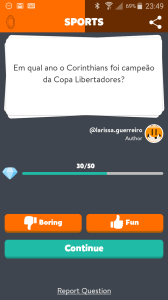 I found it pretty hard to find good apps for learning European Portuguese, but it’s relatively easy to find good quiz apps and many of them have other language settings. I have a copy of Trivia Crack which I’ve set on Portuguese so I can enjoy farting about playing games and still be learning new words, phrases and pop culture references and (crucially) facts about Brazilian football. It has its drawbacks of course: most of the questions are written by Brazilians so you get quite a lot of Brazilian grammar in there, but still, it’s more educational than Angry Birds.
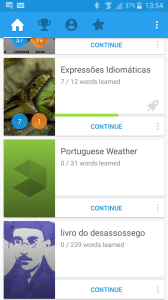 Memrise is really the only dedicated language-learning app worth having. What makes it different from other apps is that it keeps track of the words you’ve learned and returns to them a short time later, to jog your memory so that they really stick. There’s some science behind it apparently. I dunno. It works pretty well though.
 If you’re clever enough to understand films made in your target language, that’s a great way to learn more. Me, I’ve looked at a few – like “A Costa Dos Murmúrios”, “Capitães de Abril” and “Ossos” but I found them too hard to follow.

 comics, and I have continued that habit in Portuguese. Now, there are those who would tell you that Asterix books are children’s books and belong in the previous section. These people are fools and don’t know what they’re talking about. I’m pretty sure Goscinny and Uderzo only started writing the books as a gift to language-learners the world over.
 is a book I enjoyed but I’ve seen the movie too and I found myself getting bored quite early on.
 “, and very much the Portuguese equivalent of – say, Shakespeare, Dante or Cervantes. If that sounds interesting but daunting, there’s a
  (
( ), who wrote as four different people, any of whom, on their own, could rank among the best poets in Europe.
 “. He isn’t well known outside of Portugal these days, as far as I know, but he certainly was once . I just looked at his Wikipedia page, and it says that Zola once regarded him as greater than Flaubert, which is pretty high praise.
 (
(
 ” (“Beasts”) by Miguel Torga and
  by João Magueijo, and m’lovely wife has a lot more. If there are any Portuguese people reading this, I’d love to hear your suggestions for other books to try.
 Luso
Luso 
