
You have to laugh or you’d cry…
OK, not the most modest post title I’ve ever written, but seriously, every time I’ve tried Quina, I’ve managed to get the answer even though it’s insanely difficult. Each time, I get half way though and think “there’s just no way I can do this”. I make silly mistakes, don’t feel like I’ve any solid ground to stand on, and yet, by the end, I pull a rabbit out of the hat.

Ceifa means harvest, by the way. Specifically, it seems to mean harvest using a scythe (gadanha) or sickle (foice), so maybe it means more like “reaping”. And it has a related verb, ceifar, in case you’re wondering.

This guy asked if José Milhazes (he’s the guy in this video and the author of this book) was just a “Todólogo”. I couldn’t find it anywhere but as it turns out, that’s because he’d misspelled it. It should be tudólogo with a U. The suffix “-ólogo” is the equivalent of “-ologist”. And a tudo-ólogo is an everythingolohist. A know-it-all in other words. Someone who acts like an expert on everything but doesn’t really know anything.
I tried to make a joke in a discussion about a previous post and it didn’t work so here’s a very laboured discussion of when and whether “In Soviet Russia” jokes can work in portuguese. It was always going to be a challenging text and, sure enough, I made lots of errors. For me, the tricky part if how to emphasise the reversal at the end. I want it to land hard on the “you” at the end. I’m sure I’ve seen this done in portuguese by doubling up in the pronoun – like “Parece-me a mim…” but I don’t think I really stuck the landing on any of these attempts.
Este texto é uma tentativa de recriar uma piada antiga. Tentei copiar o formato duma resposta a um comentário da Dani, mas acho que não funciona.
Em inglês, o modelo é assim (imaginem que o falante é um russo num programa americano). “Here in America, is very good, everyone watch television. In old country, television watch you!”(1)
Muitos destas piadas não funcionam se forem traduzidas literalmente: “Nos Estados Unidos podes sempre encontrar uma festa. Na Rússia, o partido encontra-te sempre a ti” é engraçado em inglês porque “festa” e “partido” traduzem-se ambos* como “party”, mas em português, nem por isso.
O mais difícil, acho eu, é como enfatizar a inversão dos pronomes. Acho que preciso de usar a forma Verbo hífen pronome indireto [a] pronome subjetivo. Vamos experimentar alguns…
“Nos Estados Unidos, toda a gente vê televisão. Na Rússia** Soviética a televisão vê-te a ti”
Ou talvez “…vê-nos a nós”
No Reino Unido, comem-se nabos. Na Rússia, os nabos comem-te comem-vos a você
Ou talvez “…tu comes nabos…” ***
Hum… A forma “você” parece demasiado formal para uma piada…?
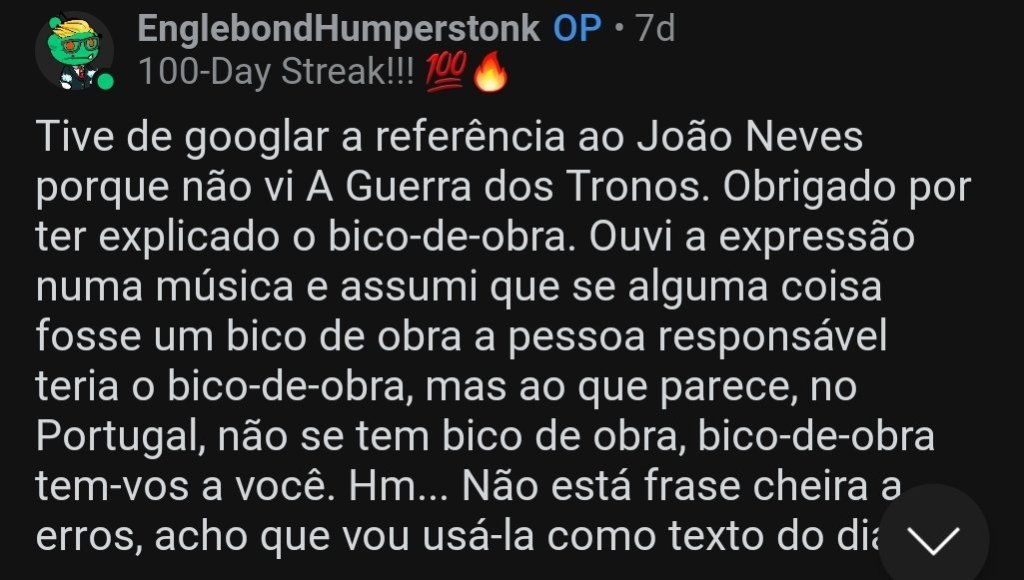
Em Portugal não se tem bico-de-obra, bico-de-obra tem-te a ti****.
Em português, conjugam-se os verbos. Na Rússia soviética, os verbos conjugam-te a ti.
O que acham? O Bruno Nogueira anda preocupado que eu roubo-lhe o emprego?
(1) A conjugação do verbo em inglês está errada, mas vou ignorar. Se as minhas flexões todas estão erradas, não é deliberado, é um lapso.
* Ambos (“both”) goes after the verb, unlike in English.
**The corrector suggested changing this to ‘na União Sovietica’ which is technically right, but I think the joke format tends to be “In Soviet Russia”, not “In the Soviet Union”
*** Although você is formal, it can be used in jokes if the formality is relevant to the situation. It would have been better in the tu form though.
**** This was the original joke I tried to make, leading to my deciding to write this post. When I first tried it, in the reddit comments under a previous text, it looked like this:


OK definitely in a learning slump. No energy to do anything. No energy to post here, listen to anything, even read my book. I’m just a big monolingual potato at the moment. I need to snap out of it.
Will I ever be good enough at listening to understand this sort of thing without the subtitles. Even with the subtitles it’s bad enough.
I saw a bad translation in a vocabulary app: embater =to hit. Well, why is it not just bater? Bater seems to be one of those words that has been used as a rooot to make other verbs, and embater can mean hit if you want to say something like “The car hit a tree”, but it’s more like a collision than a punch. The way it works is…
Bater = To Strike, Beat, Hit. The vanilla version. How you translate it depends on the pronoun, to a certain extent.
Embater = Collide, crash
Abater = Slaughter, cull
Combater = Combat, counteract
There’s also esbater (to blur) and debater (to debate) but I don’t think those are part of the same family since they aren’t as violent.

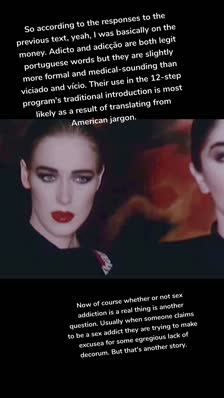
I seem to write a lot about Bater. I wrote a whole post on it a while ago and… Have I posted this meme already? I feel like I must have. It’s pretty old and there are loads of copies so I don’t know who to attribute it to.



 Luso
Luso 