I’m having a meeting with the host of the Learning Portuguese is Fun podcast today because she’s putting together a series of episodes where learners at the B2/C1 level talk to each other and she explains some of their difficulties. I’m a little nervous but also excited.
Category: English
The Perminator
My daughter has been telling people her favourite portuguese music is “Eu Tenho Dois Amores” by Marco Paulo, and she’s even sung the opening line to me a couple of times, but nothing could prepare me for the real thing.
I see a lot of people in the comments are nostalgic for it, and I get that: music that reminds you of a time and a place is always special. And I have to admit, the lad has or a set of pipes on him. But, as someone hearing it for the first time in 2023, it’s pretty cringe. The hair style, the little dance, the fact that he is singing about his two girlfriends who are completely different because um… they have different hair colours… Well, that’s the eighties for you, I suppose!
Cinzas
So I was at the banana museum, admiring the many curved fruits, when I noticed a chart displaying “O Valor Nutritiva do Banana”, listing the amount of fat, sugar, fibre and so on. I neglected to get a picture of it, but you can see it at the very bottom of this page.

So um… What? Why would cinzas (ashes) be in a banana? I puzzled it out and decided it means “potassium”. OK, OK, hear me out. We were in a museum so it seemed at least possible that the tabke was very old. When potassium was first discovered it wasnt really understood but it was known to be alkaline and to be present in ashes. In fact the name “potassium” comes from “potash”, a compound derived from wood ashes. So maybe at some point along the timeline people knew that this unidentified stuff was in a banana but they hadn’t got around to giving it a name yet.
Apparently, I was overthinking it. Cinzas, when it appears in a nutritional chart, jusy refers to the literal ashes or unburned inorganic residue left over when the food has been dried and the fats etc burned off. They can be analysed to figure out what minerals are in there but for some reason, that hadn’t been done by whoever made this table so they have just aggregated the potassium, sodium, calcium, magnesium, etc into one item: cinzas.
IT IS PERFECTLY SAFE TO GET MARRIED IN PORTUGAL!!!
Now, if I know my audience, and I think I do, you all read yesterday’s post, 1 Day of Summer, and immediately circled 31 July next year as the day for your nuptials. Even those of you who are not yet in a long term relationship have signed up for Tinder in the hope of getting a bride/groom lined up in the next 11 months and 28 days. You impetuous fools!
But wait, is it actually safe to get married in Portugal? A meme has resurfaced recently on the Twitter*, purporting to show that fully 94% of Portuguese marriages end in divorce. The sort of people who believe everything they read on the Internet have been lamenting this sad state of affairs as they awaited the Pope’s visit. But it’s bollocks of course. The BBC’s More or Less programme did a short piece about the factoid and tried to get to the bottom of it.
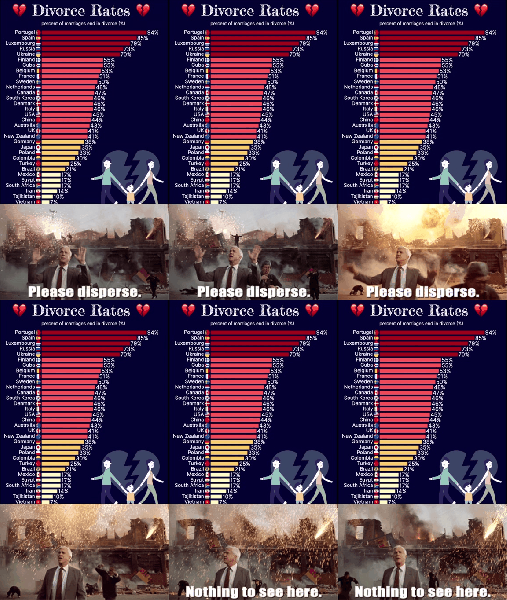
The basic gist is that the account that published it couldn’t back up the numbers. The closest available figure the BBC could find was 91% but that was comparing divorces and marriages in the same year and that year was… Ahem… 2020 when all the churches were closed and nobody was getting married. The real rate is pretty low: lower than the EU average.
So, don’t worry, you can still get married in the 31st of July 2024 in the Douro Valley with Quim Barreiros officiating, but don’t forget to invite me.
*Or “X” as we are now meant to call it… It works well for portuguese learners since the letter is pronounced “sheesh!” and that’s exactly what I say whenever I see the bloody thing.
1 Day of Summer
I had one of those moments on social media where I see something I don’t really understand and I have to go off and unravel the mystery and learn something along the way. It started with this Instagram post from Cinema São Jorge:

I guessed the origin, although I haven’t seen it for years. It’s from the pinnacle of the Manic Pixie Dream Girl movie era, 500 Days of Summer:

And I guess they’re excited because it was July the 31st, the day Quim Barreiros, accordionist and master of Música Pimba has decreed to be the best day to get married. Why? Because “depois entra agosto” (then comes August). It’s explained in this Sapo article but they’re not explaining it quite well enough for a non-native, so let me unravel the pun in all its corny glory.
“A gosto” is used in recipes in the way “to taste” is used in English recipes. Season to taste =Temperar a gosto, or you could just have “(a gosto)” in place of a specific quantity after the name of the ingredient (see this absolutely disgusting recipe, for example), meaning as much or as little as you like. So when he says “depois entra a gosto”, he’s just saying after you get married you can enter (nudge, nudge, wink, wink) whenever you please.
Assim ou Assado
So I was reading a graphic novel called “E Agora” by Raquel Sem Interesse yesterday and I came across this frame, in which the protagonist is on the wrong end of an overbearing, shouty boss.

Ooh, intriguing! What does that second bit, “Não é assim, é assado!” mean? Assado means roasted, so “It’s not like that, it’s roasted!”
But why? Well, it’s nothing to do with actual roasting, literal or figurative. Assado just happens to sound like assim, so if you want to say “it’s not like this, it’s like that”, then “No é assim, é assado” works quite well.
You get the same word pairing in other situations – as “assim ou assado” or “assim e assado” or “nem assim, nem assado’ this or that, this and that, neither one thing nor the other.
Here’s a children’s book by Ana Pessoa, for example, which is about making choices, and Marco Neves, who I’ve mentioned before as a great explainer of the portuguese language, has written a book with the same title. And if you dig around you’ll find restaurants and podcasts and all sorts, using variations on the theme.
When I asked reddit, I got a couple of examples. If a child says “eu quero assim”, the parent might reply “não é assim, nem é assado”, which I guess is just a way of saying “well, tough!”. And if a client at work has very detailed requirements, you might say “ele disse que queria assim e assado”. It’s pretty common to hear such things, apparently, but I guess I just haven’t been paying attention!
I’ve just written a blog post for tomorrow so here’s a teaser for it

Back
Well, as you can see from that last update, we’re back at home, doing laundry and catching up on sleep. I seem to have picked up a cold, or maybe it’s just the change of weather, but I’m all snotty. Better to have it at home than while I’m away though, so I’m not complaining. And I have to work today too. Le sigh.
Luckily, the weather has been pretty wet and cool in London. Why is that lucky? Well, I’m sorry your barbecues were ruined, fellow Londoners, but I’m just relieved all the plants in the allotment didn’t die of thirst as I’d expected, after being left unwatered for two whole weeks in July.
Anyway, I’ve been publishing contemporaneous, uncorrected journals of each day, as you can see, and I’ll be updating them with corrections as they come in. I’m up to day 8 now, (thanks, Dani), but day 9 onwards ate still uncorrected and probably pretty terrible.
Os ricos são foleiros
I came across this quotation by Adília Lopes in a video discussion between Bruno Nogueira, Miguel Esteves Cardoso And Rita Blanco (respectively, a comedian, a journalist/writer and an actress). It’s from a book called Bandolim and I’m not sure but I think it might be a whole poem. “Os ricos são foleiros”. I didn’t recognise the word “foleiro”, which is why I started looking at it more closely. A foleiro is someone who makes or sells “foles”. What is a fole? A leather bag, a device for squeezing air into an organ, a bellows, the bag part of a bagpipe (“gaita-de-foles”) or the interior of an accordion… You get the idea. It’s windy. But foleiro, informally, can also mean ordinary, bad quality, shabby, corny… that kind of thing. It’s the fourth definition in priberam.

So the general gist of the ‘poem’ is that the rich are corny, uninteresting and not really worthy of admiration; they just know about money. Well, I can’t argue. Like all extremely true things, it isn’t true, or at least not always but it feels like a good, satisfying, sweeping generalisation and if you’ve ever spent any time reading the twitter feeds of certain silicon valley gazillionaires you’ll know what she’s driving at.


