Phrase spotted in the wild. “Já não diz coisa com coisa”. Dizer (or falar) coisa com coisa is almost always used in the negative sense. It means you’re talking in a disconnected way, or just generally not making sense.
Not to be confused with “não estar com coisas” which means you don’t hang about, you act promptly.
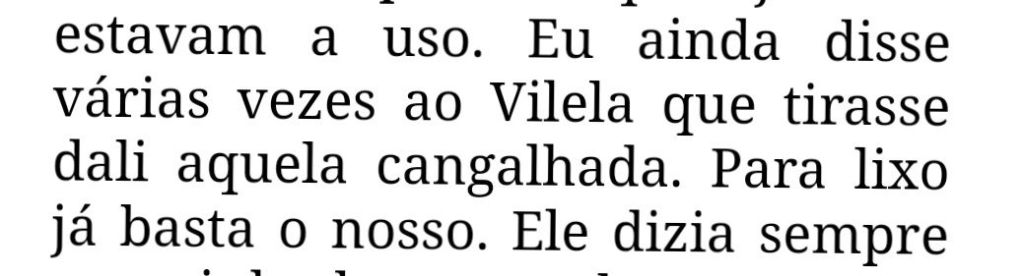
Here’s a little snippet from the book I’m reading at the moment. It’s a children’s book, similar to the Famous 5, about a pair of twins and their friends who have gone to stay with their tia Judite on her farm for the holidays, where they have an adventure. In the snippet they are asking the lady of the house where she got the load of manky old mattresses in the celeiro (grain storehouse). Why do they want to know? Read the book and you’ll find out. There’s a treasure map involved.
I was mostly interested in the phrase “Para lixo já basta o nosso” which is obviously something like “We have enough junk of our own”. I love little scraps of useful sentencecraft like this. It seems hard to think of a situation I can use it in but I’ll try!
The previous sentence contains another new bit of vocabulary: cangalhada, which is a “conjunto de trastes velhos”. And what, pray, is a traste? Well luckily priberam let’s you click on any word on its pages so I found out it’s a piece of furniture of little value. So basically a cangalhada is a load of old junk.
Quite enjoying the book. There’ll be a review soon enough, but it’s a solid short novel, not as childish as I was told. Well, I mean it is, in that the story is quite straightforward, but it’s properly written. They aren’t spoonfeeding the kids with babyish sentences and easy words!
My wife is making me watch this Madeiran cooking channel. I was unsure at first because the accent and the regionalismos were hard to get past, but it’s great. She’s hamming it up a bit, apparently: she’s playing a character of an old-time islander. I guess in English terms it’d be like someone doing a strong Welsh accent.
The food looks flippin’ great though: traditional and full of delicious calories. The camera work is fantastic and I would give my right arm for her massive clay mixing bowl. And although I hardly understand her dialogue I’m enjoying trying.
Also sort of hoping Mrs L will cook some of these things…
It came up in my YouTube feed and I’ve no idea how I’m going to be able to watch it but I’m definitely going to try. The empty nest theme strikes a chord since our baby left home for uni this year. Speaking of which, she’s coming home for Christmas later today and I’m a very happy daddy!
Frustrating that there isn’t a preposition that sounds more like “George”. Oh well.
Ele entrou na igreja, aproximou-sedum ícone, beijou-o, persignou-se e saiu, balbuciando algo. I wrote “aproximou-se a”. Also, persignar-se (genuflected) was a new word for me!
Vocês vão para o Egito?! Só podem estar a entrar connosco (I hadn’t the faintest idea what this was even meant to be saying so took a total guess on both the verb and the preposition)
Se quisesses ser menos obeso, obedecerias às prescrições do doutor Nunes. (I used the imperative tense, but that doesn’t make sense following in from the imperfect subjunctive)
Em 2003, eu formei-me em Filologia Eslava pela Universidade de Bratislava. (i used “na” as the second preposition)
Here’s a little detail I spotted in o Mangusto. The pupils in this PE class refer to their teachers as stôr and stôra. I thought it seemed weird as an abbreviation for professor(a), because where does the t come from, but apparently it is short for “Senhor(a) Doutor(a)”



 Luso
Luso 