Here’s a follow-up to that Ovibeja post. I spotted an expression I liked on their website
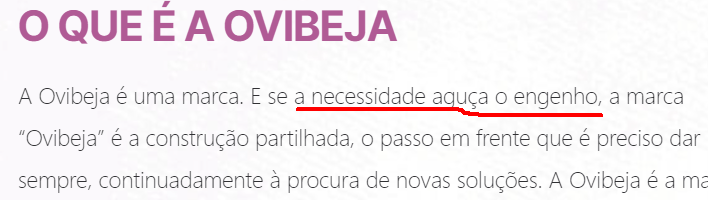
Necessity sharpens ingenuity – which looks like it’s equivalent to “Necessity is the mother of invention”. It seems to be quite widely used. Here for example.
Here’s a follow-up to that Ovibeja post. I spotted an expression I liked on their website
Necessity sharpens ingenuity – which looks like it’s equivalent to “Necessity is the mother of invention”. It seems to be quite widely used. Here for example.
I always like to mention new online ventures related to Portugal and portuguese, so allow me to point you to this newish newsletter explaining the latest current events in Portugal. It’s called Portugal Decoded and as you can guess from the name, it’s in english, not portuguese, but that’s OK, I’ve subscribed on the idea that if I read the news in english then when I listen to the news podcast I will know what to listen out for and that’ll make it easier. Anyway, if thats sounds like something you’d be interested in, try it – as Yo Gabba Gabba used to say* – you might like it.
Incidentally, while trying to find it, I came across this reaction to a video called “Portugal Explained”. I’ve seen the original before and might even have mentioned it here, but for a second time I was super-impressed at how many in-jokes the non-portuguese-speaking creator of the original video was able to squeeze in. He clearly did his homework! I’ve definitely mentioned Wuant (the guy reacting) before. He’s a silly man, but that’s influencers for you innit!
* In case you’re too young or old to have suffered through this with your kids… here
This post is about unpacking an interesting short video from Portuguese Dips a couple of years ago in November 2021. It’s part of a series about Portuguese idioms. On day 4 he talks about “Fazer Trinta Por Uma Linha“. He’s very good at these capsule summaries, and he definitely gives you all you need to start using it; basically it means they’re a handful.
But I was curious about the origin of the expression as well as how to use it. Well, as Westley says in The Princess Bride, “Get used to disappointment” because nobody seems to know. Andreia Vale, in “Puxar a Brasa à Nossa Sardinha” says there’s no origin known but tries to infer it. She points to thirty being number commonly used to denote human accomplishments, but the only examples she gives are “estar com 30 sentidos” which, ok, is fairly relevant, and the thirty pieces of silver paid to Judas… which I would say is not a good example of human accomplishment, on the whole. “Por uma linha” is like “a fio” or “a eito” (which came up in yesterday’s lyrics), being like “on the trot” or “in a row”. So they’re doing thirty things, one after another, resulting in total confusion.
In the same video he refers to “a canalha” which can either mean a gang of villains or a group of children. Hmmmm… Then there are words for naughtiness and general mischeif: irrequieto, traquino and asneira and finally he uses another expression “Têm de ter um olho nelas” which is obviously like the english expression: they have to keep an eye on them.
Quite a lot to pack into such a short video!
Well, who fancies a translation? I know I do. First translation of the new year. This one is a bit more poppy and upbeat than some of the ones I’ve done lately.
By the way, can anyone work out what the marioneta is saying at the start? Tell me in the comments because I’d love to know. But even the CAPLE exam setters aren’t sadistic enough to make you listen to a guy talking through a swozzle in their aural comprehension. The creator is currently working with a company called Mãozorra at the moment so if you want to know more, have a look at their site.
| Português | English |
|---|---|
| Modera a ansiedade de te veres a eito faz-te calmo e bom proveito Quando amanhã te levantares E achares que é natural Não pensares nessa mulher, então Tudo vai mal | Don’t focus on yourself so much* Calm down and enjoy yourself When you get up tomorrow And think it’s natural Not to think of that woman, then Everything goes wrong |
| Quando te ouvires a falar Mete a cabeça para dentro Quando te ouvires a falar Encolhe os ombros num lamento Nem penses nisso, então Tudo vai mal Tudo vai mal Vai de mal a pior E essa coragem, se és capaz Faz-te um homem, rapaz Já viste o que um dia faz? | When you hear yourself talking Put your head inside When you hear yourself talking Shrug your shoulders in sorrow So dont even think about it Everything goes wrong Everything goes wrong It goes from bad to worse And that courage, if you can Man up, lad Have you seen what one day can do? |
| E se esta noite passar Há-de te irritar o dia E se esta noite evitar O que a estupidez faria Pára com isso, então Tudo vai mal Tudo vai mal Vai de mal a pior E essa coragem, se és capaz Vá lá, faz-te um homem, rapaz modera a ansiedade de te veres a eito faz-te calmo e bom proveito Faz-te um homem, rapaz Já viste o que um dia faz? | And if this night passes It’s going to irritate you all day And if this night avoids What stupidity will do So stop that Everything goes wrong Everything goes wrong It goes from bad to worse Adn that courage, if you can Go on, man up lad Don’t focus on yourself so much* Calm down and enjoy yourself Man up, lad Have you seen what one day can do? |
*Really paraphrasing here – “Moderate your anxiety of seeing yourself constantly”
Various bits of vocabulary relating to things happening finally, at long last or in the end. I sometimes pick the wrong one. I don’t want to screw it up so I am just going to plunder the internet for examples instead of inventing any. As a basis, I have copied a lot of examples from the very helpful but slightly mind-blowing answer on this page so unless otherwise stated, that’s where they are all from, but I’ve added some other words that seem like they’re in the same area
Por fim – used to present the final result of an account: “Disse, por fim, que tudo tinha corrido tudo bem”. This seems to be pretty similar to a locution like “em resumo”
No fim – used to summarise something “Ele é muito discreto, mas, no fim, só procura a máxima diversão.” In english we might use “basically” or “deep down”
No final – a bit more straightforwardly “at the end” of something: “Ele estava no final de carreira.”
Em fim – can be synonymous with “no final de” when discussing time passing, but can also be used to discuss position in space “fica em fim da rua”. No fim can also be used to be more specific
Ao fim – used to discuss arrival at the end of a road, say. Whether you use em or a or some other preposition will depend on the verb.
No fim – similar to no final – “No fim de tanto esforço, nada conseguimos” – no final would work just as well in this sentence
Enfim is essentially em and fim glued together but it’s not a contraction in the way that “pelo” or “noutra” are; it’s an adverb that’s more or less equal to finalmente: “Chegou enfim a chuva” (from here), and it can also be used in conversation when you want to sum things up and get down to brass tacks: “Enfim, como dizem na Guerra das Estrelas, que a força esteja contigo!” (from here)
Finalmente – Finally, as in “Thank god, finally there’s an easy word to define”
Afinal – In the end. It seems to be often (but not exclusively) used at the start of the sentence, because it has a sort of summing-up effect, a bit like “at the end of the day” in english. ATEOTD is not a phrase I’m a huge fan of, but there are people who scatter it about like parmesan at an italian restaurant run by mice and my sense is that when they do it they’re more-or-less saying “afinal”.
No fim das contas or No final das contas or No fim de contas or even, god help us, Afinal de contas – there seem to be a few versions of this used by portuguese speakers and I’m sure I’ve used them all at one time or another but “no fim de contas” is the only one Priberam recognises and that’s good enough for me – it’s something like “When all is said and done” or “In the long run”: “No fim de contas, os principais ganhos em termos de desenvolvimento resultarão de uma abertura ambiciosa do comércio”

This book is pretty challenging, especially as an audiobook. I don’t know about you, but I need all my concentration for an audiobook, and it’s much more of a faff to go back and re-read anything you didn’t understand the first time, so i tend to find it takes me ages to plough through. Anyway, Wook have it on audio and they have a paper version too. It’s been translated into English as Baltasar and Blimunda and Foyles have that (I’m pretty sure they have the original too but I can’t find it on their site).
.
.
No dia em que acabei de ler “Uma Aventura nas Férias de Natal”, também ouvi a última hora-e-tal da obra-prima de José Saramago, o “Memorial do Convento”
Este livro é uma leitura mais desafiante do que o outro, mas ainda assim, não é nada complicado. É um romance histórico com elementos de Realismo Mágico. A história tem dois protagonistas: Baltasar Mateus, um soldado que lutou contra os espanhóis mas acabou por ficar maneta*, e Blimunda Jesus, uma mulher jovem que tem capacidades de perceção sobrenaturais durante períodos de jejum.
Tem lugar durante o século XVIII. O rei Dom João V faz uma promessa de construir um convento em Mafra após o nascimento do seu primeiro filho. O poder e a riqueza da coroa portuguesa estão no zénite naquela altura por causa dos lucros oriundos do Brasil, portanto o rei é capaz de apresentar a Deus um edifício magnífico. Assim a monarquia e a aristocracia desperdiçam os bens do Império sem pensar no povo.
Entretanto, os protagonistas participam na construção de uma máquina voadora, “A Passarola”. Na realidade, esta máquina é fictícia… Ou melhor, é meio-fictícia: o inventor, Padre Bartolomeu Lourenço de Gusmão existia mesmo e a ideia da Passarola tem raízes históricas, ainda que não chegasse a ser construída.
Noutras palavras, este livro apresenta uma história alternativa e fantástica do Convento de Mafra (também conhecido por “O Palácio Nacional de Mafra”), com personagens verdadeiras, mas sob o ponto de vista de várias pessoas imaginárias que vivem nas margens da história oficial. Está contado com humor e imaginação.
*I quite like that, like the eskimos and snow, the portuguese have multiple words for the loss of a bodypart. This one is one-handed, and you might already know zarolho from the poem “Camões, poeta zarolho / fez versos à dona Inês / Via mais ele com um olho / do que tu com todos os três!”
Thanks again to Cristina of Say It In Portuguese for the help.
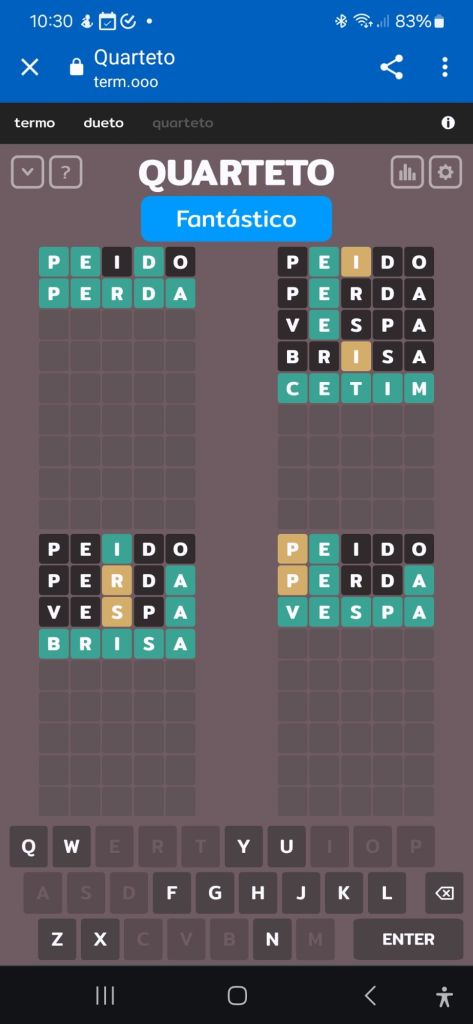
For the first time ever I’ve been able to finish the Quarteto game of Termo in only 5 moves. It’s very exciting. I’ve managed 6 a few times, but never 5. I’m writing this on New Year’s Day in the morning but I’ll schedule it for tomorrow so as not to spoil it for any Termo fans who might see this.
OK, Christmas is behind us now but it’s part of a series and I’d recommend any books by the same author for anyone who is looking for a book to read at around B1/2 level. You’ll find some words you have to look up, for sure, but the grammar is pretty straightforward. I got mine on Kobo because it was quick but Wook has it too.
Li este livro como parte da maratona “Os Clichés do Bookstagram”. Tinha planeado ler “Campo de Sangue” mas substitui-o por este porque me apetecia ler um livro natalício.
É um livro juvenil mas confesso que gostei imenso. Lembrou-me dos livros de Enid Blyton na saga “Famous Five”. Ainda que tenha um enredo muito simples, a história lê-se bem e até contém umas palavras e umas expressões desconhecidas e interessantes que forneceram conteúdos ao meu blogue!
Duas gémeas (frase redundante… de quantas gémeas estavas à espera?) vão visitar a sua tia durante as férias de natal e levam três amigos com elas. Logo na primeira noite, um deles encontra um papel escondido num colchão no celeiro onde dormem os cinco. É um mapa! Esta descoberta revela o esconderijo de um tesouro. Assim começa a aventura. Os jovens trabalham juntos para desvendar o mistério e frustrar os planos de uns criminosos que querem roubar o mapa para que possam enriquecer. Durante o desenrolar da história a autora revela aos leitores juvenis algumas coisas sobre a história do país durante o século XIX, mas sem assumir um tom didático.
Whoops! I published the uncorrected version first, but thanks to Cristina of Say It In Portuguese for decrappifying my original draft.
It looks like Wook have just put a new crop of Audiobooks on their website. I only noticed because I just went to look for a link to the book I’ve just finished and when I went to the “Literatura” page it was full of softcore erotica. José Saramago was sandwiched between “Sexo no Carro” and “Amarre-me”. Coitodo! Er… I mean Coitado!
Sadly they seem to be mostly Brazilian portuguese so be careful, they’ll damage your grammar as well as your eyesight.
I did spot a new European portuguese book though – or at least one I hadn’t noticed before: they’ve got “O Livro de Desassossego” now. Nice! I’m not sure I dare try and read it as an audiobook though… Maybe later!
Anyway I’ve got guests coming soon, but I’ve made a mental note to spend more time looking around to see if there s anything I fancy.
As usual, I’m reading 12 books at once and consequently not getting through any of them very quickly but here’s another nice expression I found today in a book I’ve been reading for a disgracefully long time.
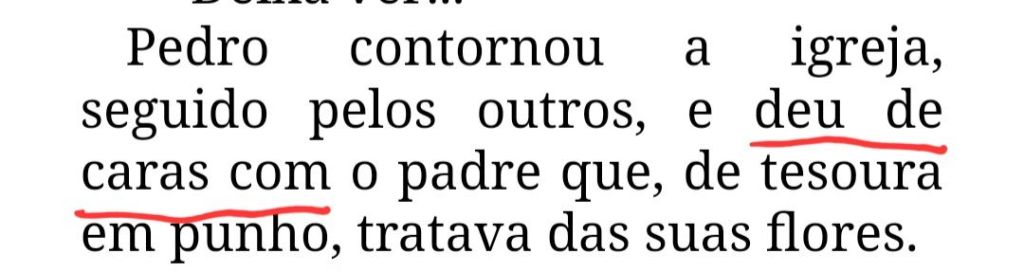
The meaning is pretty obvious from the context. “Dar de caras com…” means to run into someone unexpectedly. It’s similar to “come face to face with” in English but seems to be slanted in the direction of an unexpected encounter rather than being any situation where you’re confronting someone.
While researching, I came across a couple of other dar/cara pairings with slightly different meanings so I’ll get those down in the same blog post just to keep my thoughts organised.
Dar a cara means to take responsibility. I guess the nearest English equivalent would be “face up to”. Linguee gives a few examples, so here’s one. “A União Europeia precisa de dar a cara aos seus desafios”.
Dar com a cara na porta is like “bater com o nariz na porta”. The idea is that you’ve gone to a shop and found it’s closed so instead of the door opening for you, you smack into the glass, face first. I think more figuratively it can describe any other situation where you ask for something and find that there’s no chance whatsoever.
I’ve tried to take these examples from European portuguese. I found a few examples of some of these being used in slightly different ways by Brazilians but let’s keep it simple eh?
 Luso
Luso 