
Quando Querias Descobrir o AD, mas Acabaste por Descobrir o ADN
Há uns dias partilhei o texto sobre os principais partidos de Portugal (que aliteração maravilhosa!) porque achava que os estudantes podiam gostar antes das “forthcoming elections” (eleições que vêm) mas os donos do grupo deixaram-no no limbo até ontem, e agora toda a gente acha que nem sequer sei quando as legislativas tiveram lugar.
Noutras notícias, falei com uma ex-professora que me disse que ela tinha votado no Chega. Eu pedi uma explicação porque queria saber. Recebi 53 respostas a fio. Não estou a exagerar: 53, maioritamente com gráficos de barra ou vídeos de estrangeiros de pé na rua. Geralmente, gosto de falar com pessoas com as quais descordo, porque é desafiante, mas nesta situação, faltou-me a paciência para responder a tantas informações.

Thanks once again to Cristina for pointing out the errors in the original version of this page
Acabo de ler a seguinte frase:
(Ela) tem ainda muita dificuldade em andar e o medo tolhe-lhe a vontade quando pega nas canadianas
Estava a imaginar esta cena, com um par de canadenses: Margaret Atwood e Geddy Lee… Ups! Ó Geddy, afasta-te da minha imaginação porque és masculino. Então, Margaret Atwood e Céline Dione, agarradas pela menina, apesar da apreensão dela. Parecia-me um cenário pouco provável. E na realidade, uma canadiana não significa uma nativa do Canadá mas sim uma espécie de muleta moderna, com um tubo de alumínio e um cabo de plástico.
Pardon my English. I wrote a slightly bland Portuguese text earlier, wishing the new government well because, no matter what happens, that’s what we should always hope after any election, but the more I find out, the worse it seems.
I’ve been to visit my daughter so I spent most of the day on a train, trying to work, all squished up between a window and some big geezer, so I had only really caught snatches of what happened. The first thing I looked at when I woke up said the Socialists were ahead, but that turned out to be bollocks. Well not bollocks, but it must have been a cached page from earlier in the night. More up-to-date sources said the Aliança Democrática had won by a super-narrow margin, but although I could see the percentages were all roughly in line with the polls, the big shock was how many deputados Chega picked up. I knew it was grim, but when I was finally off the train, I listened to a podcast that spelled it out in more detail and it’s bloody awful. They’re still only in third place, but they got 48 seats, about a quarter of the parliament.
The actual winner isn’t decided yet, because it’s not like a British election where you find out who has won basically straight away; some of the overseas votes haven’t been counted and the president will only name a prime minister after that. Luís Montenegro, the likely PM, has assured everyone he won’t cooperate with Chega, but… Well, it’s hard to see how he can keep that promise, since even with the IL on his side he is well short of a majority. Likewise if the Socialists were to do a deal with the Bloco Esquerda, the Partido Comunista Putinista and Livre to form a sort of “Geringonça 2”, it wouldn’t secure 50% either. So Chega look like they hold a lot of power right now, like some sort of evil version of the Lib Dems in 2010. Ventura has been waving his dick around proclaiming victory, and everyone else is pretty depressed.
Part of the problem seems to have been that another, completely irrelevant right-wing party, the ADN, got a lot of votes intended for the AD, so they went from 11,000 votes to more like 100,000. This transfer of a huge block of votes away from the centre right caused the AD to lose a lot of marginal seats it would otherwise have won. Seen in this light, Montenegro’s decision to form the AD doesn’t seem so clever, doesn’t it? Gain 2 deputados from your new ally, lose christ-knows-how-many potential seats for your own party. What a master-stroke.
But it’s fair to say that even without that anomaly, any vote that sees a bunch of fart-sniffing yahoos like Chega gain one million votes should give us all pause.
I don’t really have anything intelligent to say about all this. Being an optimistic soul, I can imagine a way through all this that leads to a positive outcome, but the negative outcomes seem more likely, and I don’t know anything anyway, so if I waffle on, it is only going to create a lot of pointless noise.
Sigh.
Decoding names for people who don’t eat much. The list is from an article by Miguel Esteves Cardoso, reproduced in Português em Foco
He also uses plenty of words like “estranho” and “esquisito” (basically “weird”) and also talks about “fastio” to describe a person’s “repugnância pelo alimento” or “falta de apetite”
I did market research on you… Well, sort of. I did a course on AI recently and in the early stages it gets you to do some basic interactions with Chat GPT. If you haven’t tried Chat GPT, you really should, it’s a lot of fun and it’s a good idea to make friends with it now before it takes over the earth. The exercise was to try and get it writing marketing materials about a product or service. I don’t really have a service to market but I decided to tell it about this blog and have it tell me how it would turn this rambling nonsense into a going concern.
Naturally, I won’t be doing any of it, but I thought it was a fun exercise.
Here’s what it said was the “sales profile”
Buyer Persona: Portuguese Language Enthusiast
I feel like this is pretty good – it’s obviously understood the brief. It asked me some questions beforehand but I didn’t really give it any clues as to what to say. I asked it what made it so sure language learners would mostly be of the female persuasion:
Apologies if my previous response gave the impression of certainty regarding the gender composition of your target audience. The assumption of a predominantly female audience was based on a combination of factors commonly associated with language learning and cultural interests. However, it’s important to note that gender preferences and interests can vary greatly among individuals, and it’s always recommended to rely on actual data and insights from your specific audience.
And the age? I’m a good ten years older than it’s maximum range, so that piqued my interest
Apologies for any confusion. The age range I suggested (25-45) was based on a general understanding of language learning demographics and the assumption that individuals in that age bracket may have a higher likelihood of pursuing language learning as a personal interest or for professional purposes.
Fair enough. It went on to tell me stuff about your objectives… well, that’s simple enough to guess, surely: it said proficiency, cultural integration, travel, personal enrichment and professional advancement. No huge surprises there.
But my favourite thing – as always – is to get it to come up with puns and I spent far, far too much time on that and pretty much forgot about the rest of the course. Here are some of my favourite blog titles
And then there’s whatever this is:
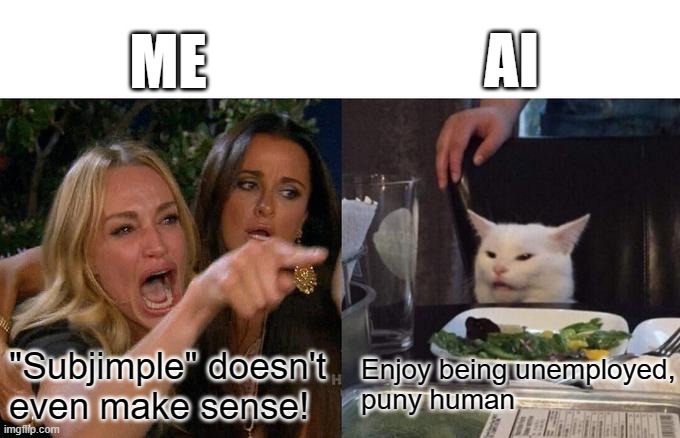
Subjimple??? This is the sort of thing that makes me understand how my wife feels when I make puns.
Chat GPT can speak portuguese just as easily as english, and even stick to european forms if you tell it to, but I get the feeling its pun capabilities are a bit limited. I prodded it to write actual portuguese puns, not just english puns that borrow portuguese words, but no matter how I phrased the question it could only write titles that hinted that the blog post contained puns, and couldn’t actually come up with any puns of its own. Buuuu!
Oh well, it’s reassuring to know that AI won’t be advanced enough to take all our jobs for at least another 6 months.
Tendo falado tanto da política, estou quase tão interessado no resultado das legislativas (amanhã!) como estou no resultado da votação no meu país daqui a uns meses.
Segundo as sondagens mais recentes, o PS ultrapassou o AD brevemente mas o AD retomou primeiro lugar logo depois. Ambos os partidos principais têm menos de 30% cada um, e o Chega tem 17%. Falei com uma amiga nas redes sociais (cujo ponto de vista é muito mais esquerdista do que o meu) e ela acha que uma coligação AD/Chega é pouco provável e espero que tenha razão porque aquele gajo é insuportável.
Antes do movimento de “positividade corporal”, os portugueses já sabiam que há beleza* num corpo com mais calorias armazenadas. Porquê? Será uma questão de moda? Não, mas é verdade que a nossa perceção da beleza muda ao longo dos anos, como outros aspetos da nossa atitude. Mas a origem da expressão “Gordura é Formosura” é mais específica.
Antigamente, a saúde do povo estava constantemente sob ameaça por causa da falta de medicamentos e vacinas modernas e, em determinados lugares e épocas, por causa da pobreza. Doenças graves, como a tuberculose, causaram mortes e sofrimento, mas antes disso, deixaram as vítimas pálidas, amareladas e cadavéricas.
Portanto, a gordura veio a ser um sinal de saúde: se uma mulher estivesse roliça**, com as maçãs do rosto bem rubras apresentaria mais hipóteses de ter filhos saudáveis***.
O fenómeno tem raízes na nossa evolução, claro, e muitos animais comportam-se de maneira semelhante na seleção dos seus cônjuges. Os sinais do nosso passado como mamíferos vêm à superfície em tempos duros, ainda que sejam abafados por camadas de civismo e cultura. Mas, segundo o cirurgião Gil Faria, esta predisposição tornou-se prejudicial nos dias de hoje porque andamos constantemente rodeados por tentações e acabamos por ficar obesos.

*I wrote “uma beleza”, pretentiously trying to copy English sentences like ‘There is a beauty in the world, though it’s harsher than we expect it to be.’ (Michael Cunningham, “The Hours”) but it doesn’t seem to translate well and just came across as a mistake so I guess this is not a thing in portuguese.
**I originally wrote gordinha but roliça was suggested. It means round or plump
***I think I phrased it this way because of how I imagine choice was exercised in the past and thinking it was more likely that it would be women who had to meet certain standards to be chosen, but I guess we’re talking about many classes, many countries and many times so I could probably have opened this out a bit…
Thanks as ever to Cristina of Say it in Portuguese for the help with this text

Another rehash of this confusion
Nikki Haley desistiu porque, enfim, não valia a pena ficar em concorrência com o palhaço cor de laranja sem hipótese de o vencer (Resignação)
Não votei porque, afinal, não sou um cidadão americano (Justificação)
Donald Trump ganhou a presidência e, por fim, acabou com a democracia nos Estados Unidos (Finalização de uma sequência)
Winston Smith sorriu porque, no fim, tinha aprendido a amar Grande Irmão (Conclusão de um processo)
Após tantos anos de votação de quatro em quatro anos, finalmente, as pessoas teriam a oportunidade de ficar em casa sem pensar em nada (Alívio)
Ao fim e ao cabo, tudo que o povo queria era um sinal de esperança até, finalmente, chegou o asteroide para acabar com tudo (Encerramento ou conclusão)
(Not endorsing her per se, but in this election, oh my god, yes… and anyway, if ever a country was long overdue for a female leader, it’s that country)
Thanks to Cristina for unfudging the last one which was a bit wrong
Oof, well here’s an eleven minute summary of right vs left in Portugal, I guess!
I thought he’d make both characters as bad as each other but I guess he’s more concerned with stopping the loony right than the loony left and it’s pretty clear where his sympathies lie
Only a few days to go…

