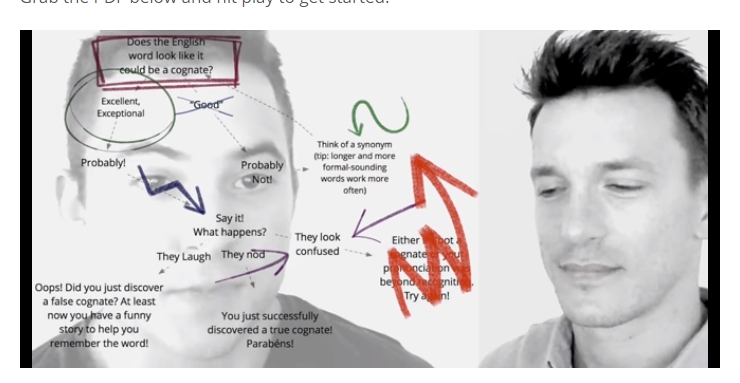
The Practice Portuguese Podcast is really blossoming now that Joel is doing it full-time. There are some new videos on the site along with the usual podcast episodes, a pronunciation chart and new stuff being promised for the future. You can see the first two all three videos free on the site – 5000 Words You Already KnowOpen and Closed Vowels and Tools for learning European Portuguese (including the big reveal of their secret weapon in their war to make the world speak European Portuguese). Each one is a very specific examination of an aspect of the language that can help you move forward in vocabulary (first one) or pronunciation (second) and to get more Portuguese into your life in general (third). Actually, to tell the truth, the second one blew my mind a bit because I tried to listen without paying much attention and maybe I need to sit down again with it and put the effort in.
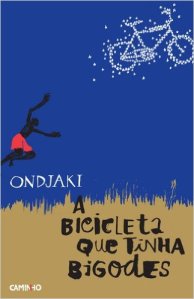
Acabo de ler um livro dum escritor angolano que se chama “Ondjaki”. É um livro para jovens, e o protagonista é um miúdo angolano que mora em Luanda. O argumento concerne a um concurso da Radio Nacional de Angola. Os Ouvintes deviam de escrever uma história infantil, e pelo primeiro prémio, um concorrente ganharia uma bicicleta com as cores da bandeira nacional (vermelho, preto e amarelo).
O miúdo sonhou com aquela bicicleta e fez planos para compartilhá-a com os seus amigos, Isaura e “Jorge TemCalma” (que é designado assim porque nunca tinha calma!). Infelizmente, não têm ideia para uma história, mas o seu vizinho era um escritor muito conhecido e tinha uma caixa cheia de letras* para histórias não publicadas, que inventou enquanto que ele coçava os bigodes. O miúdo decidiu que precisava de roubar aquela caixa e usar uma ideia do escritor para ganhar a bicicleta.
As personagens eram interessantes e credíveis. Por exemplo, a Isaura morava numa quinta e conhecia todos os bichos na área, as lagartas, os sapos, as lesmas, e tinha-lhes dado nomes próprios. Os nomes eram de vários heróis socialistas: os sapos chamam-se Fidel e Raul, e o gato Gandhi, por exemplo. O efeito foi muito engraçado!
*=I’m not sure about “Letras” here. Letras can mean either letters of the alphabet or lyrics of a song, whereas it seems to mean notes or outlines towards a book. The Brazilian (“Angel’s Roses”) who marked it left it in place but the Portuguese teacher who looked at it wanted to correct it. So either it’s an idiomatic use of the word that exists in Brazil and Angola but not Portugal or else maybe it’s a child’s way of expressing what they saw in the box – a lot of letters on a page. In fact, in a couple of places, they talk about seeing “Letters and accents too” so maybe that’s right. They also talk about a magical glow, so maybe the whole description of the box is clouded by fantastical language that I just can’t punch though.
This is a corrected version of a spoken answer I gave to a question about a time I had been told off at school. My friend Márcio rewrote it in a more natural way to help me understand how it could be improved. I thought there were enough interesting mistakes getting corrected that it was worth transcribing the whole thing so I’d remember it better.
Eu estava na escola primária, há três anos quando* nós mudámos da casa. Eu e o meu irmão fomos para um nova escola primária, e quando estávamos na nova escola, havia um grupo de rapazes que decidiram que não gostavam de nós. Eram rapazes da minha turma** e da turma do meu irmão. Então eles disseram “Não gostamos de vocês! Vocês cheiram mal, então nós vamos bater-vós”.
Depois da aula, houve uma grande luta, e de alguma forma, dois desses rapazes malcriados ficaram magoados. Eu fiquei muito orgulhoso por ter sido capaz de me defender a mim e o meu irmão, mas infelizmente a professora não pensou da mesma forma de nós
*=I tried to write it as “quando tinha estado na escola” – literally “when I had been at school…” to see how well awkward British past tenses translated to Portuguese. The answer seems to be “not well”.
**=Turma = Class (in school)
My original speech was a great deal wordier than, so it’s nice to see it written out tidily like this. I seem to be making a lot of ser/estar type errors, as well as the occasional “estar” where a “ficar” would be better. These are all things I know but as usual they just don’t come out in the heat of the moment.
Yesterday I made a horrific discovery, namely that the phrase “pode ser” didn’t mean what I thought it meant. It really shook me to the core, because it was one of the stout workhorses of my vocabulary, ready to come out at a moment’s notice and bridge a gap in a sentence. As I said to my friend Márcio, who first questioned it:
Sobre “pode ser”: acreditei que significava “maybe” (talvez) mas perguntei a minha esposa e ela disse que quer dizer “It may be”, nem “maybe”.
Estou em choque. Foi uma das primeiras palavras/expressões que aprendi. Sinto-me como alguém informou-me que “obrigado” não significa “Thank you” ou “bom dia” não significa “good morning”. Devo deitar uns minutos…
Na segunda-feira, a minha esposa e eu fomos ao Barbican Centre, uma sala de concertos em Londres para ver um concerto da famosa cantora Ana Moura. O nosso sobrinho, que tem vinte e dois anos, cuidou da nossa filha. Ambos fomos directos do trabalho e mesmo assim quase chegámos atrasados. Sem surpresa, quando chegamos, ouvimos muitas vozes portuguesas no átrio, porque a Ana Moura é muito mais conhecida em Portugal do que em Inglaterra e vivem entre quarenta mil e cinquenta mil portugueses em Londres, a trabalhar principalmente na indústria de serviços.
O concerto começou com “Moura Encantada”, que é uma canção que conheço bem. Depois, cantou alguns fados tradicionais, cheios de saudade e pena, mas também cantou vários fados mais novos como “fado dançado” e até uma canção em inglês – Lilac Wine de Nina Simone. Ela disse que “Lilac Wine” é uma canção que representa o espírito do fado apesar de não ser portuguesa. Depois de três canções um homem na audiência gritou “Ah Fadista”. Aparentemente isto é um grande elogio para uma cantora. Finalmente, ela cantou as duas canções mais conhecidas, que se chamam “Dia de Folga” e “Desfado”.
Gostámos muito do concerto. Eu aproveitei para ouvir as palavras das canções, e além da Ana, ambos adorámos o som da guitarra portuguesa, tocada por Ângelo Freire.
I enjoyed this because aside from being a good song in its own right, it’s a very rare example of a song in Portuguese that I can understand almost 100% without help
The guy singing it seems a little aggrieved with the views of the ladies in his life. Perhaps not quite ready to order his “Meninist” t-shirt online, but he’s definitely disgruntled. Well, that’s OK, we all have bad days, and he got a good song out of it, so who’s complaining? There doesn’t seem to be a translation online so I’ve done one myself
Os Maridos das Outras / Other People’s Husbands
Everyone knows men are brutes
Who leave beds unmade
And things unsaid
They’re not very astute, they’re not very astute
Everyone knows men are brutes
Everyone knows men are ugly
They leave conversations unfinished
And laundry to pick up
And they’re evasive, and they’re evasive*
Everyone knows men are ugly
But other people’s husbands, no
Because other people’s husbands are
The archetype of perfection
The pinnacle of creation
Docile creatures of a completely different species
Who always make their wives’ friends happy
And everything men don’t do
Everything men aren’t, everything men aren’t
Other people’s husbands are, other people’s husbands are
Everyone knows men are rubbish
They like music nobody likes
And never lay the table
Lower than a beast, lower than a beast
Everyone knows men are rubbish
Everyone knows men are animals
Who smell strongly of wine
And never know which way to go
Na na na na na na, na na na na na**
Everyone knows men are animals
But other people’s husbands, no
Because other people’s husbands are
The archetype of perfection
The pinnacle of creation
Amiable creatures of a completely different species
Who always make their wives’ friends happy
And everything men don’t do
Everything men aren’t, everything men aren’t
Other people’s husbands are, other people’s husbands are
*=”E vem com rodeios” actually means “they come with roundabouts”. I’m guessing the figurative meaning of this but I could be wrong.
So here’s a good example of half-understanding a song and completely missing the point. I always thought this song was about a Moorish (Moroccan, Saracen, Muslim) sorcerer of some kind, but swotting up on my Ana Moura lyrics ahead of next week’s concert, I found out that it’s not that at all. Apparently a Moura is a fairy-tale creature from old Galician and portuguese legends. Reading the description on the Wikipedia page, it sounds an awful lot like a djinn/genie of Arabic folktales, so it’s not wholly fanciful that the moor in the sense of Moorish invaders (Mouros) and the Mouro/Moura of legend are bound up in some way, but it certainly illustrates the point that relying on half-understanding most of the words in a song can be deceptive!
Fui ao consulado ontem para levantar o meu certificado DEPLE. Os empregados falaram inglês comigo. Senti que devi responder em português mas estava preocupado. Se desse um erro, talvez não mo dariam. Afinal, quando já estava seguramente na minha mão suada, gritei “obrigado” e “até Novembro” e “adeus” e fui-me embora*