Ouvi falar desta artista recentemente (Onde? Quando? De quem? Nem sequer me lembro!) e decidi fazer uma pesquisa. Não estou a par das correntes do mundo artístico: poucas vezes entro numa galeria e se, por acaso, ouvir algo sobre a arte moderna os factos entram por um ouvido e saem por outro. Mas o site da artista impressionou-me muito: ela oferece um vasto leque de competências na criação das suas obras: há estátuas de ferro forjado, corações de Viana construídos de talheres de plástico, um carro enfeitado de ouro, um helicóptero com penas cor-de-rosa e brilhantes por todo o lado no exterior (o transporte pessoal de Elton John?) e algumas esculturas tão extensivas* que parecem cenários de filmagem! Além da arte, está a utilizar uma espécie de engenharia.
Até certo ponto, lembra-me a obra do Bordalo II, cujas esculturas alegram as ruas de Portugal. Ambos produzem obras de tamanho impressionante e cores marcantes, mas enquanto as dele são feitas de materiais reciclados, como garrafas, pneus e embalagem, dando um ar improvisado e bruto aos seus animais fofos, as obras de Joana Vasconcelos são compostas de materiais requintados; brilhantes e limpos; mesmo que os materiais escolhidos sejam frequentemente fora do normal (por exemplo “a noiva”, feita de milhares de tampões), o objetivo é tornar o quotidiano belo, quase o oposto do outro artista.
As obras de Joana Vasconcelos podem ser encontradas neste canto da Internet**. É deslumbrante, até na ecrã. Numa galeria, hão de ser ainda melhores!
Some of Joana Vasconcelos’s artworks
*This is probably a weird choice of adjective for a sculpture but there are some that really spread out over a wide area of ground which is why I’ve said they remind me of a film set in some sort of Sci-fi scenario, but you’d normally want something more like “gigante” or “imenso”, I think.
**Another daft choice of words. Why “corner of the Internet”? Well, that’s just what we used to call a website when I was into amateur web design in the early 00s. “Welcome to my corner of the Internet”. I won’t change it here, but it’s a good reminder that if you choose to express yourself in interesting, colourful ways like this, your audience might not think “gosh, how quirky and charming” they might just think “you have clearly made a mistake and we won’t know what you’re taking about” so maybe sometimes it’s better to stick to taking like a sensible person.
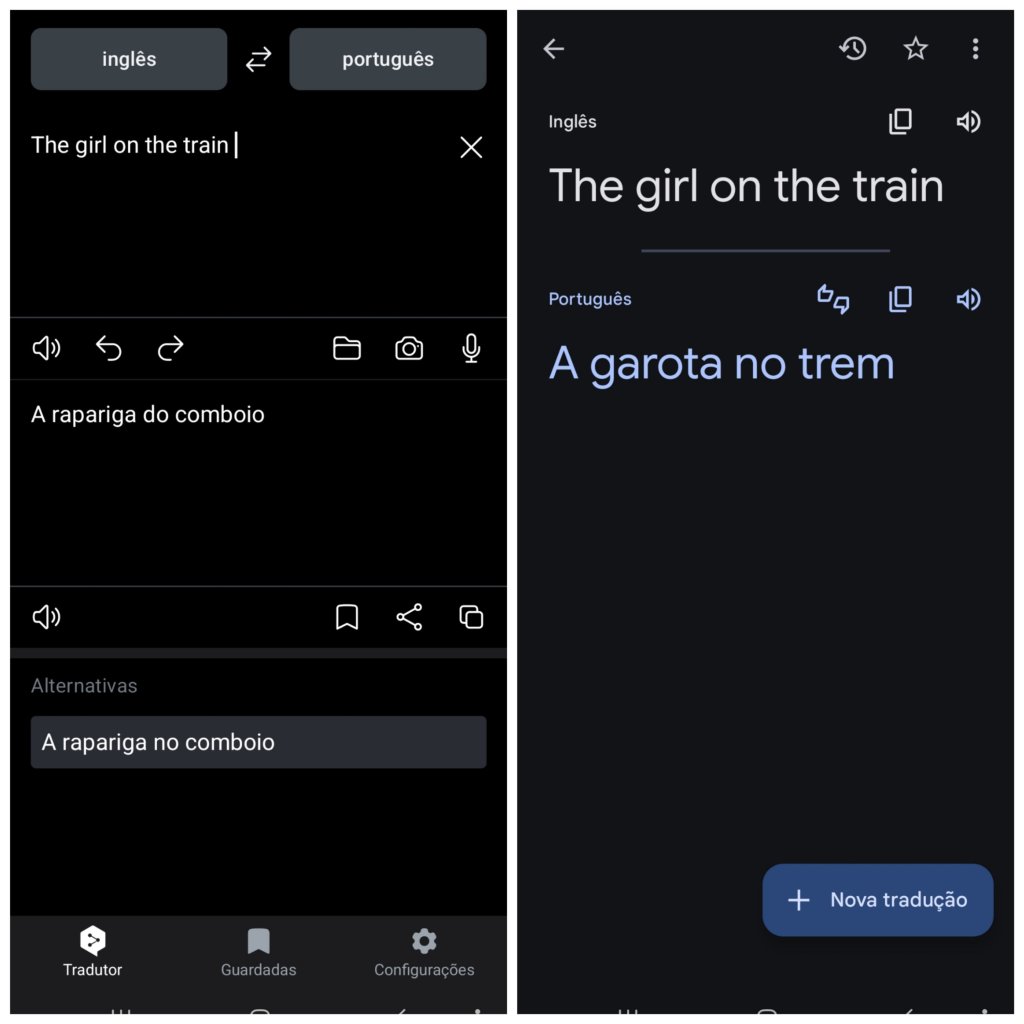
So I was asked a question about something I said in the post about Linguee the other day. I said that I thought Google Translate (aka Gtranslate) was better than Deepl for certain things. Both are translation apps, but Deepl is usually thought of as better at European portuguese, so people will usually recommend it. That’s usually good advice: if you didn’t know any Portuguese and you wanted to translate something into European Portuguese you’re usually better off with Deepl.
Deepl (left) correctly translates this book title into European Portuguese while Gtranslate comes up with the Brazilian version.
So why did I say Gtranslate was better? Because we’re language students, so I think we usually don’t want the app to do all the work for us. English-Portuguese translation isn’t something we need often. But what we do want is the opposite: we want it to check our work by translating it back into English because of it can understand it then that’s a pretty good indicator that we got it right.
So for example, if I’ve written “Este carro é muito carro”, what I want is for it to say “this car is very car”, so I know I’ve goofed; I’ve put an extra r in “caro”. If it translated it correctly as “this car is very expensive”, I wouldn’t notice my idiocy.
And so I thought Deepl would be less useful because it is AI and it’s cleverer, which means if you did something like this it would be more likely to guess what you meant and translate it correctly, hiding the error and lulling you into a false sense of security.
Líliana, (whose website The Talking Sardines caters for early stage learners around A1/A2), asked for an example so I tried a few. Want to see if I was right? Read on!
Let Battle Commence
OK, so let’s put both apps in the Thunderdome together and see which emerges victorious. Two apps enter, one app leaves. In each round, I have presented the translators with a sentence with a couple of minor errors. Remember, it’s a backwards competition. What I want is for it to give the wrong answer because that’s more useful than hiding the mistake.
In each case, Deepl on the left, Gtranslate on the right
“Gosto de escreve contas de fada”
Escreve should be an infinitive “escrever” and a fairy tale is a “conto de fado”, not a “conta de fado”
Deepl responded to “conta de fada” better, by translating it literally. Gtranslate is cleverer (ie less useful) because it has hidden the mistake, but Gtranslate also makes change suggestions – in the middle of the screen it asks: “Será que quis dizer…”, meaning “Did you mean to say…” and there it gets bonus points for spotting the grammatical error in escrever and suggesting I change it. Great!
Result: tie! Each spotted one mistake and ignored the other.
Well, this is a surprise. Maybe I was too harsh on Deepl?
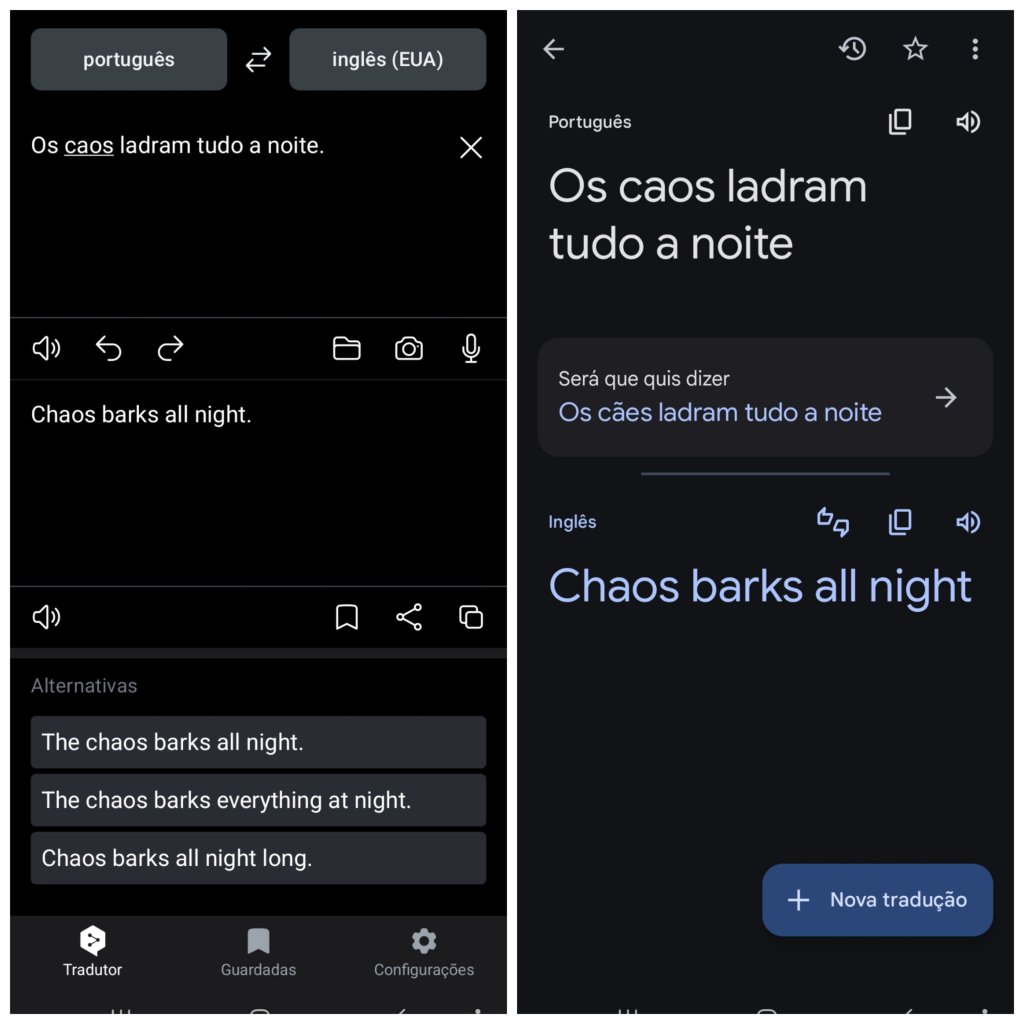
“Os caos ladram tudo a noite”
The word cão (Dog) has one of those weird plurals: cães. The word “caos” does exist but it means “chaos”. Oh and and obviously I’ve used “tudo” (everything) in place of “toda” (all).
This would make a great album title, wouldnt it? Gtranslate has a helpful suggestion, but both have correctly translated one mistake and erased the other
Result: tie! Both get one right, one wrong. Whether or not you want it to spoon feed the answer is a matter of taste so I don’t give Gtranslate extra points for that.
“Estou na quinda a trater dos porcos”
Quinta and tratar are both spelled wrong
Deepl is just freestlying. I don’t even know what it’s thinking there. Gtranslate has translated it correctly (not helpful) but it has very cleverly and helpfully suggests that I fix both spelling errors. Great work!
Result: Gtranslate is victorious. Initially it loses marks for ostensibly ignoring the errors, but it scores top marks for prompting me to fix both, not just the first. Deepl only highlights one mistake.
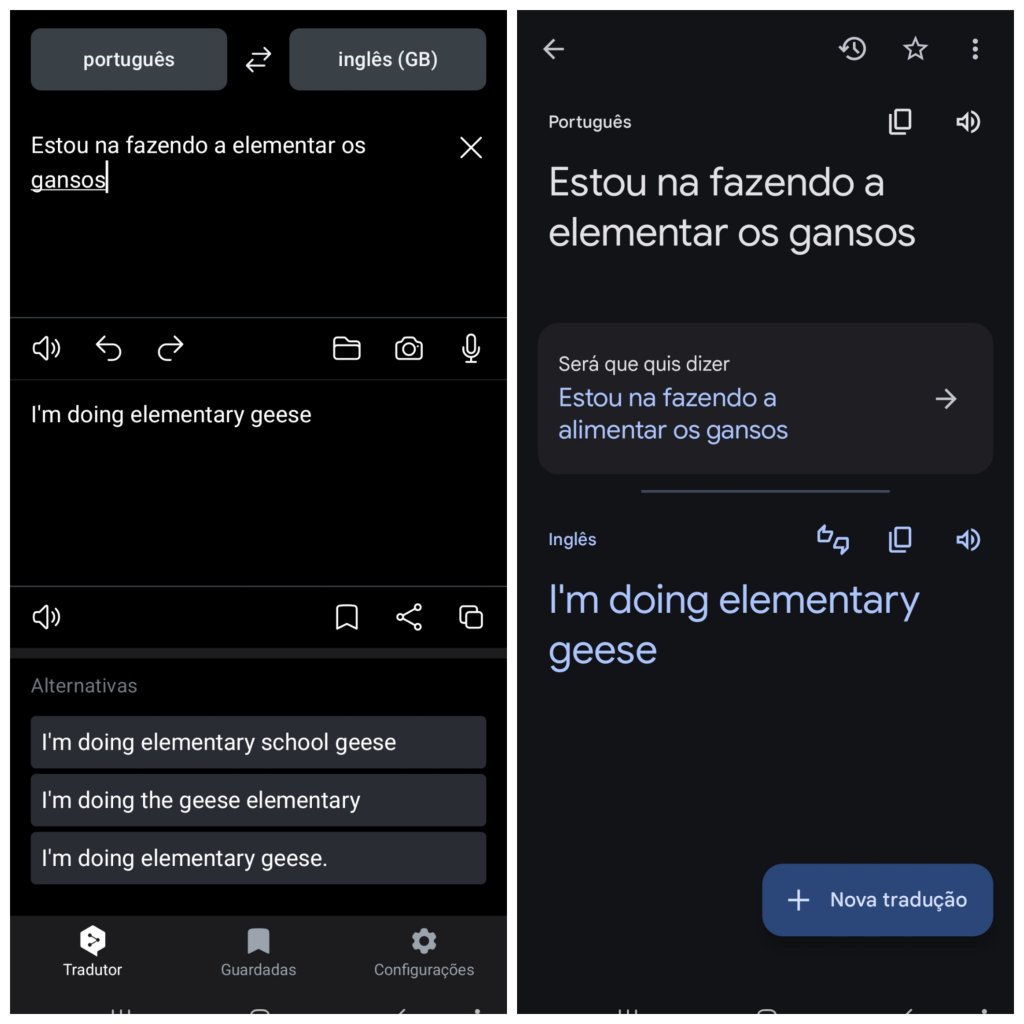
“Estou na fazendo a elementar os gansos”
Fazenda is another word for farm (I think I’m right in saying it’s more specifically a larger, family owned farm), whereas fazendo is just the present participle of fazer. And the verb I’m looking for is “alimentar”.
Both helpfully mistranslated both words. Gtranslate is correctly able to suggest the correction for one of them at least.
Result: tie! Both have done their job correctly, translating garbage into garbage. Whether or not you want the extra help Gtranslate gives you is a matter of taste.
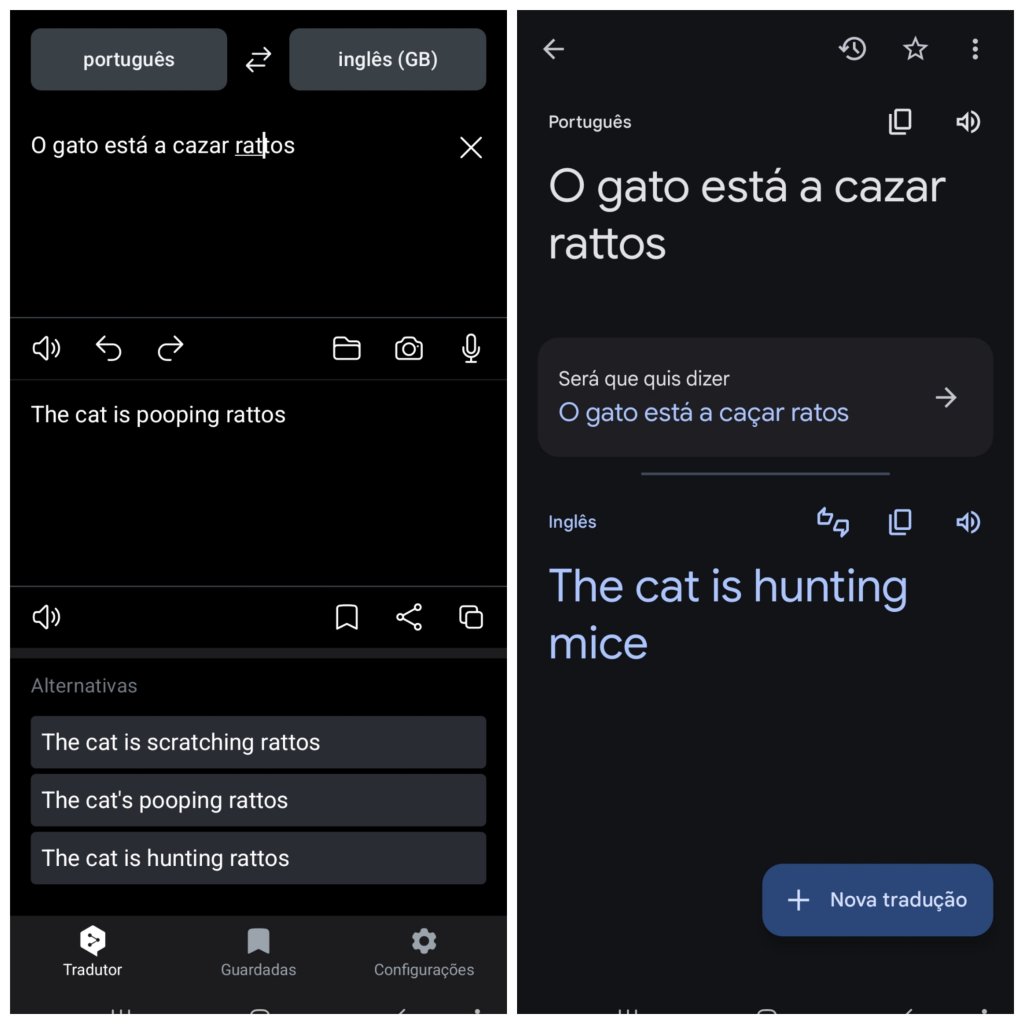
“O gato está a cazar rattos”
Caçar and ratos are both spelled wrong.
Deepl tries to be clever and interpret cazar but guesses the z is supposed to be a g. It has no idea what I am talking about with the extra t in rattos. Good. Gtranslate cleverly translates both words correctly, which is unhelpful, but it redeems itself by suggesting corrections for both words.
Result: Deepl is victorious. Although gtranslate has clearly done a better job here, I think I would prefer Deepl’s confusion, prompting me to rethink what I’d written, so I’m reluctantly awarding it the laurels here.
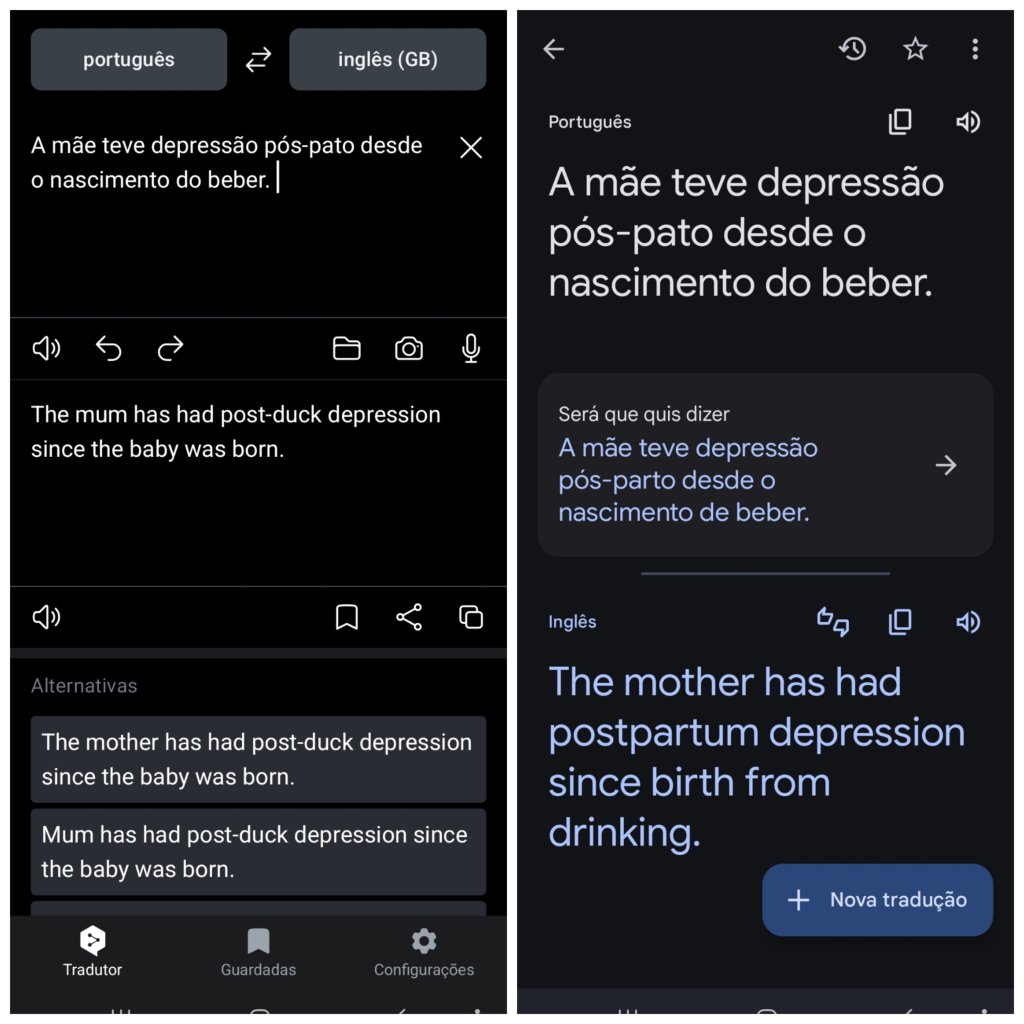
“A mãe teve depressão pós-pato desde o nascimento do beber.”
Postpartum depression is missing an r and bebé has gained one.
Deepl helpfully produces surreal results on the first mistake but annoyingly airbrushes out the second. Gtranslate unhelpfully takes the first error in its stride but does a better job of highlighting the second. It also provides a suggested correction in which it suggests a spelling change, so between its two parts of its reply it has correctly flagged both errors.
Result: Gtranslate wins another round.
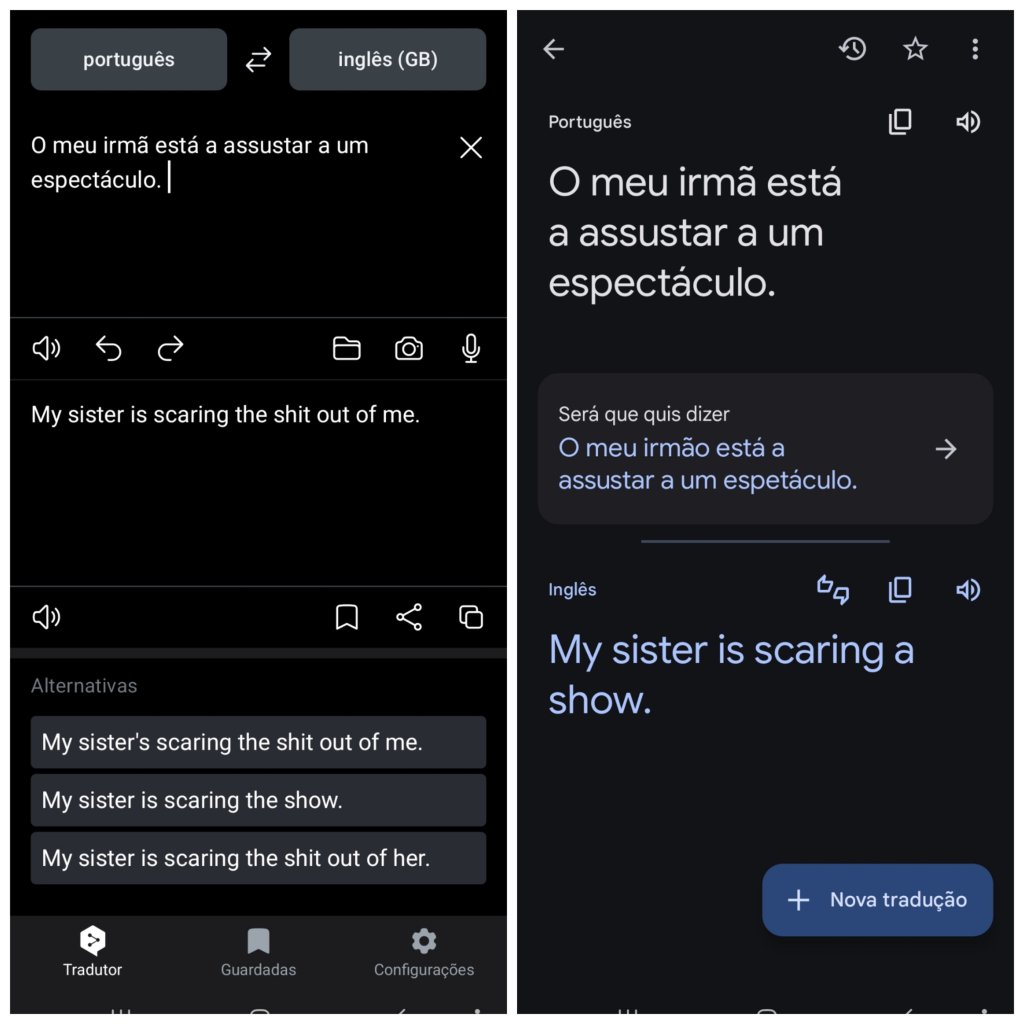
“O meu irmã está a assustar a um espectáculo”
Irmã is feminine and the “o meu” should match. The verb should be assistir, not assustar
Deepl is reliving childhood trauma. Well, that’s fine, at least it acknowledges something is wrong. Gtranslate keeps a level head, correctly mistranslates the word that is incorrect. It also offers a suggestion to harmonise the gender of irmã.
Result: Gtranslate is a clear winner since it gives a far more precise indication of what’s wrong without peeing in its pants.
Conclusion
As I said at the beginning, Deepl remains the best for English-Portuguese translation, but as the results show, in most cases, Gtranslate is better for reverse-translation in situations where you want to check your own written portuguese.
I was surprised by the results. I was expecting Deepl to be more accomplished at working around errors. It was far more hit and miss than that, but it’s undeniable in most cases that what Gtranslate offers is much more useful than what Deepl offers. You’re much more likely to be able to fix your errors that way.
Remember, this isn’t going to be enough on its own. My process is usually:
Read the text and correct obvious errors.
Paste into Gtranslate, correct what it mistranslates.
Paste into FLiP to check for syntactical errors. FLiP has its blind spots and will occasionally flag a valid word, but by and large it’s helpful.
Show to a teacher and/or post it here and wait for someone to tell me i have 38 more errors to fix.
Então, ainda não falei da rainha, Cesária Évora? Tive a sorte de assistir a* um espetáculo dela em… hum… 2001, se não me engano. Naquela altura, não falava nem uma palavra de português mas mesmo se falasse não me teria ajudado porque a maior parte da obra dela está em Crioulo Cabo-Verdiano. Fomos com a tia da minha esposa. A minha esposa nasceu no Cabo Verde e viviu lá durante os seus primeiros anos, antes da família dela ter voltado para a Madeira. A cantora tinha uma maneira muito relaxada de se apresentar na sala de concertos. Não parecia ser muito animada. Só cantou de pés descalços**. Havia uma mesa no centro do palco e, durante o seu intervalo, a banda continuou a tocar enquanto ela sentou-se numa poltrona, acendeu um cigarro, deitou um pouco de vinho num copo*** e ficou tranquila, nem sequer olhando o público durante 3 ou 4 minutos até à abertura da próxima música.
Queria fazer uma tradução da sua canção “Angola”, que é empolgante, mas claro que preciso da ajuda de um português que entenda o crioulo. Roubei as letras deste site, mas acho que o homem que fez esta tradução parafraseou um pouco. Por exemplo, aquela primeira linha tem uma conjugação do verbo “viver”, sem dúvida. Acho que ela diz “Essa vida boa que os senhores estão a viver”. Existem vários sites online onde se explicam estas línguas parecidas com o português padrão – por exemplo, aqui está a descrição de “nhôs” no Infopedia . E tenho as minhas dúvidas sobre a interpretação de “Ami nhos ca ta matá-me” porque parece-me tão descabido no contexto… mas tenho de confiar no tradutor porque ele afirma que é fluente!
A música é linda. Eu não sei nada de teoria da música e se calhar, estou completamente errado, mas parece-me influenciado pela música do Brasil, com um ritmo sincopado que me lembra o**** Samba, mas é mais do que só uma cópia: muito mais. Tem um som único, e a voz dela é… Ouso dizer “ouro sobre azul”? O efeito da voz e da música é esmagador!
*I need to smack myself in the head with a frying pan a few times till I remember to put the “a” after “assistir”
**I’m only talking about the concert but I could easily have said the same about her career.
***I really screwed this sentence up – I tried to use the verb “derramar”, which isn’t even the right verb (it means spill) but then I managed to get it even wronger and wrote “derrubar”. I think deitar is the right verb even though it sounds weird – I usually associate it with laying something down or chucking it away. I also wanted to express the idea that she poured out a few sips worth, but that didn’t go any better. Hopefully this works. the easy way would be to say “encheu um copo” because why wouldn’t you want to fill it all the way up? But I was trying to be more specific than that. Sigh. This seems like a very basic thing to be confused about when I’m meant to be at C1 level.
****Not “do Samba”: “it reminds me of” doesn’t have de, whereas “i remember” does – so the preposition use is pretty much the opposite of english, really!
Crioula
Português
Inglês
Ess vida sabe qu’nhôs ta vivê Parodia dia e note manché Sem maca ma cu sabura Angola angola Oi qu’povo sabe Ami nhos ca ta matá-me ‘M bem cu hora pa’me ba nha caminho Ess convivência dess nhôs vivência Paciência dum consequência Resistência dum estravagância
Essa vida boa que vocês têm Paródia dia e noite até de manhã Sem mágoas, com alegria Angola, Angola Oh que povo alegre A mim não me matam Venho com hora para partir A convivência na vossa vivência Paciência duma consequência Resistência duma extravagância
That good life you’re living Parodies, day and night, until morning Without pain, but with happiness Angola, Angola Oh what a happy people They don’t kill me I come when it’s time to be on the way The way living together is a way of life Patience of consequence Resistance of extravagance
Thanks to Cristina of Say it in Portuguese for correcting the text description above the video.
I just noticed Linguee now has a menu right at the top of the page showing a Deepl-powered translator built into it and a “write” tab for syntax-checking. Unfortunately that last one only covers a few languages so far and portuguese isn’t one of them but it’s on the cusp of covering all the useful features: a contextual dictionary, a translator that’s better than gtranslate and soon a page that replicates the features of FLiP. Maybe now I won’t have to have three tabs open at once when I want to check my portuguese texts.
The problem with Deepl, of course, is that it’s too clever. I like to paste my portuguese texts into a translator and, if it correctly renders it into english I know I’m on the right track. Google is good for this: it will translate it back to english stupidly, making your mistake obvious, but Deepl will more likely just work around the error and translate it properly, so in a way, Google Translate is more useful because more stupid.
I like the way Linguee is shaping up though, and I will keep an eye on that Write tab!
I’ve updated the resources pages. If you’re new to the site, these are fixed pages that I update from time to time with some of my favourite learning ideas, lists of portuguese audios and anything else that seems useful.
Has anyone else tried the interactive version of Português Em Foco?
I decided to get book 4 because I’d heard good things about it, and although I’m sticking with Português Outra Vez for the time being, I thought I’d have a look at the first few pages because I was curious.
The content looks really good. Here I am in the first exercise and straight away it’s giving good, challenging exercises about how the clichés and verbal tics in everyday conversation reflect on underlying cultural attitudes. I’m not finding it easy to use though. For example, in my browser (Chrome) it is basically unusable and I can’t even scroll up and down the text on the screen. So, I got the Blink Learning app, and that seemed to be much better. I can read the text and listen to a guy reading it out, so I was quite happy, but then when I get to the interactive exercises…
I find the layout challenging. I have to write synonyms or explanations for each of the given words of phrases, but the space for text is tiny: I have to write in those tiny white rectangles on the right hand side of the screen! Now, I can do that, but the boxes don’t expand, as far as I can tell, so I can’t see the text as a whole, meaning I can’t check for any typos or anything.
Later, there are interactive exercises based on multiple choice that allow the user to validate the answers chosen, which is great, but there are also pages that need the user to record spoken answers. Well… Fine, but I assume the book doesn’t come with an actual human doing the marking, so when I’ve written or recorded an answer, how will I know whether or not I was correct?
The package only says it is a “Livro aluno e caderno exercícios”, so perhaps it’s expecting me to be paired with a tutor who will hold up that end of things, or that I’ll mark my own homework by also buying the teacher guide, but that seems to negate the idea of it being an interactive book, surely?
I dunno, I’m not feeling very energetic at the moment so maybe I’ll leave it for a day when I have more spoons and then press on to see what happens, but it’s not looking great so far.








 Luso
Luso 