Posted in Portuguese

A Época a. C.

Continuing my series of mini-biographies I’m doing a twofer today and describing the two footballers on the cover of the first Portuguese Textbook I ever owned. It’s a bit of a cheat because I’m trying to only talk about living people but Eusébio went to that big stadium in the sky in 2014. Meh, I’ll stretch a point. The a. C. in the title is a joke a. C. Means “antes de Cristo” not “antes de Cristiano”.

Durante época antes de Cristiano, existiam outros futebolistas pre-históricos.

Segundo arqueólogos, o jogador português mais famoso dos anos noventa e os primeiros anos deste século era Luís Figo. Figo estreou com o Sporting Clube de Portugal. Como a sua fama cresceu, outras equipas queriam atraí-lo. Jogou pelo Barcelona e pelo Real Madrid em espanha e, nos últimos anos da sua carreira, por Internazionale na Itália.

Luís Figo
Luís Figo (pic by Biser Todorov)

Ainda mais distante no passado, no período Jogorássico, havia um jogador chamado simplesmente Eusébio. Eusébio da Silva Ferreira nasceu em Moçambique em 1942 enquanto aquele país ainda era uma “província ultramarina”. Jogou por várias equipas portuguesas e estrangeiras e na seleção portuguesa desde 1961 até 1973.

Eusebio
Eusébio

Eusébio é considerado um dos melhores jogadores de sempre e foi um prolífico goleador (marcou quase 900 golos ao longo da sua carreira). Foi alcunhado “O pantera negra” (hum… A flexão do adjectivo é confusa aqui: artigo masculino com adjetivo masculino… Mas suponho que “pantera negra” é o nome do animal e não é considerado um adjetivo distinto, pois não…?)

Posted in English

One Thousand

This site passed the thousand post mark a couple of days ago. One thousand posts in 6 years. That’s about one every two days on average. I’d barely believe I was capable of that level of commitment but look, here we are.

Posted in Portuguese

Ana Garcia Martins

Not quite the latest in the series of texts about famous (and alive) Portuguese people.

A pipoca mais doce - o livro

Ana Garcia Martins é uma apresentadora, bloguista e autora portuguesa. A sua carreira começou em 2004 quando lançou o blogue “A Pipoca Mais Doce“. O blogue não tem tema específico: fala de roupa e da moda mas também sobre ser mãe e como afastar piolhos. Uma publicação recente no seu blogue teve por assunto pneus. Costuma recomendar marcas específicas. Parece-me que a sua posição como “influenciadora” está a atrair a atenção de departamentos de marketing que querem aproveitar a sua plataforma mas não sei. Foi convidada do “Pressão no Ar”, a rubrica do “5 para a meia-noite” e admitiu que não recusaria de trabalhar com marca nemhuma porque “toda a gente tem o seu preço”

Mais recentemente, Ana, (que é muitas vezes conhecida pelo nome do blogue em vez do seu nome próprio) tornou-se apresentadora da programa Big Brother. Estou-me nas tintas para tais programas, mas, apesar disso, não é possível evitar ouvir falar deles e portanto ouvi falar dela também.

Tanto quanto eu sei era casada com um gajo qualquer mas os dois separararm-se e já tem namorado que é outro gajo qualquer mas acho que já escrevi mais do que quero sobre uma personalidade de televisão portanto por hoje chega.

Posted in Portuguese

Nuno Peres

Another biographical text. Thanks to ThisCatIsConfused for the correction (only one – I must have been on good form the day I wrote it!)

Ando a tentar escfrever textos sobre portugueses famosos. O de hoje é o sexto. Nuno Miguel Machado Reis Peres é um cientista. É um professor catedrático no centro de física na universidade de Minho. O seu campo de pesquisa é a teoria de matéria condensada, matérias 2d, incluindo o nosso amigo, o grafeno.

Famoso? Como assim? É verdade que o Doutor não é famoso no sentido tradicional. Tanto quanto sei não tem sido convidado no “Big Brother: Famosos”, mas não importa muito porque se fosse confiado, não teria tempo porque o Doutor Peres é um dos cientistas mais citados no mundo. As suas obras receberam mais que 24 milhares de citações. Faz parte do “Graphene Flagship” um projeto importantíssimo da União Europeia.

You can read more about Dr Peres here.

Posted in Portuguese

Lurgi

A couple of texts from last week when I had the covid (I’m better now).

Doente

Apanhei este maldito vírus. A minha filha estava doente na semana passada e já passou para mim. Bolas.

Um Dia Na Cama

Apesar de não estar assim tão doente, estou a aproveitar a oportunidade para ficar em casa e na cama, a ler um livro. Tenho dois em andamento atualmente: Segredo Mortal de Bruno M Franco e Death and the Penguin de André Kurkov. Adoro os dois.

Deixo de Espirrar

Finalmente testei negativo ao* coronavirus depois de 6 dias de doença. Estava com sorte: apanhei o vírus durante a vaga omicron e estou vacinado.

Vou tentar correr 5 quilómetros hoje mas não sei se vai ser possível. Há quem diga que as vítimas do Covid permanecem com falta de fôlego durante algum tempo depois de recuperar.

*negativo ao, not negativo pelo, surprisingly

Posted in Portuguese

Primavera

Como provavelmente já disse, temos um lotinho de terra na horta comunitária. No ano passado o tempo andava muito húmido (ai funesta Primavera!) e apesar de termos constituído uma estufa, muitas plantas faleceram (quem me dera, quem nos dera, não terem morrido nesses dias). Os tomates por exemplo, ficaram infetados de fungos* (todos os tomates que nós tínhamos plantado rebentaram-se** e desfizeram-se). Ainda por cima, a construção da estufa levou tanto tempo que não conseguimos plantar sementes no início da estação de cultivo***.

A horta comunitária

Mas neste ano, conseguimos pôr tudo em andamento muito cedo. Plantamos uns alhos franceses, favas e cebolinhas no Outono que estão quase prestes a colher. Além disso, temos sementes na estufa que estão a crescer e os morangueiros**** ainda têm flores. Quando vamos por lá, tudo tem aspecto prometedor. Com sorte, vamos ter umas boas saladas este ano!

* Infected with funguses (fungos) not just fungus (fungo). It’s more natural to use the plural in this kind of situation.

** I originally used “quebrar” but that’s more usual when you’re talking about hard, solid objects breaking. In this case they burst (rebentar) or split (rachar)

*** The growing season

**** A good example of a word where changing the last letter doesnt just change whether you are referring to a man or a woman but changes what it actually is that you’re referring to: morangueiro = strawberry plant / morangueira = strawberry seller

Posted in English

It Was A Good Effort

I feel a bit sorry for this fella trying to tell an interesting anecdote about that time he met the widow of Portugal’s favourite writer. Only one problem: Fernando Pessoa wasn’t married and, having died in 1935, even if he had been, it seems unlikely his widow would be in a fit state to hang around in museums having bants with Irish tourists.

People reckon he must have meant José Saramago, whose widow, Pilar Del Rio is still very much with us.

It’s so sad though. Great story, he’s showing interest in the local literature and football, it’s working, but he just muddled up the name. Oof. Totally the sort of thing I’d do but thank goodness, if it were me, there wouldn’t be anyone around to film it.

Posted in Portuguese

Vergonha

A text from a few days ago with thanks to Butt_roidholds for the corrections

Em Inglaterra, celebramos o Dia da Mãe em Março, ao contrário da maioria dos países, onde as pessoas esperam até Maio* porque não amam** as suas mães tanto quanto nós amamos as nossas.

Regra geral, nunca perco o dia, mas neste ano andei distraído e esqueci-me completamente. Eu e a filha entrámos em pânico. Ela começou a fazer uns queques (naquela altura não sabíamos que ela estava com covid). Entretanto abri o site Interflora para enviar flores para a avó dela, que é também a minha mãe. Que desgraça.

*I wrote “até ao Maio” but that’s doubly wrong. Firstly you don’t need the article in front of the name of the month, and secondly you don’t use “a” after esperar. It would normally be esperar para (wait to be able to do something) or esperar por (wait for) or esperar em (wait in expectation)… Hm… The definitions in brackets are pretty loose there. This is why a site like Linguee is so useful: you can see actual examples of these kinds of constructions and get a sense of when they are used.

**Apparently my joke misfired because although “amar” is changing to be more like the English verb “love”, traditionally Portuguese people would use “gostar” or “adorar” when talking about their parents so my attempt at a cheeky joke just made me sound like Oedipus

Posted in English

The Heels Are Alive

We tend to learn body parts early on in our language journey and we think we’ve got them all mastered because we’ve mastered how to sing “heads, shoulders, knees and toes” in Portuguese but there are all kinds of other body parts that don’t get a look-in: armpits (axilas), kidneys (rins), calves (panturrilhas ou “barriga de perna“), and so on.

One I came across today and probably should have known was “calcanhares” meaning heels. There are a few expressions involving heels, some of which are familiar and some less so

Calcanhar de Aquiles – the Achilles heel can be used figuratively to mean a person’s weak spot, just as in English

Dar aos calcanhares – is like the English expression “to show a clean pair of heels”, in other words, escape or run off quickly.

Não chegar aos calcanhares de alguém doesn’t really have an equivalent in English. If you don’t reach someone’s heels it means you are vastly inferior. A minha filha gosta de David Tenant mas na minha opinião, não chega aos calcanhares de Tom Baker.

And an English expression that doesn’t have a direct match in Portuguese would be “high heels”. In Portuguese the heel of a shoe has a different name: salto, so a salto alto is a high heel shoe. It’s a bit confusing because salto can also mean a jump, so salto alto sounds like it should mean a high jump, but the athletic event we call a high jump is “salto em altura” in Portuguese.

Posted in English

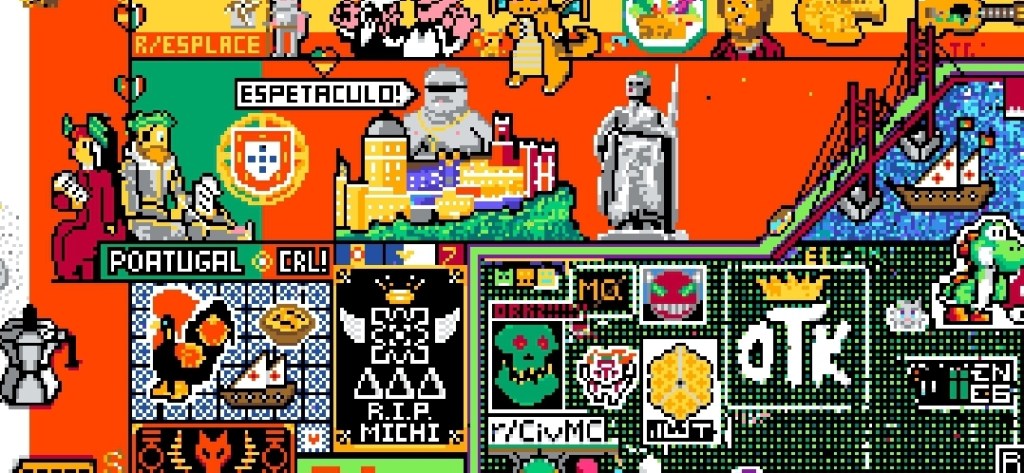
r/place

Just popped over to the r/place subreddit, which is a sort of giant collaborative artwork being created by millions of people, and I noticed quite near the middle there are a lot of Portuguese people carving out a little niche for themselves. I strongly approve.