Posted in Portuguese

A Segunda Tenativa

Here are a couple of texts about my second attempt to walk from here to the Thames Barrier and back along the Thames Path (a round trip of 50 miles). Autocorrect seems to have deliberately messed up a lot of words to spite me, but I’ll put the more interesting corrections down at the bottom

1. O Pequeno Almoço

Saí da casa muito cedo para dar um passeio. Comprei uma sandes de fiambre de um carrinho* perto da ponte. Enquanto estava à espera, um dos homens a trabalhar no próximo carrinho (uma peixaria) fazia uma pausa para fumar um cigarro. Depois, voltou ao seu trabalho mas, durante todo este tempo, usava a mesma luva plastica azul. Nojento! De que serve uma luva descartável se a usas enquanto estás a colocar um cigarro entre os lábios, meu javardola?

Eu não disse nada disso, claro, mas fiquei contente por ter escolhido uma sandes em vez duma sardinha crua. Que alívio que eu não seja uma foca**.

* = The corrector queried whether it was really a “carrinho” since he associated that with this sort of thing 👉 we-e-ell, it wasn’t quite like that but it definitely did have wheels. It was a mobile, wooden bench that could be used for a pop up market and then taken away when not in use. Possible alternatives would be “rulote” (caravan – definitely not!) or banca (a stand or stall). Banca kinda works, but I think if that as more of a static structure so I’ll stick with carrinho and hope it doesn’t sound too ridiculous.

**  Trocadilho de bónus:
Um leão andava à caça logo de manhã e apanhou uma girafa. Qual a refeição? Pescoço Almoço

2. O Resto do Dia

Antes do natal, fiz uma tentativa de andar daqui para a barreira contra inundações – uma viagem de 50 milhas de ida e volta. Falhei por causa de ter bolhas nos pés. Mas o passeio de ontem (o que descrevi no texto, que comecei com um pequeno-almoço* perto da ponte) foi uma segunda tentativa e desta vez consegui! Parti antes das 8 e continuei a colocar um pé à frente do outro** 87000 vezes durante 16 horas até atingir*** a meta e voltei para casa antes da meia noite. Tive bolhas nos pés e dores nas pernas. Comi uma tigela de chilli, mas depois, quando fiquei a pé, o meu corpo comecei a tremer e acabei por me sentar novamente . Bebi mais alguma coisa e deitei-me. Acordei com muita fome. Estou fraco e sinto-me como se tivesse uma gripe mas vale a pena!

*The Acordo Ortográfico has opinions abiut hyphen use too. It’s maddening.

**I originally wrote “um pé antes do outro” because id heard the expression “pé ante pé” but that means walking stealthily, on tiptoe and it sounds very wrong in this context. In fact, the corrector write “dá a entender que estás a andar de costas” (“it gives the impression that you are walking backwards”) Well, that sounds like it should be my next challenge…

***I wrote “até atingi” (literally “until I reached” but Portuguese grammar doesn’t work like that. After a preposition you wheel out the infinitivo pessoal. “Until reaching”

Posted in English

You Say Patudo, I Say Patão

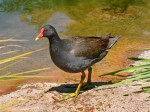
Unfinished business from yesterday’s moorhen-related content: suppose the birds who wanted to body shame the moorhen had decided to call him a fat duck instead of bigfoot? How would they do that? They could say “pato gordo” or “pato gordinho” of course, but is there a shorter option?

Portuguese speakers tend to use the -inho ending on a lot of words as a diminutive, so patinho is little duck, gatinho is little cat and so on. Augmentatives – endings that make a word bigger or stronger are a little rarer and less regular, but substituting – ão for the final o is quite a common way of doing it. Or -ona if it ends in an a.

So in this case, patão would be a chonky duck. You probably won’t hear this very often in Portugal. Things are more likely to be – inho than – ão, but there’s a supermarket in Brazil called patão, and the word does exist in priberam, so it’s not just a Brazilian thing.

I’m trying to think where I’ve heard these kinds of endings: garrafão is a huge bottle, facalhão is a big kitchen knife, and I think I’ve seen it used for outdoor work knives (maybe even a machete?) in some contexts too. Barrigão is used to mean a big belly, whether it’s big because there is a baby in there or because the owner is too fond of Sagres.

You have to be a little careful with these though. I think, because they are quite rare, they might be used for humorous affect and you probably don’t want to accidentally say the wrong thing. Mulherão, for example: how’s that going to come across? Tall woman? Great woman? Fat woman? Coarse woman? It might depend on the context or that tone of voice, so unless you’re supremely confident I’d just leave it out if I were you.

There are other endings too. I can’t really do justice to them without, basically, rewriting this article from Practice Portuguese word for word, so if you want to know more, I’d say toddle on over there and see what the boys have to say on the subject.

Posted in English

Patudo

Here’s another nugget from social media. I saw a meme on Instagram about depressed animals which, unfortunately, I can’t really reproduce here because it had someone’s user name in it, but no worries: the interesting bit was off to one side, where a sad-looking moorhen was thinking “As outras aves chamaram me patudo. Body shaming é tão 90s”

What were they saying to body-shame the poor moorhen? Well, my first thought was that pato means “duck” so maybe patudo is like an exaggerated form of that word, meaning something like “big duck” or “fat duck”. But I looked it up and after an initial double-take when I saw that there is a kind of tuna called a patudo, I saw what was really happening. The root of patudo isn’t from “pato”, it’s from “pata”. It means big-footed. And it’s true, moorhens really do have massive feet for wading through the bogs. Poor moorhen! Coitadinha de gallinula!

Posted in English

Arguing Again

One of the annoying things about being on twitter in Portuguese mode is that I often see things in English I want to reply to but I don’t want to break character and can’t be bothered logging into my normal account. Solution: I just reply in Portuguese, knowing full well that the person won’t understand.

I upbraided someone for a pet peeve of mine: posting made up Orwell quotes. I mean, if you are going to post a bold quite about the importance of truth in a world of fake news, at least take the time to find out if it’s a fake quote.

The guy took umbrage, told me I should “speak English” and said I was showing my stupidity. So I replied with…

Childish? Yes, but I’m calling it homework so it’s allowed.

Posted in Portuguese

That Complaint Email In Full

(Tch – embarrassing typo in the title of the first version of this – I need to get better at proofreading)

Well, I said I’d write an email to complain about Biblio so here it is

Exmo Senhor(a)

Fico muito contente por ver que existe uma aplicação portuguesa que disponibiliza* audiolivros portuguesas fora do controlo das grandes empresas americanas. Espero que esteja a ser bem sucedida. Já ouvi metade de um livro e quero vos informar sobre um pequeno defeito que, se fosse acertado, tornaria a aplicação mais útil para os leitores.

Parece que a app não tem permissão de continuar quando uma notificação toca ou quando o sistema operativo põe o ecrã em suspensão. Não sei especificamente como, mas o audiolivro sempre pára depois de um ou dois minutos. Tenho de tocar no ecrã para pôr a narração de volta em andamento. Isso é chato porque quero colocar o meu telemóvel no bolso enquanto estou a caminhar ou a fazer jardinagem, mas não é possível com a vossa aplicação.

Espero que este problema seja fácil de remediar porque quero comprar mais livros no futuro.

Obrigado.

Com os melhores cumprimentos,

*=related to that false friend I mentioned the other day of course. Disponibilizar = to make available