Posted in English

Concordância

I am becoming increasingly obsessed with Deolinda. There’s just something intoxicating about understanding a song in another language. I cottoned on to one called “Concordância“, which seems to be about grammar. Intrigued, I went looking for a translation but there wasn’t one. So I sat down and I wrote one. As it turns out, it’s quite witty. She starts with “I am a pronoun, a personal pronoun” and goes on to state what she wants from this man who is trying to subsume her into a nós. She demands “complementos diretos” which are both direct objects and also have the double meaning of complements that we use in english. “Nome” also means both “noun” and “name” and of course adjectives change depending on the noun, so you can see there’s stuff going on here that probably has more resonance if you’ve been taught Portuguese grammar at a Portuguese school.

There’s a website called lyricstranslate where people can post lyrics and others can translate them so I submitted one for Concordância and you can read it here if you’re so inclined.


Posted in English

Through the Looking Glass

This morning I stumbled on a series of videos by someone calling herself Marianareads on Youtube, about reading books in English. On closer inspection, it seems she is Brazilian rather than Portuguese, which put me off slightly, and also she seems to have a thing for vampires. She seems very enthusiastic and her massive subscriber list means she must be doing something right, but she’s not for me, so I moved along. Youtube then spent some time trying to interest me in a whole string of brasileiras novas, before I finally hit paydirt in the form of an actual, 100% authentic Portuguese vlogger, discussing easy books for Portuguese readers to improve their English vocabulary. This seemed interesting to me because of course it’s the inverse of what I’ve been doing in some of my posts on here.

Intrigued?

Little House of Books on “Wonder” (which I’ve read) and “A Monster Calls” (which I haven’t read yet and… what’s Portuguese for “Spoiler Alert”? *googles* “alerta de spoiler”, apparently) and some others

Diário da Chris on “A Christmas Carol” (Alerta de Spoiler: he gets a bit nicer at the end) “Wonder” again and “The Fault in our Stars”, to name but three

ACromaDosLivros – I’m not sure but from previous linguistic detective work, I think “Croma” or “Cromo” means nerd, so this must be “the book nerd”. I think. The first video of hers I watched was about The Curious Incident of the Dog in the night Time though, so she’s got good taste.


Posted in English

The Sound and the Fury

cocorocoI mentioned in a previous post that the Portuguese seem to use “Tiquetaque” in place of “Tick Tock”. This made me dig out my old Astérix comics and check out the sounds made by people and things during the course of a story
.
Here’s the one I remember best  ->

So apparently Portuguese roosters say “Cocorocóóóóó” instead of “Cockadoodledooo!” I think this is much cooler. There’s a Portuguese family who have a rooster that crows in the allotment behind the rowing club I’m a member of and now I’ll be able to address him in his own language.

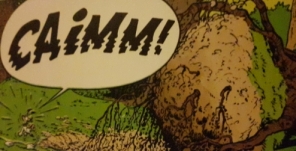
caimDogs, I’m less sure of. Dogmatix is called Ideiafix in Portuguese (Asterix character names, on their own, are probably a subject for a blog post for someone with more linguistic skillz than I have now). In the books I have, the only noise he makes is “CAiMM!” but that sounds more like a yelp than a bark. I googled it and apparently the more conventional dog noise is “Au Au”. OK, I can believe that.

truzMoving on to inanimate objects, how about knocking on a door?

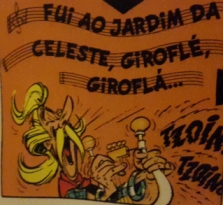
“Truz Truz Truz” is apparently le mot juste. That’s just bizarre though. Are we sure that’s really knocking? Maybe Cacafonix (Cacofonix) is playing his harp outside the door? 20160402_230111

Well no, I promise you, that’s knocking and anyway Cacofonix’s harp goes TZOIN (or is there a last letter there? I can’t see because it’s cut off by the edge of the panel. It looks like a rounded letter so I want to make it “TZOING” but I think that’s just my English prejudice coming through to make it as much like “Twang” as I can possibly manage. TZOINO? Ach, who knows.

crac


This one, at least, looks familiar. The crac(k) of a tree as it is pulled down by slaves


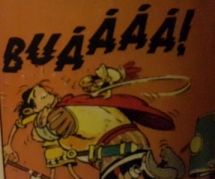
buaaa


And here, the pathos of the Roman centurion reduced to tears


The trouble with Astérix, though, is that you’re never quite sure what is a survival from the original French or perhaps something that the translators made up…


For a more cerebral look at the sounds made by animals in different languages, try this article in the Guardian

Posted in Portuguese

Remar

Esta tarde foi a corrida anual de remo entre as universidades de Cambridge e Oxford. Aconteceu em Londres, perto do nosso apartamento apesar das duas universidades ficam longe daqui.
Oxford ganhou o prémio os últimos três anos. Eles vestem de azul escuro e o capitão da selecção, Morgan Gerlak, é dos EUA. Porém, este ano, foi ganho por Cambridge, vestidos de azul claro, sob a liderança de Henry Hoffstot dos EUA.
Foi uma grande vitoria dos EUA contra os EUA. As condições do rio eram horríveis. O vento soprava e fazia ondas. Então os barcos encheraram-se de água.
Nos outros anos, a minha família e eu íamos ao rio Tamisa para ver a conclusão da corrida mas hoje ficámos em casa e vimos tudo na televisão.

In addition to my usual thanks to people who helped on iTalki, I’d like to thank the eagle-eyed Fernando Kvistgaard, who emailed me some corrections I had missed when I transcribed the text onto the blog and made some useful suggestions about style too.

Posted in English

Nãããããoooo!!!!

At the time of writing, Conjuga-me.net is offline with some message about being suspended. I’m horrified because it’s my go-to site for verb conjugation.

Luckily, my teacher has told me of an equivalent called conjugacao-de-verbos.com which seems, if anything, even better – but terrifying – because it has ALL THE TENSES not just the main ones. But I will miss conjuga-me if it is gone for good. It’s a very tidy little site and I am used to its layout and it’s colour scheme.

Posted in Portuguese

Comentários Sobre Um Filme: Ossos

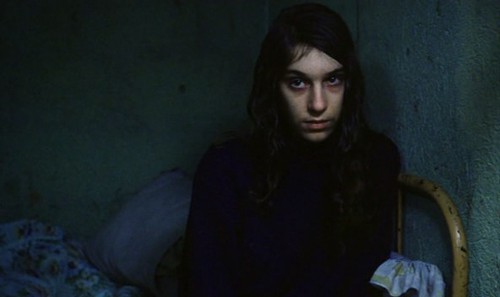
Estou a ver um filme de Pedro Costa que se chama “Ossos” para praticar a compreensão. Até a este ponto (vinte e dois minutos, treze segundos) houveram talvez quatro linhas do diálogo. Por isso, não aprendi muito até agora!

Além disso, actores: parem de resmungar! Falem claramente!

notebook_image_676797

After I wrote this, it didn’t get much better. There are great long stretches in which people

  1. brood
  2. smoke fags
  3. lurk in the dark
  4. stare silently into the horror of it all
  5. brood while smoking a fag and holding a baby
  6. gas themselves

And all this time, barely a word is spoken for five, ten minutes at a time. When there is dialogue it is mumbled and nobody changes their facial expression or gives any visual clue about what they’re mumbling about. In short, I don’t recommend this one as a way of practising aural comprehension!

Muito obrigado Sophia, Ruan, Fabio, Caio e Felipe pelas correcções quando apareceu em iTalki

Posted in Portuguese

A Livraria

Ontem, tinha uma bilhete para um debate no sexto andar duma livraria no centro de Londres que se chama “Foyles”. Foi parte duma série de debates antes da eleição do prefeito da cidade sobre sujeitos no que concerne aos cidadãos*. O de ontem foi sobre a migração: Os refugiados da Síria, o movimento das pessoas por dentro do Reino Unido, as cidadãos da União Europeu, e pessoas que chegam doutros países de África e da Ásia, por exemplo.
Os falantes são todos de esquerda política: Daniel Trilling, o editor da revista “A Humanista”, Rebecca Omonira-Oyekanmi, uma jornalista que escreve sobre os direitos da mulher, e Owen Jones, escritor de dois livros, “Chavs” e “O Estabelecimento”. Por isso, não havia muito desacordo entre eles, e o que é um debate sem divergências? Não faz mal, mesmo ainda foi interessante.

Uma coisa muito estranha aconteceu. Tendo chegado atrasado na sala onde foi a discussão, tirei o meu casaco e sentei-me. Passado uns minutos. De repente, uma mulher, que chegou também atrasada, sentou-se ao meu lado. Reconheci-a. Esta era a irmã mais nova da minha esposa!

notebook_image_678034Depois do debate, e depois de termos saído da sala, vimos a secção de livros estrangeiros, onde estavam talvez trezentos livros portugueses, mas não precisamos de livros novos agora.

*=É correcto? O “Spellcheck” disse que sim, mas porque não “cidadões?

http://www.foyles.co.uk/Our-London-Moving


Picking up on that last footnote about the plurals: Apparently I am an idiot because I knew several words that didn’t fit the pattern in my head that -ão words become -ões words when pluralised. Cão, for example, becomes cães. Apparently it depends on the word’s root in Latin.

If it had a_u in the latin form, it will follow the -ão/-ãos pattern

Hand = Manus (Latin) -> Mão (Portuguese Singular)  -> Mãos (Portuguese Plural)

If it started as an a_i word in Latin then it will follow the -ão/-ães pattern

Dog = Canis (Latin) -> Cão (Portuguese Singular) -> Cães (Portuguese Plural)

If it started as an a_o word in Latin then it will follow the -ão/-ões pattern

Nation = Nationis (Latin) -> Nação (Portuguese Singular) -> Nações (Portuguese Plural)

Now of course this is all the kind of thing that you don’t need to know AT ALL to be able to speak the language, but it’s freaking amazing to know! I only did two years of Latin at school, about 35 years ago so it doesn’t help me very much but knowing there’s an order to it makes it feel more manageable than if it was just pure randomness!

The third form seems to be the most common so in a pinch, if I don’t know which way to jump, I would make that my default guess. More Portuguese plurals here.

Thanks again to Sophia and to Rubens for their help with corrections and in decrypting the mystery of the plurals!

Posted in Portuguese

Uma Notebooquinha

(LOL – Eu sei, esta palavra não significa nada* mas em qualquer caso, gosto dela)

No próximo verão, a escola da minha filha vai apresentar uma peça de teatro que se chama “Peter Pan”**. Não queria um papel falando. Por isso, ela tem o papel do crocodilo. Ela tem de correr atrás de Capitão Gancho. Não falará mas terá um relógio. Ouvindo o som do relógio (“Tick Tock Tick Tock” – é o mesmo som em português***?) a audiência saberá que o crocodilo está a chegar.
De repente, ela correrá para fora do palco e fingirá morder varias pessoas na primeira fila

*=I originally posted this as “Uma Notebooquinha” because it’s treating notebook (iTalki uses Notebooks as ways of getting corrections for small pieces of written work) as a Portuguese word and adding the diminutive “inha” on it because it was only a little notebook. Of course a better way to say it – as Rubens pointed out – would be to make a proper portuguese word using “Caderno” => “Caderninho” but  “Notebooquinha” is so beguiling that I have retained it here

**=From thnotebook_image_678500original text: “Pedro Panela”? Não, talvez não devo usar um tradução de “pan” – Of course, this is also a joke. Pan is a surname. If he was a character called Peter who was some sort of hideous anthropomorphised saucepan then “Peter Panela” might be right

***=No, apparently it’s “Tick Tack Tick Tack” in Brasil (Thanks again Rubens) and “Tiquetaque” in Portugal (Thanks Fernanda). I think there could be a good blog post about Portuguese Onomatopeia soonish.